Custom Orthotics for Bunions: Benefits, Pain Relief, and Treatment Options
Introduction
Bunions can make walking, standing, exercising, and wearing everyday shoes uncomfortable. The condition often develops gradually, causing a visible bump near the base of the big toe. Over time, the big toe may angle toward the smaller toes, while the joint becomes irritated by pressure from footwear. For people experiencing these symptoms, custom orthotics for bunions may help reduce pressure on sensitive areas of the foot, improve weight distribution, and support more comfortable movement. Depending on the individual’s foot structure and symptoms, orthotic devices can form part of a conservative treatment plan alongside appropriate footwear and other interventions.
However, custom orthotics do not usually correct the structural deformity that causes a bunion. Their primary purpose is to help manage symptoms and improve function. The right treatment depends on the severity of the bunion, the amount of pain it causes, the person’s activity level, and whether other foot problems are present.
At Ritz Clinic, patients can explore custom orthotic services and discuss whether an individualized foot-support solution may be appropriate for their needs.
This guide explains what bunions are, how custom orthotics may help, what research says about their effectiveness, how to choose suitable footwear, and when additional medical treatment may be necessary.
What Is a Bunion?
A bunion, medically known as hallux valgus, is a deformity involving the joint at the base of the big toe. The big toe gradually angles toward the second toe, while the first metatarsal bone may move in the opposite direction. This creates a prominent bump on the inner side of the foot.
The bump is not simply an extra piece of bone. It reflects changes in the alignment of the bones and joint. The surrounding soft tissues may also become irritated, particularly when shoes press against the area.
Bunions can develop in one or both feet. Some people have a visible deformity without significant pain, while others experience discomfort that interferes with walking or everyday activities.
Common symptoms include:
- A visible bump near the base of the big toe.
- Redness or tenderness around the affected joint.
- Pain when wearing narrow or tight shoes.
- Swelling or irritation after prolonged walking.
- Stiffness or reduced movement of the big toe.
- Calluses caused by altered pressure or friction.
- Difficulty finding comfortable footwear.
- Pain beneath the ball of the foot in some cases.
Symptoms can vary considerably. A larger bunion is not necessarily more painful than a smaller one, and treatment decisions should consider both the physical examination and the effect on daily life.
The NHS guide to bunions explains common symptoms, conservative treatments, and circumstances in which specialist assessment may be appropriate.
What Are Custom Orthotics for Bunions?
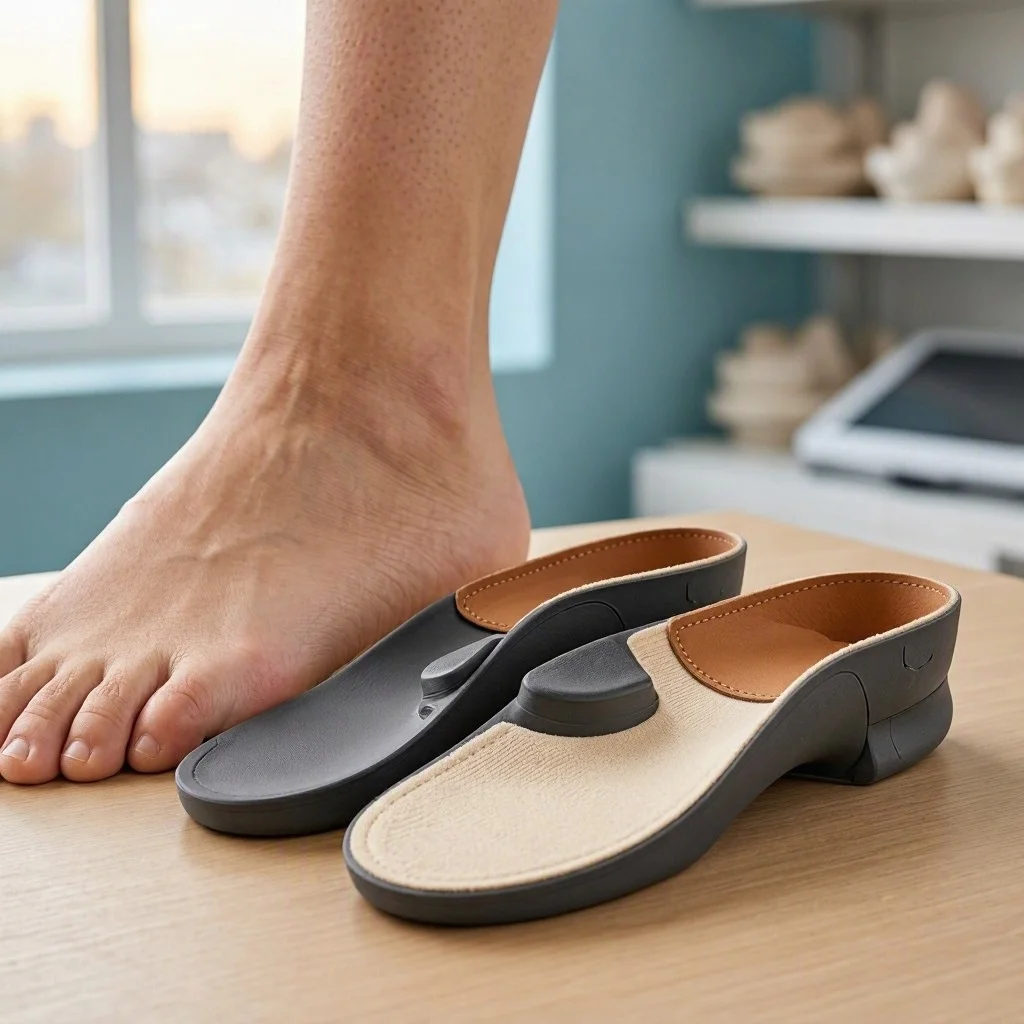
Custom orthotics are individually designed devices worn inside shoes to support the feet and influence pressure distribution during standing and movement.
They are designed according to factors such as foot shape, symptoms, walking pattern, joint mobility, footwear, and activity requirements. Depending on the assessment, an orthotic may include supportive contours, cushioning, or specific modifications intended to accommodate a bunion or reduce pressure elsewhere in the foot.
Custom orthotics differ from standard insoles, which are manufactured in common sizes and designs. A custom device may provide more individualized support when a person’s symptoms or foot structure require specific adjustments.
However, custom-made does not automatically mean better. Some people may obtain sufficient relief from suitable footwear and an over-the-counter insole, while others may benefit from a more individualized device.
For bunions, the objective is generally to improve comfort and function rather than force the big toe back into a normal position.
How Can Custom Orthotics Help Bunions?
The effectiveness of orthotics depends on the individual’s foot mechanics and the cause of their symptoms. They may help in several ways.
1. Reducing Pressure Around the Bunion
One of the most important goals of conservative bunion care is to reduce pressure and friction around the affected joint.
When a shoe presses against the prominent area, the skin and surrounding tissues may become irritated. Orthotics cannot make a narrow shoe wider, but a suitable device may influence how the foot sits and how pressure is distributed inside the shoe.
A clinician may recommend an orthotic design that accommodates the bunion without creating additional pressure. The shoe itself must also have enough room for the forefoot.
2. Redistributing Pressure Across the Foot
A bunion can change how weight moves through the forefoot during walking. Some people develop additional pressure beneath the second or third metatarsal heads, leading to discomfort in the ball of the foot.
An appropriately designed orthotic may help redistribute loading across the foot. The precise design depends on the location of pain, foot structure, and movement pattern.
The aim is to reduce excessive pressure on sensitive areas without creating new pressure points.
3. Supporting Comfortable Walking
Bunion pain can make people shorten their steps, avoid pushing off through the big toe, or change how they distribute weight.
When an orthotic helps reduce discomfort, it may make walking and standing more manageable. However, results vary, and orthotics do not guarantee that normal walking mechanics will be restored.
If pain is related to joint stiffness, significant deformity, or another foot condition, additional treatment may be needed.
4. Accommodating Individual Foot Structure
Not all bunions affect the foot in the same way. Some people have flexible joints, while others experience stiffness or more pronounced structural changes.
Custom orthotics may be designed to accommodate these differences and the person’s footwear requirements. The design should be based on an appropriate assessment rather than on the appearance of the bunion alone.
5. Supporting Other Conservative Treatments (Custom Orthotics for Bunions)
Orthotics may be used alongside wider footwear, protective bunion pads, activity modification, and exercises when appropriate.
These approaches address different aspects of the problem. For example, a wider toe box reduces direct shoe pressure, while an orthotic may help manage pressure beneath the foot.
Combining suitable approaches may improve comfort, although no single combination works for everyone.
Can Custom Orthotics Correct a Bunion?
Custom orthotics generally do not correct the structural deformity of a bunion.
A bunion involves changes in the alignment of the bones and joint. An insole may influence pressure distribution and support foot function, but it does not usually reverse those structural changes.
Some products are marketed as bunion correctors, toe straighteners, or alignment devices. These products may provide temporary comfort or help separate the toes, but there is limited evidence that they permanently correct an established bunion.
The Guy’s and St Thomas’ NHS Foundation Trust bunion guidance notes that insoles may improve pain but do not correct the bunion itself.
Surgery may be considered when symptoms remain significant despite appropriate conservative treatment. The decision depends on pain, functional limitations, the severity of the deformity, and the individual’s circumstances.
For many people, symptom management is a reasonable goal even when the bunion’s appearance does not change.
What Does Research Say About Custom Orthotics for Bunions?
Research suggests that custom-made foot orthoses may help reduce pain in some people with symptomatic bunions, particularly over the short term. However, the evidence is limited, and results should not be interpreted as proof that orthotics work equally well for every patient.
A systematic review of custom-made foot orthoses reported evidence that, among people younger than 60 with painful bunions, mild to moderate hallux valgus, and no limitation in first metatarsophalangeal joint movement, custom orthoses were more effective than no intervention for reducing pain after six months. The benefit was not maintained at 12 months in the same comparison.
The review also found that surgery provided greater pain reduction than custom orthoses at six and 12 months in the studied population. These findings do not mean that every person with a bunion needs surgery; treatment decisions depend on symptom severity, individual needs, and the risks and benefits of each option.
Read the systematic review of custom-made foot orthoses for foot pain.
The practical takeaway is that orthotics can be a reasonable conservative option, but expectations should be realistic. They may help manage pain without correcting the underlying deformity, and they should be reviewed if symptoms persist or worsen.
Who May Benefit from Custom Orthotics for Bunions?
Custom orthotics may be worth considering for people whose bunions cause discomfort during daily activities and whose assessment suggests that an individualized device could help.
Potential candidates include people who:
- Experience recurring foot pain while walking or standing.
- Have pressure beneath the forefoot as well as bunion discomfort.
- Need a device that accommodates specific foot characteristics.
- Have difficulty finding comfortable support with standard insoles.
- Spend long periods standing at work.
- Participate in walking, running, or other activities that aggravate symptoms.
- Have tried suitable footwear changes but continue to experience discomfort.
Not everyone with a bunion needs custom orthotics. If the main problem is direct pressure from a narrow shoe, changing footwear may provide more benefit than adding an insole.
A qualified healthcare professional can help determine whether a custom device is appropriate or whether another conservative option should be tried first.
What Happens During a Custom Orthotics Assessment?
An orthotic assessment helps determine whether a device is likely to address the person’s symptoms and which features may be suitable.
1. Medical and Activity History
The clinician may ask when the bunion developed, where pain occurs, which activities aggravate symptoms, and whether the condition affects one or both feet.
They may also ask about footwear, previous injuries, exercise habits, relevant medical conditions, and treatments already attempted.
This information helps distinguish discomfort caused by the bunion from other possible problems, such as arthritis, nerve irritation, or pain beneath the forefoot.
2. Foot and Joint Examination
The clinician may examine the position of the big toe, the prominence of the joint, areas of tenderness, skin irritation, and the movement of the affected joint.
They may also assess the rest of the foot, including the arch, heel, and forefoot, because these features can influence pressure distribution.
The examination should identify whether there are signs of a condition that requires additional medical investigation.
3. Gait and Footwear Assessment
The clinician may observe how the person stands and walks and ask which shoes are most comfortable.
Depending on the setting, the assessment may include foot measurements, a digital scan, or an impression of the foot. These methods can assist with device design, but no single measurement determines the best orthotic for everyone.
The results should be interpreted alongside symptoms and clinical findings.
4. Selecting the Orthotic Design
If an orthotic is appropriate, the clinician may recommend a prefabricated insert or a custom-made device.
Design decisions may involve cushioning, support, thickness, pressure-relieving features, and compatibility with the person’s footwear.
For bunions, avoiding additional pressure around the prominent joint is especially important. A device that fits poorly may make symptoms worse.
5. Fitting and Follow-Up
Once the orthotics are ready, the clinician should check the fit and explain how to introduce them into daily use.
A follow-up appointment may help identify whether the device improves comfort and whether adjustments are needed.
Persistent discomfort, rubbing, numbness, or new pressure points should not be ignored. The orthotic and footwear combination may need to be reviewed.
How to Choose Shoes When You Have Bunions
Footwear is one of the most important parts of conservative bunion management. Even a well-designed orthotic may be uncomfortable inside a shoe that presses against the affected joint.
Choose a Wide Toe Box
Look for shoes that provide enough space for the toes to rest naturally. The big toe should not be forced toward the smaller toes, and the shoe should not press against the bunion.
A wider toe box can reduce rubbing and make walking more comfortable.
Avoid Narrow, Pointed Shoes
Shoes that taper sharply toward the toes can compress the forefoot and aggravate bunion symptoms.
If a particular shoe consistently causes pain or redness around the joint, choose a better-fitting alternative whenever possible.
Consider a Lower Heel
High heels shift more body weight toward the front of the foot. This can increase pressure around the forefoot and make some bunions more uncomfortable. (Custom Orthotics for Bunions)
Lower-heeled footwear with a comfortable sole may help reduce this pressure.
Look for Comfortable Cushioning
A shoe with appropriate cushioning may improve comfort during walking and standing. The ideal level depends on the person and activity.
The shoe should also feel stable and secure. Excessive softness is not necessarily better if it makes walking uncomfortable or unstable.
Make Sure the Orthotic Fits
Custom orthotics take up space inside a shoe. Shoes with sufficient depth or removable insoles may accommodate them more easily.
If the device makes the shoe too tight, pushes the foot upward, or causes the heel to slip, the combination may need to be changed.
The NHS also recommends wide shoes with a low heel and a soft sole as part of bunion self-management. See the NHS bunion guidance.
Other Treatments That May Help Bunions
Custom orthotics are only one possible part of conservative treatment. Depending on the symptoms, several other approaches may help.
1. Bunion Pads
Soft pads can provide a barrier between the bunion and the inside of a shoe. They may reduce rubbing and protect irritated skin.
However, a pad that is too thick can make a tight shoe even more restrictive. Choose a product that fits comfortably and stop using it if it causes skin irritation.
2. Toe Spacers
Toe spacers may help separate the big toe from the second toe and reduce contact or pressure in selected cases.
They do not reliably reverse the structural deformity of an established bunion. They should fit comfortably and should not cause pain, numbness, or skin damage.
3. Activity Modification
If certain activities repeatedly aggravate symptoms, temporarily adjusting their duration or intensity may help manage discomfort.
This does not necessarily mean stopping all activity. The aim is to maintain a tolerable level of movement while avoiding excessive pressure on the affected area.
4. Foot Exercises
Gentle foot and toe exercises may help maintain mobility and muscle function when appropriate. However, exercises should not be expected to straighten an established bunion.
A healthcare professional can recommend exercises based on joint mobility, pain, and functional goals. Stop an exercise if it causes significant pain.
5. Pain Management
Some people may benefit from short-term pain relief or measures to manage irritation. The appropriate option depends on medical history, other medications, and individual risks.
Ask a pharmacist or healthcare professional for advice if you are unsure which treatment is suitable.
6. Physiotherapy
Physiotherapy may help address foot mobility, muscle function, balance, or difficulties with walking and exercise.
It can complement orthotic treatment when appropriate, particularly if the person has other foot or ankle problems. Physiotherapy does not guarantee that the bunion’s structural alignment will change.
How Long Does It Take for Custom Orthotics to Help?
There is no single timeline for improvement. Some people notice greater comfort relatively quickly, while others require adjustments or additional treatment.
The response depends on the severity of the symptoms, the orthotic design, footwear, daily activity levels, and the underlying cause of pain.
Follow the fitting clinician’s instructions for introducing a new device. A gradual increase in wear time may help identify problems before they become more uncomfortable.
Monitor whether:
- Walking becomes more comfortable.
- Pain around the bunion decreases.
- Pressure beneath the forefoot changes.
- The orthotic fits securely inside the shoe.
- Rubbing, numbness, or skin irritation develops.
If symptoms worsen or the device remains uncomfortable, arrange a review. Persistent pain may indicate that the orthotic needs adjustment or that a different treatment approach is required.
Are Custom Orthotics Better Than Standard Insoles?
Not necessarily. Custom orthotics offer an individualized design, but standard insoles may be sufficient for some people.
The choice depends on the cause of the symptoms, the shape of the foot, the type of footwear, and the person’s response to treatment.
Consider the following factors:
- Pain location: Does the device address the area causing discomfort?
- Foot structure: Are specific design features needed to accommodate the bunion?
- Fit: Does the insole fit without making the shoe too tight?
- Comfort: Does it improve symptoms without creating new pressure points?
- Cost: Is the potential benefit worth the additional expense?
- Follow-up: Can the device be adjusted if it does not fit comfortably?
Custom orthotics should be recommended because they serve a specific purpose, not simply because they are more expensive than standard products. (Custom Orthotics for Bunions)
When Should You See a Healthcare Professional?
A bunion may be managed conservatively when symptoms are mild, but professional assessment is advisable when pain persists or interferes with normal activities.
Arrange an appointment if:
- Bunion pain has not improved after several weeks of appropriate self-care.
- Pain limits walking, exercise, or work.
- The deformity appears to be progressing.
- The big toe becomes increasingly stiff.
- You develop pain beneath other toes or across the ball of the foot.
- You are uncertain whether the bump is a bunion or another condition.
Seek prompt medical advice if the joint becomes suddenly very red, hot, swollen, or extremely painful, as these symptoms may indicate another condition, such as gout or infection.
People with diabetes, reduced foot sensation, or circulation problems should seek professional guidance early because skin irritation and pressure injuries can be more serious.
When Is Bunion Surgery Considered?
Surgery may be discussed when pain remains significant despite appropriate non-surgical treatment and the condition substantially affects daily activities.
The decision is based on symptoms, examination findings, functional limitations, and individual circumstances—not simply on the appearance of the bunion.
Surgery aims to correct the underlying deformity, but recovery takes time and complications are possible. It is not necessary for everyone with a bunion.
For additional information, consult the NHS bunion treatment guide.
Custom Orthotics at Ritz Clinic
Finding the right approach to bunion discomfort begins with understanding how the condition affects the foot and daily activities. A suitable assessment can help determine whether custom orthotics, standard insoles, footwear changes, or another treatment is appropriate.
At Ritz Clinic, patients can explore the available custom orthotics service and ask about assessment and fitting options.
Before choosing a device, consider asking:
- What is contributing to my bunion pain?
- Could footwear changes alone help?
- Would a custom orthotic offer a meaningful advantage over a standard insole?
- How should the device fit inside my shoes?
- When should I return for a review?
- What should I do if symptoms do not improve?
The goal is to choose an approach that supports comfortable movement and fits the individual’s needs. Orthotics should be part of an appropriate treatment plan rather than a substitute for medical assessment when symptoms are persistent or unusual.
Frequently Asked Questions
1. Can custom orthotics help with bunion pain?
Custom orthotics may help some people by modifying pressure distribution and supporting foot function. Research suggests they can reduce pain in selected people with mild to moderate symptomatic bunions, although the benefits may vary over time. The appropriate design depends on the person’s symptoms and foot mechanics.
2. Do custom orthotics straighten bunions?
Custom orthotics generally do not straighten an established bunion or reverse the underlying bone alignment. Their main purpose is to help manage pain and improve comfort during movement. Surgery is the treatment used to correct the structural deformity when it is clinically appropriate.
3. Are custom orthotics better than regular insoles for bunions?
Not in every case. A standard insole or a change to wider footwear may provide sufficient relief for some people. Custom orthotics may be useful when individualized support or pressure redistribution is needed. The best option depends on the clinical assessment, comfort, footwear, and treatment goals.
4. Can orthotics prevent a bunion from getting worse?
There is insufficient evidence to promise that orthotics will prevent bunion progression. They may help manage pain and pressure, but they do not reliably correct the underlying structural deformity. Properly fitting footwear can help reduce irritation and is an important part of conservative management.
5. Should I wear orthotics all day?
Follow the instructions provided by the clinician who fits your orthotics. Some people need a gradual adjustment period. If the device causes persistent pain, rubbing, numbness, or skin irritation, stop using it until the fit has been reviewed.
6. Can I wear custom orthotics with bunion pads?
In some cases, yes. Orthotics and bunion pads address different issues and may be used together if the combination fits comfortably. However, adding a thick pad inside a shoe can reduce available space and increase pressure. Seek advice if you are unsure about the fit.
7. What shoes are best for bunions?
Shoes with a wide toe box, a comfortable low heel, suitable cushioning, and enough internal depth are often recommended. Avoid shoes that compress the toes or rub against the bunion. If you use orthotics, make sure the shoes can accommodate the device without creating additional pressure.
8. Can exercises get rid of a bunion?
Exercises may help maintain mobility and muscle function, but they do not reliably reverse an established bunion. The most suitable exercises depend on symptoms and joint mobility. A healthcare professional can help identify whether exercise is appropriate for your condition.
9. When should I consider surgery?
Surgery may be considered when bunion pain remains significant despite appropriate conservative treatment and affects everyday activities. The decision should be made with a qualified healthcare professional after discussing potential benefits, risks, recovery time, and alternatives.
10. How do I know whether I need custom orthotics?
An assessment can help determine whether an orthotic is likely to address your symptoms. If the main problem is shoe pressure, wider footwear may be enough. If you have persistent pain or specific foot mechanics that require individualized support, custom orthotics may be worth considering.
Conclusion (Custom Orthotics for Bunions)
Custom orthotics for bunions may help reduce discomfort by improving pressure distribution, accommodating individual foot structure, and supporting more comfortable walking. They can be a useful conservative option for some people, particularly when combined with suitable footwear and other symptom-management strategies.
However, orthotics do not usually correct the structural deformity of a bunion, and custom devices are not necessary for everyone. The best approach depends on pain severity, foot mechanics, footwear, activity requirements, and the individual’s response to treatment.
If bunion pain persists, limits daily activities, or worsens despite appropriate self-care, seek professional assessment to discuss further options. With realistic expectations and a personalized treatment plan, many people can manage symptoms and maintain a more comfortable level of daily activity.