Physiotherapy for De Quervain’s Tenosynovitis: Treatment, Exercises, and Recovery
Introduction
Pain on the thumb side of the wrist can make everyday activities surprisingly difficult. Opening a jar, lifting a cup, typing, using a phone, carrying shopping bags, or picking up a child may become uncomfortable when the tendons responsible for thumb movement are irritated. One possible cause is De Quervain’s tenosynovitis, a condition affecting the tendons and surrounding tendon sheath near the base of the thumb. Physiotherapy for De Quervain’s tenosynovitis focuses on reducing irritation, improving comfortable thumb and wrist movement, modifying activities that aggravate symptoms, and gradually rebuilding the hand’s ability to tolerate everyday demands. Depending on the severity of the condition, treatment may also involve a thumb-supporting splint, medical advice about pain relief, or a corticosteroid injection.
The condition can develop gradually through repeated hand movements or appear after a period of increased physical demands. It is sometimes associated with pregnancy and the postnatal period, particularly when frequent lifting and carrying place additional demands on the thumb and wrist. However, it can affect people of different ages and activity levels.
With an appropriate treatment plan, many people improve without surgery. Recovery varies according to symptom severity, how long the condition has been present, associated health conditions, and the demands placed on the hand.
This guide explains what De Quervain’s tenosynovitis is, how physiotherapy may help, which exercises can be appropriate during rehabilitation, how activity modifications support recovery, and when further medical assessment may be necessary.
What Is De Quervain’s Tenosynovitis?
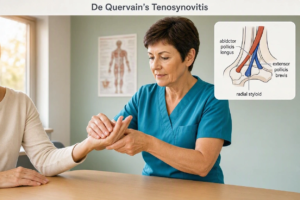
De Quervain’s tenosynovitis is a painful condition affecting the tendons that help move the thumb away from the hand and extend it. These tendons, known as the abductor pollicis longus and extensor pollicis brevis, pass through a narrow compartment on the thumb side of the wrist.
Tendons connect muscles to bones and transmit the force required for movement. A tendon sheath is a protective covering that helps the tendon glide smoothly. In De Quervain’s tenosynovitis, irritation and thickening around this tendon compartment can make movement painful and restrict the tendons’ ability to glide comfortably.
The condition is sometimes described as De Quervain’s tendinopathy because tendon changes may involve more than inflammation alone.
Which Tendons Are Affected?
Two main tendons are involved:
- Abductor pollicis longus (APL): Helps move the thumb away from the palm.
- Extensor pollicis brevis (EPB): Helps straighten the thumb at its base.
These tendons contribute to gripping, pinching, lifting, and positioning objects in the hand. When movement through their shared compartment becomes painful, tasks requiring repeated thumb use can become difficult.
Physiotherapy aims to reduce excessive irritation and gradually restore the hand’s capacity for these movements.
Common Symptoms of De Quervain’s Tenosynovitis
Symptoms usually occur near the base of the thumb and the thumb-side edge of the wrist. They may begin gradually or follow an increase in repetitive activity.
Common symptoms include:
- Pain near the base of the thumb.
- Tenderness along the thumb side of the wrist.
- Swelling around the affected tendon compartment.
- Pain when gripping, pinching, or twisting objects.
- Discomfort when lifting a child or carrying a bag.
- Reduced thumb or wrist movement because of pain.
- Difficulty opening jars or turning door handles.
- Reduced confidence when using the affected hand.
- Occasionally, a catching or snapping sensation during thumb movement.
Symptoms may worsen when the thumb and wrist are used together under load. For example, lifting a heavy object while the wrist is bent can place additional demands on the affected tendons.
The intensity of pain does not always indicate the extent of the tendon changes. A clinician should assess persistent symptoms to confirm the likely cause and rule out other conditions.
What Causes De Quervain’s Tenosynovitis?
De Quervain’s tenosynovitis is associated with irritation around the tendons that move the thumb. Repetitive loading, forceful gripping, and activities that combine thumb movement with wrist deviation may contribute to symptoms.
There is not always one identifiable cause. Symptoms can develop after a change in workload, an increase in repetitive movements, or a period of caring for a young child.
Repetitive Hand and Wrist Movements
Some activities repeatedly load the thumb tendons, especially when performed for long periods without adequate recovery.
Examples include:
- Repeatedly using a phone with one hand.
- Typing or using a mouse for extended periods when hand positions are uncomfortable.
- Gardening and pruning.
- Knitting, sewing, or crafting.
- Manual work involving gripping or twisting.
- Playing certain musical instruments.
- Repeatedly lifting or carrying objects.
These activities do not automatically cause De Quervain’s tenosynovitis. The overall workload, force, frequency, recovery time, and individual factors all matter.
Pregnancy and the Postnatal Period
Some people develop De Quervain’s tenosynovitis during pregnancy or after childbirth. Changes in fluid balance and the increased physical demands of caring for an infant may contribute.
Repeatedly lifting a baby under the arms, supporting the baby’s weight with the wrists bent, or using the thumbs to maintain a strong grip can aggravate symptoms.
Changing lifting techniques, supporting the baby with the forearms, and using a comfortable feeding or carrying position may help reduce strain.
Other Contributing Factors
Previous wrist injuries, inflammatory conditions such as rheumatoid arthritis, and individual anatomical differences may also influence symptoms.
Because several conditions can cause pain near the thumb, it is important not to assume that every episode of thumb-side wrist pain is De Quervain’s tenosynovitis.
How Is De Quervain’s Tenosynovitis Diagnosed?
Diagnosis usually begins with a review of symptoms, activity levels, medical history, and the movements that reproduce pain.
A clinician may examine the thumb and wrist for tenderness, swelling, restricted movement, and discomfort during specific functional tasks. A clinical maneuver, such as the Finkelstein test, may be used as part of the assessment. However, no single self-administered test should be used to confirm the condition.
Imaging is not required in every typical case. X-rays may be used when a fracture or arthritis is suspected, while ultrasound or other imaging may be considered if the diagnosis is uncertain or another condition needs investigation.
Conditions That Can Cause Similar Symptoms
Other possible causes of thumb-side wrist pain include:
- Thumb-base osteoarthritis.
- Wrist sprains or fractures.
- Other tendon disorders.
- Nerve irritation.
- Inflammatory joint conditions.
- Pain arising from another part of the wrist or hand.
A correct diagnosis helps ensure that the treatment plan addresses the underlying problem rather than repeatedly aggravating the area.
The American Academy of Orthopaedic Surgeons provides further information about diagnosis and treatment options.
Why Is Physiotherapy Important for De Quervain’s Tenosynovitis?
Physiotherapy can help people understand what aggravates their symptoms and how to return to normal hand use without repeatedly overloading the affected tendons.
Treatment is not limited to stretching or strengthening. It may include education, activity modification, splinting advice, comfortable movement, progressive exercises, and strategies for completing work and household tasks.
Reducing Irritation
The initial aim is to reduce the activities and positions that repeatedly provoke pain. This does not necessarily mean avoiding all thumb and wrist movement.
Instead, the therapist helps identify which tasks need temporary modification and which activities can continue safely. Reducing excessive loading while maintaining suitable movement can help make daily activities more manageable.
Restoring Comfortable Movement
Pain may cause a person to protect the thumb and wrist, leading to stiffness and reduced confidence. Gentle movement, introduced at an appropriate stage, can help maintain mobility without forcing the tendons through painful ranges.
Improving Strength and Load Tolerance
Once symptoms have settled sufficiently, selected exercises can help rebuild the hand’s ability to tolerate gripping, lifting, and other everyday tasks.
Progression should be gradual. Starting with heavy resistance or repeatedly performing painful movements can aggravate symptoms rather than improve function.
Supporting a Return to Daily Activities
A physiotherapist can recommend practical changes to the way a person lifts objects, uses tools, performs household tasks, or manages repetitive work.
These adjustments can be especially useful for people whose occupations or caregiving responsibilities make it difficult to stop using the affected hand entirely.
Physiotherapy Treatment Options for De Quervain’s Tenosynovitis
The appropriate treatment depends on symptom severity, duration, daily demands, and the person’s response to initial care.
1. Activity Modification
Activity modification is often an important early step. It involves reducing or changing the movements that place excessive strain on the affected tendons.
Examples include:
- Taking regular breaks during repetitive tasks.
- Avoiding forceful pinching when possible.
- Using both hands to distribute the load.
- Keeping the wrist in a comfortable, relatively neutral position.
- Using larger-handled tools when appropriate.
- Reducing repetitive twisting or forceful gripping.
- Temporarily asking for help with tasks that provoke significant pain.
The goal is to manage the workload, not permanently avoid using the hand.
As symptoms improve, activities can be reintroduced gradually according to comfort and functional ability.
2. Thumb Spica Splinting
A thumb spica splint supports the wrist and thumb while limiting movements that may irritate the affected tendon compartment. It may be recommended during daily tasks or at night, depending on symptoms and clinical advice.
The fit matters. A splint that is too tight may cause discomfort, skin irritation, tingling, or changes in circulation. A hand therapist or other qualified professional can help select and adjust an appropriate support.
Wearing a splint does not mean that the hand should remain immobilized indefinitely. The duration and timing of use should reflect the treatment plan, and movement and strengthening may be introduced as symptoms allow.
3. Cold Therapy for Symptom Relief
A cold pack wrapped in a cloth may temporarily reduce pain after an aggravating activity. It should not be placed directly against the skin.
Use cold therapy for a short period and stop if the skin becomes excessively uncomfortable or changes color. People with reduced skin sensation or circulation problems should seek advice before using cold treatments.
Cold therapy can help with symptom management, but it does not replace activity modification or a suitable rehabilitation plan.
4. Therapeutic Exercise
Exercise selection depends on the stage of recovery. Early treatment may focus on comfortable movement and gentle muscle activation. Later rehabilitation may include thumb control, wrist strengthening, grip exercises, and gradual exposure to functional tasks.
Exercises should not cause sharp pain or a sustained increase in symptoms. If pain worsens during exercise or remains noticeably elevated afterward, the intensity, range, or number of repetitions may need to be reduced.
5. Manual Therapy and Other Modalities
A physiotherapist may consider selected hands-on techniques or other modalities as part of a broader treatment plan. These approaches should be used according to the individual’s needs and available evidence, rather than presented as a guaranteed way to heal the tendon.
Education, load modification, appropriate splinting, and progressive rehabilitation remain important elements of conservative care.
6. Medical Treatment When Needed
Some people require additional treatment if symptoms remain significant despite appropriate activity modification and splinting.
A healthcare professional may discuss pain-relieving medication or a corticosteroid injection. Medication suitability depends on the person’s medical history, other medicines, and individual risk factors.
A clinician may recommend referral to a hand specialist if symptoms are persistent, the diagnosis is uncertain, or conservative treatment has not provided sufficient improvement.
Exercises for De Quervain’s Tenosynovitis
Exercises can be helpful, but the right choice and timing are important. The following examples are educational and should be adapted to the individual’s symptoms and professional recommendations.
If the wrist is acutely painful, significantly swollen, or recently injured, obtain advice before starting exercises. Do not force stretches or attempt to reproduce a diagnostic test repeatedly.
1. Gentle Thumb Movement
This exercise aims to maintain comfortable thumb mobility without adding significant resistance.
How to perform it:
- Rest the forearm on a table or comfortable surface.
- Keep the wrist in a relaxed, neutral position.
- Slowly move the thumb away from the palm within a comfortable range.
- Return the thumb to its starting position.
- Repeat gently without forcing the movement.
Keep the movement controlled and stop if it causes sharp or increasing pain. A therapist may adjust the range according to your symptoms.
2. Thumb Opposition
Thumb opposition involves moving the thumb toward the fingertips. It supports everyday tasks such as handling small objects.
How to perform it:
- Rest your hand comfortably with the palm facing upward or sideways.
- Slowly bring the thumb toward the index finger.
- If comfortable, continue toward the other fingertips.
- Return to the starting position.
Avoid squeezing the fingertips together forcefully. The goal is comfortable movement rather than a strong pinch.
3. Gentle Wrist Movement
Maintaining comfortable wrist movement may help reduce stiffness when the wrist has become guarded.
How to perform it:
- Support your forearm on a table.
- Keep the hand relaxed.
- Slowly bend the wrist forward and backward within a comfortable range.
- Return to the neutral position between movements.
Do not repeatedly move into the direction that reproduces strong pain on the thumb side of the wrist. The exercise should be modified or omitted if it aggravates symptoms.
4. Isometric Thumb Exercise
Isometric exercise involves activating a muscle without producing substantial joint movement. A physiotherapist may introduce this type of exercise when the symptoms are sufficiently settled.
How to perform it:
- Place the thumb in a comfortable position.
- Use the opposite hand to provide very gentle resistance.
- Attempt to move the thumb against that resistance without allowing it to move significantly.
- Hold briefly, then relax.
Begin with low effort. The exercise should not cause sharp pain or a substantial flare-up. Your therapist can advise which direction and level of resistance are appropriate.
5. Gentle Grip Exercise (Physiotherapy for De Quervain’s Tenosynovitis)
Grip exercises may be useful later in rehabilitation when everyday gripping is becoming more comfortable.
How to perform it:
- Hold a soft ball or a rolled-up towel.
- Gently squeeze without bending the wrist excessively.
- Hold briefly, then release completely.
- Rest between repetitions.
Start with very light pressure and avoid forceful pinching. If gripping reproduces the original pain, postpone the exercise and discuss a suitable alternative with your therapist.
6. Gradual Functional Strengthening
As symptoms improve, the therapist may introduce exercises that resemble the person’s everyday activities. These may include light lifting, controlled carrying, handling objects, or graded work-specific tasks.
The aim is to increase the hand’s capacity gradually, without suddenly returning to the full workload that originally aggravated the symptoms.
Important: There is no single exercise program suitable for everyone with De Quervain’s tenosynovitis. Exercises should be selected according to symptom irritability, clinical assessment, and functional goals.
What Should You Avoid During Recovery?
During a painful flare-up, repeatedly performing the same aggravating movements may prevent symptoms from settling.
Activities that may need temporary modification include:
- Forceful pinching or gripping.
- Repeated twisting of the wrist.
- Lifting heavy objects with the wrist bent.
- Carrying a heavy bag using the thumb and fingers alone.
- Prolonged phone use in a position that stresses the thumb.
- Aggressive stretching that reproduces pain.
- Heavy resistance exercises before the hand is ready.
Avoiding every movement is not always necessary. Instead, identify which activities trigger symptoms, reduce the load where possible, and gradually rebuild tolerance.
If a task is unavoidable, consider using both hands, keeping the wrist comfortable, bringing the object closer to the body, or using an alternative grip.
De Quervain’s Tenosynovitis During Pregnancy and After Childbirth
De Quervain’s tenosynovitis can develop during pregnancy or after childbirth, when changes in the body may coincide with frequent lifting and carrying.
Caring for a baby often requires repeated gripping, lifting, feeding, and repositioning. These activities can place additional stress on the thumb tendons, particularly when the wrist is bent or the thumb is used to support much of the baby’s weight.
Practical Strategies for Parents
Helpful adjustments may include:
- Supporting the baby’s body with the forearms and palms.
- Avoiding repeated lifting under the baby’s arms when that position aggravates symptoms.
- Keeping the wrist as comfortable and neutral as possible.
- Using pillows to support the arms during feeding.
- Asking for assistance with lifting when pain is severe.
- Taking short breaks when practical.
- Discussing a suitable splint with a healthcare professional.
The aim is to reduce unnecessary strain while allowing essential caregiving tasks to continue as safely as possible.
Persistent pain should not automatically be attributed to pregnancy or childcare. Assessment can help confirm the diagnosis and identify an appropriate treatment plan.
How Long Does Recovery Take? (Physiotherapy for De Quervain’s Tenosynovitis)
Recovery varies from person to person. Some people notice improvement within several weeks after reducing aggravating activities and using suitable treatment. Others may need a longer period, particularly if symptoms have been present for months or daily activities repeatedly irritate the tendons.
The Mayo Clinic’s treatment guidance notes that symptoms often improve when treatment begins early, although individual outcomes differ.
Factors That May Influence Recovery
Recovery can be affected by:
- How long symptoms have been present.
- The severity of pain and functional limitation.
- The frequency of repetitive hand movements.
- Whether activity modifications are practical.
- Consistency with splint use when prescribed.
- Other medical conditions.
- Response to rehabilitation and any additional treatment.
A gradual improvement in everyday function is often more useful than relying on a specific number of days as the only measure of progress.
If symptoms are worsening, remain substantially limiting, or fail to improve despite appropriate treatment, seek further assessment.
Can De Quervain’s Tenosynovitis Be Treated Without Surgery?
Many cases can be managed without surgery. Conservative treatment may include activity modification, a thumb spica splint, symptom-relief measures, and appropriately selected rehabilitation.
A corticosteroid injection may be considered when symptoms are significant or persistent. A recent systematic review of conservative treatments reported that corticosteroid injection combined with full-time orthosis use ranked highly for pain and functional improvement, but the certainty of the evidence was low to very low. Treatment decisions should therefore be individualized rather than based on a single study alone.
Surgery may be considered when symptoms remain troublesome despite suitable non-surgical treatment or when a specialist determines that it is appropriate.
The procedure typically releases part of the covering around the affected tendons to give them more room to glide. Rehabilitation after surgery may include wound care guidance, movement exercises, and a gradual return to normal hand use.
The treating surgeon determines when strengthening, lifting, and demanding activities can resume.
Preventing Recurring Symptoms
Although recurrence cannot always be prevented, practical changes can reduce repeated irritation.
Manage Repetitive Workloads
Break long tasks into shorter periods where possible. Alternate between activities that use different muscle groups, and avoid increasing workload abruptly after a period of reduced activity.
Improve Wrist Position (Physiotherapy for De Quervain’s Tenosynovitis)
Try to keep the wrist in a comfortable, neutral position during lifting and gripping. A strongly bent wrist combined with forceful thumb use may increase discomfort.
Use Both Hands When Practical
Distributing weight between both hands can reduce the demand placed on one thumb and wrist. Use larger handles or tools when appropriate, and avoid holding heavy objects with a tight pinch grip.
Return to Activity Gradually
Once symptoms improve, increase activity in stages. Monitor how the hand responds during the task and afterward. A large increase in workload may provoke symptoms even when the hand feels better at rest.
Address Symptoms Early
If thumb-side wrist pain starts to interfere with daily activities, consider seeking assessment before it becomes persistent. Early guidance may help identify aggravating movements and appropriate treatment options.
When Should You Seek Medical Advice?
Professional assessment is recommended when wrist or thumb pain persists, interferes with daily activities, or does not improve after modifying aggravating movements.
Seek prompt medical care after a significant injury, particularly if there is severe pain, obvious deformity, marked swelling, or an inability to move the hand normally.
Urgent assessment is also appropriate if the hand becomes unusually cold or pale, sensation changes significantly, or there is rapidly increasing redness, warmth, or swelling accompanied by fever.
A healthcare professional can determine whether the symptoms are consistent with De Quervain’s tenosynovitis or whether another condition requires investigation.
How Physiotherapy Can Support Recovery at Ritz Clinic
A suitable rehabilitation plan begins with understanding the person’s symptoms, daily activities, work demands, and functional goals.
For De Quervain’s tenosynovitis, a physiotherapist may help identify aggravating movements, recommend activity modifications, guide comfortable mobility exercises, and progress strengthening when appropriate. Advice may also cover how to manage repetitive tasks and return to normal activities without rapidly increasing the workload.
Some people require medical treatment or assessment by a hand specialist in addition to rehabilitation. Physiotherapy should form part of an appropriate care plan rather than delay necessary medical investigation.
Learn more about physiotherapy services at Ritz Clinic.
The most effective approach is one that matches the person’s symptoms and daily demands. Treatment should be reviewed if pain increases, function deteriorates, or progress is slower than expected.
Conclusion (Physiotherapy for De Quervain’s Tenosynovitis)
Physiotherapy for De Quervain’s tenosynovitis can help reduce the impact of thumb-side wrist pain, restore comfortable movement, and support a gradual return to everyday activities. The condition affects the tendons responsible for thumb movement as they pass through a narrow compartment near the wrist, often causing discomfort during gripping, lifting, pinching, and twisting.
Treatment commonly begins with activity modification and, when appropriate, a thumb spica splint. Gentle movement and progressive exercises may be introduced as symptoms allow, with the goal of rebuilding strength and improving the hand’s tolerance for daily tasks.
Recovery is not identical for everyone. Some people improve with conservative treatment, while others may need a corticosteroid injection or specialist assessment. Surgery is generally considered when symptoms remain significant despite appropriate non-surgical care.
The key is to avoid repeatedly aggravating the affected tendons while maintaining suitable movement and gradually rebuilding function. Early assessment, realistic activity adjustments, and an individualized rehabilitation plan can help many people manage symptoms and return to the activities that matter to them.
Frequently Asked Questions (Physiotherapy for De Quervain’s Tenosynovitis)
1. What is the best treatment for De Quervain’s tenosynovitis?
Treatment often includes activity modification, a thumb spica splint when appropriate, symptom management, and individualized rehabilitation. Some people may also benefit from a corticosteroid injection. The best approach depends on symptom severity and clinical assessment.
2. Can physiotherapy help De Quervain’s tenosynovitis?
Yes. Physiotherapy can help identify aggravating activities, improve comfortable movement, guide appropriate exercises, and support a gradual return to work and daily activities. Some people also require medical treatment.
3. Which exercises are suitable for De Quervain’s tenosynovitis?
Depending on the stage of recovery, exercises may include gentle thumb movement, thumb opposition, comfortable wrist movement, light isometric exercises, and later-stage grip strengthening. Exercises should be selected according to symptoms and should not be forced through sharp pain.
4. Should I wear a brace for De Quervain’s tenosynovitis?
A thumb spica splint may help support the wrist and thumb and reduce aggravating movements. A healthcare professional can advise on the fit, timing, and duration of use.
5. How long does De Quervain’s tenosynovitis take to heal?
Some people improve within several weeks, while persistent cases may take longer. Recovery depends on symptom severity, activity demands, and response to treatment. Continued pain should be reassessed rather than ignored.
6. What activities can make De Quervain’s tenosynovitis worse?
Forceful gripping, repetitive pinching, twisting, lifting with a bent wrist, and repeated thumb movements may aggravate symptoms. Temporary modifications can reduce strain while the condition improves.
7. Can De Quervain’s tenosynovitis go away without surgery?
Yes. Many people improve with non-surgical treatment, including activity modification, splinting, and appropriate rehabilitation. Some require injections, and surgery may be considered if symptoms persist despite suitable conservative care.
8. Is De Quervain’s tenosynovitis common after pregnancy?
It can occur during pregnancy or after childbirth. Repeated lifting and carrying, along with other physical changes, may contribute. Adjusting lifting techniques and seeking professional advice can help manage symptoms.
9. Can I continue working with De Quervain’s tenosynovitis?
Many people can continue working with appropriate modifications. Reducing forceful gripping, taking regular breaks, adjusting tools, and keeping the wrist comfortable may help. Significant or worsening pain may require temporary changes to work duties.
10. Does De Quervain’s tenosynovitis always cause swelling?
No. Some people have pain and tenderness without obvious swelling. The absence of swelling does not rule out the condition, and persistent symptoms should be assessed.
11. Is a corticosteroid injection effective for De Quervain’s tenosynovitis?
A corticosteroid injection can reduce pain and symptoms for some people. Its suitability depends on the clinical assessment, potential risks, and other treatment options. A healthcare professional can explain the expected benefits and limitations.
12. When should I see a physiotherapist or doctor?
Seek assessment if pain persists, limits daily activities, or does not improve after modifying aggravating movements. Significant injury, severe pain, marked swelling, deformity, or changes in circulation or sensation require prompt medical attention.