Sciatica Treatment at Home: Complete Guide to Managing Sciatic Nerve Pain
Sciatica can make everyday life surprisingly difficult. A simple walk, sitting at a desk, getting into a car, or sleeping at night may become uncomfortable when pain travels from the lower back into the buttock and leg. Many people therefore look for practical Sciatica Treatment at Home options that can help them manage symptoms while their body recovers.
The good news is that many cases of sciatica improve over several weeks to a few months. During recovery, appropriate home care can help you remain active, manage discomfort, maintain mobility, and gradually return to your normal routine. However, home treatment does not suit every situation. Severe or worsening neurological symptoms require medical assessment rather than continued self-treatment.
Effective Sciatica Treatment at Home usually involves several simple strategies rather than one particular remedy. Staying appropriately active, avoiding prolonged sitting, using heat or cold when helpful, performing suitable exercises, improving sleep, pacing activities, and managing your daily movements can all form part of a sensible recovery plan.
This guide explains how to manage sciatica at home, which activities may help, which mistakes to avoid, and when you should seek professional care.
What Is Sciatica?
Sciatica describes symptoms caused by irritation or compression of the sciatic nerve or one of the nerve roots that contribute to it.
The sciatic nerve travels from the lower part of the spine through the buttocks and into the leg. When the nerve or one of its roots becomes irritated, symptoms can travel along the leg rather than remaining only in the lower back.
Common symptoms include:
-
Sharp or burning pain
-
Pain traveling down one leg
-
Tingling or pins and needles
-
Numbness
-
Muscle weakness
-
Buttock pain
-
Lower back discomfort
-
Pain that becomes worse with certain movements
A herniated or slipped disc is one common cause of sciatica. However, spinal stenosis, spondylolisthesis, injuries, and other spinal conditions can also contribute.
Because different causes can produce similar symptoms, you should not assume that every case requires the same treatment.
Can You Treat Sciatica at Home?
Many people can initially manage uncomplicated sciatica with appropriate self-care.
The NHS recommends continuing normal activities as much as possible, trying regular exercises, starting gentle activity, and avoiding prolonged periods of sitting or lying down.
However, home treatment should not mean ignoring your symptoms.
Instead, think of home care as an active recovery strategy. You can monitor your symptoms while gradually returning to normal movement.
If symptoms continue for several weeks, become worse, or prevent normal activities, professional assessment becomes appropriate.
Stay Active During Sciatica Recovery
One of the most important parts of Sciatica Treatment at Home involves staying appropriately active.
When pain becomes intense, lying down may feel like the safest option. However, remaining inactive for long periods can make it harder to maintain strength and mobility.
Instead, try to change positions regularly.
For example, you can:
-
Take short walks around your home
-
Stand up regularly
-
Perform gentle movements
-
Continue manageable household activities
-
Avoid sitting continuously for several hours
-
Gradually return to normal daily tasks
You do not need to perform intense exercise.
The goal is simply to avoid unnecessary inactivity while respecting your symptoms.
NICE guidance recommends encouraging people with low back pain with or without sciatica to continue normal activities as far as possible.
Avoid Prolonged Bed Rest
Bed rest can seem attractive when your leg hurts. However, prolonged bed rest is generally not a useful long-term strategy for uncomplicated sciatica.
A short period of comfortable rest can be reasonable when symptoms feel intense. Nevertheless, you should gradually return to movement as your tolerance allows.
Cambridge University Hospitals advises people with sciatica to move regularly because movement can help prevent stiffness and muscle deconditioning.
Therefore, instead of spending most of the day in bed, try alternating between:
Rest → gentle movement → activity → comfortable rest
This approach allows you to recover without becoming completely inactive.
Walking for Sciatica
Walking is one of the easiest forms of Sciatica Treatment at Home because you do not need special equipment.
Start with a distance that feels manageable.
For example, you might begin with:
-
Five minutes of walking
-
Several short walks throughout the day
-
A slow, comfortable pace
As your symptoms improve, gradually increase the duration.
You do not need to complete one long walk. Several shorter walks can work well during an early flare-up.
Walking also provides a simple way to maintain general fitness while you recover.
If walking significantly increases your leg pain, numbness, or weakness, reduce the amount and seek professional advice if the problem continues.
Gentle Exercises at Home
Exercise can become an important part of managing sciatica.
The NHS provides general exercises for people with sciatica, while emphasizing that people with health problems, injuries, symptoms, recent health events, or uncertainty about exercise suitability should seek professional advice first. It also advises stopping an exercise if it causes pain or makes you feel unwell.
Possible home exercises may include:
-
Gentle pelvic movements
-
Controlled knee movements
-
Comfortable mobility exercises
-
Walking
-
Gentle strengthening
-
Hip exercises
-
Core exercises
The right exercise depends on your symptoms.
Do not assume that an exercise is suitable simply because it helped someone else.
Gentle Mobility Exercises
Mobility exercises can help you maintain movement while you recover.
For example, you might perform gentle knee movements while lying on your back.
Start by bending your knees and keeping your feet supported. Then slowly allow the knees to move within a comfortable range.
The movement should remain controlled.
You should not force your lower back into an extreme position.
Another option involves gentle pelvic movements. These exercises can help you practice controlled movement without requiring heavy resistance.
If an exercise consistently increases your leg symptoms, stop it and discuss alternatives with a physiotherapist.
Stretching for Sciatica
Stretching can help maintain flexibility, but aggressive stretching does not necessarily improve nerve-related pain.
This distinction matters.
Sciatica involves nerve irritation or compression, so repeatedly forcing a painful leg into a deep stretch may aggravate symptoms in some people.
If you stretch at home:
-
Move slowly
-
Avoid bouncing
-
Keep the stretch gentle
-
Do not force your range
-
Stop if symptoms significantly worsen
A physiotherapist can determine whether specific stretching exercises suit your presentation.
Core Strengthening at Home (Sciatica Treatment at Home)
Once acute symptoms become more manageable, strengthening may become useful.
Core exercises can help improve trunk control and prepare your body for everyday activities.
A simple starting exercise involves abdominal bracing.
Lie comfortably on your back with your knees bent. Gently tighten your abdominal muscles without holding your breath. Hold the contraction for a few seconds, then relax.
Repeat several times.
As your strength improves, you may progress toward exercises such as:
-
Bridges
-
Bird-dog movements
-
Controlled sit-to-stands
-
Modified squats
-
Hip strengthening exercises
Start with a low level of resistance and increase gradually.
Glute and Hip Exercises
The muscles around your hips and buttocks contribute to walking, standing, lifting, and other everyday movements.
Simple exercises may include:
Glute Bridges (Sciatica Treatment at Home)
Lie on your back with your knees bent.
Keep your feet comfortably on the floor. Tighten your abdominal and gluteal muscles gently and raise your hips.
Pause briefly and lower yourself with control.
Begin with a small number of repetitions.
Sit-to-Stand
Use a stable chair.
Stand up slowly and then sit down with control.
This exercise trains several muscles that you use throughout the day.
As you become stronger, you can gradually increase repetitions.
Heat for Sciatica Pain
Heat can provide temporary comfort for some people with sciatica.
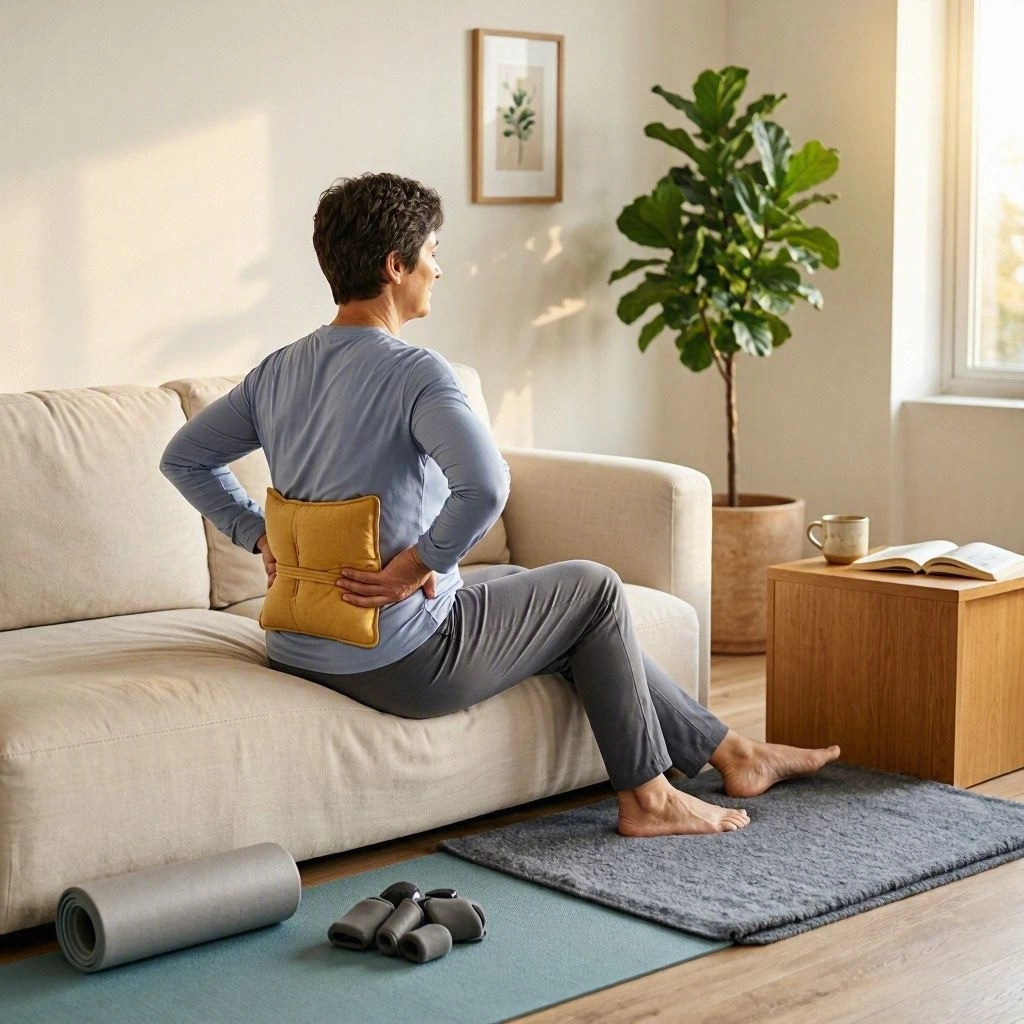
You can use a heat pack over a painful area for a limited period while relaxing or before gentle activity.
Heat may help reduce muscle tension and make movement feel more comfortable.
However, use heat carefully.
Never place an extremely hot object directly against your skin. Also, take extra care if numbness affects the area because reduced sensation can increase the risk of burns.
The NHS lists heat packs as one option for self-managing sciatica symptoms.
Cold Therapy (Sciatica Treatment at Home)
Some people prefer cold rather than heat, particularly during periods when the area feels irritated.
A cold pack can be wrapped in a towel and applied for a short period.
Do not place ice directly against your skin.
You can experiment with heat or cold and use whichever provides more comfortable symptom relief.
Neither method should replace appropriate movement and rehabilitation.
Cambridge University Hospitals also lists heat or ice as possible symptom-management strategies.
Improve Your Sitting Position
Sitting can become uncomfortable during a sciatica flare-up.
Instead of trying to find one perfect posture, focus on avoiding prolonged static positions.
You can:
-
Change position regularly
-
Stand up frequently
-
Walk briefly between tasks
-
Use a comfortable chair
-
Keep your feet supported
-
Avoid prolonged slouching if it aggravates symptoms
If sitting increases your leg pain, alternate between sitting, standing, and walking whenever possible.
This approach can be particularly useful for people who work from home.
Take Regular Movement Breaks
Working for several hours without moving can make symptoms harder to manage.
Try setting reminders to stand or walk throughout the day.
For example, every 30 to 60 minutes you could:
-
Stand up.
-
Walk around the room.
-
Change your position.
-
Perform a few comfortable movements.
-
Return to your task.
The exact schedule does not need to be perfect.
The main objective is to avoid remaining in one position for long periods.
Sleeping With Sciatica
Pain can make sleep difficult.
Try to find a position that feels comfortable rather than forcing yourself into a specific sleeping posture.
If you sleep on your side, placing a pillow between your knees may feel comfortable for some people.
If you sleep on your back, placing support beneath your knees may also help.
The most important factor is comfort.
If your pain repeatedly wakes you or prevents normal sleep, consider speaking with a healthcare professional.
Good sleep can support your ability to manage pain and remain active during the day.
Pacing Your Daily Activities (Sciatica Treatment at Home)
One common mistake involves doing too much on a good day.
You may wake up feeling better, complete several household tasks, exercise intensely, and then experience significantly worse symptoms later.
Instead, use pacing.
Pacing means dividing demanding activities into smaller sections.
For example:
Instead of cleaning the entire house at once:
Clean for a short period → rest or change activity → continue later
You can use the same principle for:
-
Shopping
-
Gardening
-
Cooking
-
Household cleaning
-
Driving
-
Exercise
-
Work
Gradually increasing activity helps you rebuild tolerance without repeatedly overloading your body.
Lifting Objects at Home
You may still need to lift objects while recovering.
Use sensible lifting techniques:
-
Keep the object close to your body
-
Avoid sudden twisting
-
Bend through your hips and knees when appropriate
-
Move slowly
-
Avoid lifting loads that exceed your current capacity
If an object feels too heavy, ask for help.
As your symptoms improve, you can gradually rebuild your lifting capacity rather than avoiding lifting forever.
Managing Household Chores
Household activities can become challenging with sciatica.
You do not necessarily need to stop them completely.
Instead, modify the activity.
For example:
-
Break cleaning into shorter sessions
-
Avoid staying bent forward for long periods
-
Change positions regularly
-
Use tools with longer handles when helpful
-
Take short movement breaks
The goal is to maintain independence while respecting your current physical limits.
Pain Medication at Home (Sciatica Treatment at Home)
Medication may help some people manage symptoms while they remain active.
However, medication choices depend on your health, other medicines, allergies, age, and other factors.
The NHS recommends asking a pharmacist about painkillers and notes that paracetamol alone is unlikely to help sciatica, while the benefit of NSAIDs such as ibuprofen remains uncertain.
Therefore, do not assume that an over-the-counter medication is automatically safe for you.
A pharmacist or healthcare professional can help you choose an appropriate option.
Relaxation and Breathing
Pain can create tension and anxiety.
When discomfort becomes intense, people may unconsciously tense their shoulders, abdominal muscles, or back.
Slow breathing can help you relax.
Try:
-
Sit or lie in a comfortable position.
-
Breathe slowly through your nose.
-
Allow your abdomen to expand gently.
-
Exhale slowly.
-
Repeat for several minutes.
Relaxation does not directly remove the underlying cause of sciatica. Nevertheless, it can help you manage the experience of pain and make it easier to remain calm during a flare-up.
Maintain a Healthy Routine (Sciatica Treatment at Home)
Recovery does not depend only on exercises.
Your overall routine also matters.
Try to maintain:
-
Regular sleep
-
Healthy meals
-
Adequate hydration
-
Appropriate physical activity
-
Regular movement breaks
-
Stress-management strategies
Cambridge University Hospitals recommends looking after general health and wellbeing as part of managing sciatica.
What Should You Avoid at Home?
Some habits can make recovery harder.
Avoid Prolonged Bed Rest (Sciatica Treatment at Home)
Remaining in bed for most of the day can reduce activity and contribute to stiffness and deconditioning.
Avoid Sitting for Hours
Change positions regularly.
Avoid Aggressive Exercise
Do not suddenly return to heavy lifting, intense running, or demanding workouts during a flare-up.
Avoid Forcing Painful Stretches
More stretching does not automatically mean faster recovery.
Avoid Ignoring Neurological Symptoms
New weakness, significant numbness, or bladder and bowel changes require professional evaluation.
Can Massage Help at Home?
Self-massage or gentle massage around tense muscles may feel comfortable for some people.
However, massage does not necessarily address the cause of nerve irritation.
If you use massage as part of home care, keep pressure comfortable and avoid aggressive techniques directly over painful or numb areas.
For persistent symptoms, professional assessment can help determine whether manual therapy is appropriate.
How Long Does Home Treatment Take?
There is no fixed recovery period for everyone.
The NHS explains that sciatica often improves within a few weeks to a few months, although some cases last longer.
Your recovery can depend on:
-
The underlying cause
-
Severity of nerve irritation
-
Duration of symptoms
-
Activity level
-
General health
-
Response to treatment
-
Presence of neurological symptoms
Instead of measuring recovery only by pain intensity, look for functional improvements.
For example, you might notice that you can:
-
Walk farther
-
Sit longer
-
Sleep better
-
Work more comfortably
-
Complete household activities
-
Exercise with fewer symptoms
These changes can provide useful signs of progress.
A Simple Sciatica Treatment at Home Routine (Sciatica Treatment at Home)
A simple daily routine might look like this:
Morning
-
Get out of bed gradually
-
Perform gentle mobility movements
-
Walk for several minutes
-
Avoid sitting for a prolonged period immediately after waking
During Work
-
Change position regularly
-
Take short walking breaks
-
Avoid remaining seated continuously
-
Perform comfortable mobility exercises
Afternoon
-
Take another short walk
-
Complete your prescribed strengthening exercises
-
Pace household activities
Evening
-
Perform gentle mobility if comfortable
-
Use heat or cold if it provides relief
-
Prepare for a good night’s sleep
This routine is only an example.
Your actual program should depend on your symptoms and physical condition.
When Should You Stop Home Treatment?
Home treatment should not continue indefinitely if symptoms fail to improve.
The NHS recommends seeking medical advice if sciatica has not improved after trying home treatments for a few weeks, if symptoms are getting worse, or if pain prevents normal activities.
You should also seek professional advice if you develop:
-
Persistent numbness
-
New weakness
-
Increasing leg pain
-
Difficulty walking
-
Symptoms that repeatedly return
-
Pain that significantly interferes with sleep or work
A physiotherapist or doctor can assess your symptoms and determine whether additional treatment is necessary.
Emergency Symptoms You Should Never Ignore (Sciatica Treatment at Home)
Although many cases of sciatica improve without emergency treatment, certain symptoms require immediate medical attention.
Go to an emergency department or seek urgent emergency care if you develop:
-
Sciatica affecting both legs
-
Severe or worsening weakness in both legs
-
Significant numbness in both legs
-
Numbness around the genitals
-
Numbness around the anus or buttocks
-
Difficulty starting urination
-
Inability to urinate
-
Loss of bladder control
-
Loss of bowel control
These symptoms can indicate a serious spinal or neurological problem.
Do not attempt to manage these symptoms with home exercises, massage, heat, or rest.
When Should You See a Physiotherapist?
A physiotherapist can be useful when you are unsure which exercises are appropriate or when symptoms continue despite home care.
Professional assessment can examine:
-
Strength
-
Mobility
-
Nerve-related symptoms
-
Walking
-
Functional limitations
-
Exercise tolerance
-
Work requirements
-
Sports activities
A physiotherapist can then create a progressive exercise program and modify it as you recover.
NICE guidance supports exercise approaches tailored to an individual’s needs, preferences, and capabilities.
Frequently Asked Questions About Sciatica Treatment at Home
Can sciatica go away on its own?
Yes. Many cases improve over several weeks to a few months. However, persistent, worsening, or function-limiting symptoms should receive professional assessment.
What is the best Sciatica Treatment at Home?
There is no single home remedy that works for everyone. Staying appropriately active, walking, performing suitable exercises, avoiding prolonged sitting, managing activities, and using heat or cold for symptom relief can form part of home care.
Should I stay in bed with sciatica?
Usually, prolonged bed rest is not recommended. Short periods of rest may provide comfort, but gradually returning to movement is generally encouraged.
Can walking help sciatica?
Walking can help you remain active during recovery. Start with a comfortable duration and gradually increase your activity.
Is heat good for sciatica?
Heat can provide temporary relief for some people. Use it carefully and protect your skin, especially if numbness affects the area.
Should I use ice or heat?
Both can provide symptom relief for some people. Try the option that feels more comfortable while protecting your skin from excessive temperature.
Can stretching make sciatica worse?
Yes, aggressive stretching may aggravate symptoms in some people. Keep stretches gentle and stop if symptoms become significantly worse.
Can I exercise with sciatica?
Many people can perform some form of exercise during recovery. Start gently and progress gradually. If you are unsure whether an exercise suits your symptoms, ask a physiotherapist or other healthcare professional.
How long should I treat sciatica at home?
You can use home care while symptoms gradually improve. However, if symptoms have not improved after several weeks, become worse, or interfere with normal activities, seek professional medical advice.
When is sciatica an emergency?
Emergency symptoms include severe or worsening weakness or numbness in both legs, numbness around the genitals or anus, and new bladder or bowel problems. These symptoms require urgent assessment.
Final Thoughts (Sciatica Treatment at Home)
Sciatica Treatment at Home can provide useful support for many people experiencing uncomplicated sciatic nerve symptoms.
The most important principle involves staying appropriately active rather than becoming completely inactive. Short walks, gentle exercises, regular position changes, sensible activity pacing, and gradual strengthening can help you maintain physical function while your symptoms improve.
Heat or cold may provide temporary comfort, while better sleep and a consistent daily routine can make it easier to manage the recovery process. Medication may also have a role for some people, but you should check with a pharmacist or healthcare professional before taking painkillers, particularly if you have other medical conditions or take other medicines.
At the same time, home treatment has limits.
If your symptoms continue for several weeks, become worse, or prevent you from performing normal activities, professional assessment can help identify the next appropriate step. A physiotherapist can also help you develop an exercise program that matches your symptoms and physical capabilities.
Most importantly, do not ignore serious neurological warning signs. New bladder or bowel problems, numbness around the genital or anal area, or severe or worsening weakness or numbness affecting both legs require urgent medical assessment.
With appropriate activity, gradual rehabilitation, and professional guidance when needed, many people can progressively return to their normal daily activities.