Best Exercises for Neck Pain: 2500-Word Guide to Stretching, Strengthening, and Recovery
Neck pain can make everyday activities such as working at a computer, driving, exercising, reading, or sleeping more difficult. For many people, carefully selected exercises can be an important part of managing symptoms and improving neck function. The best exercises for neck pain are not necessarily the most difficult exercises. Effective rehabilitation usually begins with movements that are comfortable and controlled before gradually progressing toward strengthening and endurance exercises.
Neck pain can have many causes. Muscle tension, prolonged computer use, repetitive activities, sports injuries, poor sleep positions, reduced physical activity, and certain neck or nerve conditions can all contribute to symptoms. Because the cause matters, exercises should be selected according to the individual’s symptoms and physical abilities.
This guide explains some commonly used exercises for neck mobility, strengthening, posture, upper-back conditioning, and general recovery. These exercises are intended for general educational purposes and should not replace an assessment from a qualified healthcare professional.
Why Exercise Can Help Neck Pain
When neck pain occurs, it is common to reduce movement because movement may feel uncomfortable. However, avoiding activity for too long can contribute to stiffness, reduced strength, and lower confidence in movement.
Appropriate exercise can help improve:
Neck mobility
Muscle strength
Muscle endurance
Shoulder function
Upper-back mobility
Postural endurance
General physical activity
Confidence with movement
Exercise may also help people return to normal activities more gradually.
The goal is not to force the neck into painful positions. Instead, rehabilitation should progressively improve the body’s ability to move and tolerate everyday demands.
Before Starting Neck Exercises
Before beginning exercises, consider your symptoms.
Gentle exercises may be appropriate for mild and uncomplicated neck discomfort. However, professional assessment may be necessary if your symptoms are severe, persistent, or associated with neurological changes.
Stop an exercise and seek professional advice if it causes significant worsening of symptoms, especially:
Numbness
Tingling
Significant weakness
Dizziness
Loss of coordination
Severe radiating pain
If neck pain follows significant trauma, such as a serious accident, medical assessment may be more appropriate than beginning an exercise program independently.
1. Neck Rotation Exercise
Neck rotation is one of the simplest mobility exercises.
How to perform it (Best Exercises for Neck Pain)
Sit or stand comfortably.
Relax your shoulders.
Look straight ahead.
Slowly turn your head toward the right.
Stop when you reach a comfortable range.
Return to the center.
Repeat toward the left.
Keep the movement slow and controlled.
Do not force the final part of the movement.
Why it may help (Best Exercises for Neck Pain)
Neck rotation helps maintain comfortable movement through the cervical spine and surrounding tissues.
This exercise can be particularly useful for people who spend long periods sitting in one position.
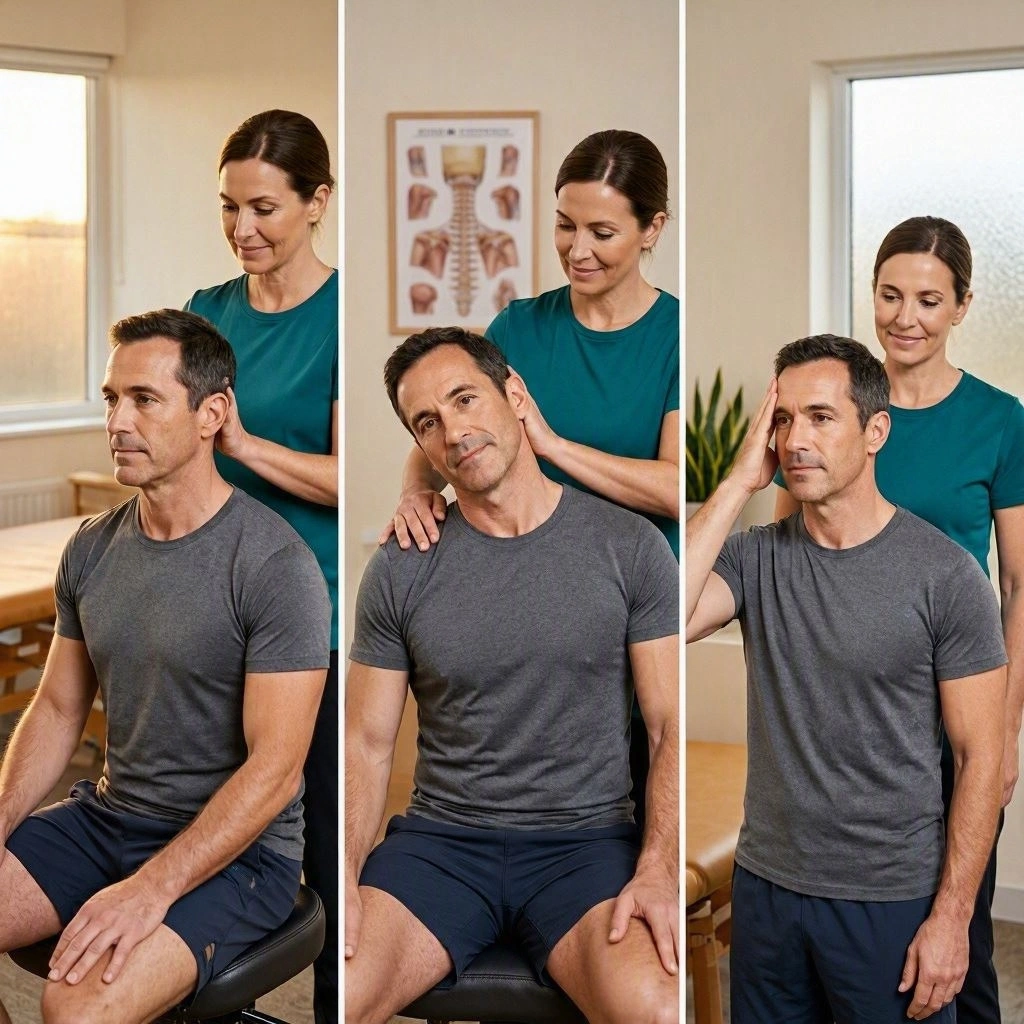
2. Neck Side-Bending Exercise
Side bending involves gently bringing your ear toward your shoulder.
How to perform it
Sit upright.
Keep your shoulders relaxed.
Slowly move your right ear toward your right shoulder.
Return to the center.
Repeat on the left side.
Do not lift the shoulder toward the ear.
Important point
You should not force the movement with your hand. A gentle range is usually sufficient.
3. Chin Tucks (Best Exercises for Neck Pain)
Chin tucks are commonly used in neck rehabilitation programs.
They can help people practice controlled positioning of the head and neck.
How to perform a chin tuck
Sit or stand comfortably.
Look straight ahead.
Gently draw your chin backward.
Keep your head relatively level.
Hold briefly.
Relax.
The movement should resemble creating a small double chin.
Avoid pushing your head aggressively backward.
Why chin tucks are useful
Chin tucks can help develop awareness and control of head and neck positioning.
They may be particularly useful for people who spend extended periods working at computers.
4. Neck Isometric Flexion
Isometric exercises strengthen muscles without requiring significant movement.
How to perform it
Place your palm against your forehead.
Gently press your head forward.
Use your hand to resist the movement.
Do not allow your head to move significantly.
Hold briefly.
Relax.
The effort should be controlled rather than maximal.
5. Neck Isometric Extension
This exercise works the muscles involved in extending the neck.
How to perform it
Place your hands behind your head.
Gently press your head backward.
Resist the movement with your hands.
Keep the head relatively stationary.
Hold briefly.
Relax.
Avoid excessive force.
6. Isometric Side Resistance
This exercise can target the muscles responsible for side bending.
How to perform it
Place your right hand against the right side of your head.
Gently attempt to move your head toward your hand.
Resist the movement with your hand.
Hold briefly.
Relax.
Repeat on the other side.
Keep your shoulders relaxed throughout the exercise.
7. Neck Rotation Isometric Exercise
Rotation strengthening can also be performed without significant movement.
How to perform it
Place your hand against one side of your head.
Gently attempt to rotate your head toward your hand.
Resist the movement.
Keep your head relatively still.
Relax.
Repeat on the opposite side.
Use light resistance and controlled effort.
8. Upper Trapezius Stretch
The upper trapezius muscles are located around the neck and upper shoulder.
When these muscles feel tight, gentle stretching may provide temporary relief.
How to perform it
Sit comfortably.
Keep one shoulder relaxed.
Slowly tilt your head toward the opposite side.
Hold the comfortable stretch.
Return to the center.
Repeat on the other side.
Do not pull aggressively on your head.
9. Levator Scapulae Stretch (Best Exercises for Neck Pain)
The levator scapulae connects the upper shoulder region with the neck.
How to perform it
Sit comfortably.
Turn your head slightly toward one side.
Gently look downward.
Allow the neck to move into a comfortable stretch.
Hold briefly.
Return to the starting position.
The stretch should remain gentle.
10. Chest Stretch
Neck discomfort can sometimes occur alongside tightness in the chest and shoulders.
A chest stretch may help improve upper-body mobility.
How to perform it
Stand in a doorway.
Place your forearms against the frame and gently move your body forward.
Keep the movement comfortable.
Do not force your shoulders backward.
11. Shoulder Blade Squeezes
Shoulder blade exercises can help improve upper-back muscle activation.
How to perform them
Sit or stand upright.
Keep your arms relaxed.
Gently draw your shoulder blades toward each other.
Hold briefly.
Relax.
Avoid shrugging your shoulders.
Why they matter
Improving upper-back strength can complement neck rehabilitation, especially for people who spend significant time sitting.
12. Resistance Band Rows
Rows are an excellent general upper-back strengthening exercise.
How to perform them
Secure a resistance band appropriately.
Hold the handles or band.
Keep your shoulders relaxed.
Pull your elbows backward.
Gently squeeze your shoulder blades.
Slowly return to the starting position.
Avoid using excessive resistance.
13. Wall Angels (Best Exercises for Neck Pain)
Wall exercises can help develop upper-body movement control.
How to perform wall angels
Stand with your back near a wall.
Position your arms comfortably.
Slowly move your arms upward.
Return them downward.
Maintain controlled movement.
Do not force your shoulders or neck against the wall.
If the movement causes discomfort, reduce the range.
14. Thoracic Extension
The upper back plays an important role in neck and shoulder movement.
How to perform it
Sit in a stable chair.
Place your hands comfortably behind your head or across your chest.
Gently extend through the upper back while keeping the movement controlled.
Avoid forcing the neck backward.
Why it may help
Improving upper-back mobility can provide greater movement options for the neck and shoulders.
15. Seated Thoracic Rotation
This exercise focuses on upper-back rotation.
How to perform it
Sit upright.
Place your arms across your chest.
Slowly rotate your upper body toward one side.
Return to the center.
Rotate toward the opposite side.
Try to allow the upper back to perform most of the movement.
16. Bird Dog
The bird dog is a core and whole-body stability exercise.
How to perform it
Start on your hands and knees.
Keep your spine comfortable.
Extend one arm and the opposite leg.
Hold briefly.
Return to the starting position.
Repeat on the opposite side.
Avoid lifting the head excessively.
Keep the neck in a comfortable position.
17. Dead Bug
The dead bug can help develop core control.
How to perform it
Lie on your back.
Bend your knees.
Position your arms comfortably.
Slowly move one arm and the opposite leg.
Return to the starting position.
Alternate sides.
Keep your neck relaxed.
18. Bridge Exercise
Bridges strengthen the hips and contribute to general physical conditioning.
How to perform it
Lie on your back.
Bend your knees.
Place your feet comfortably on the floor.
Gently lift your hips.
Pause briefly.
Lower slowly.
Keep your head and neck relaxed.
19. Walking for Neck Health (Best Exercises for Neck Pain)
Walking may seem unrelated to neck pain, but maintaining general physical activity is an important part of rehabilitation.
it can help reduce prolonged sitting and encourage movement throughout the day.
You can start with short walks and gradually increase duration according to your tolerance.
20. Gentle Shoulder Rolls
Shoulder rolls are a simple movement exercise.
How to perform them
Sit or stand comfortably.
Slowly move your shoulders upward.
Move them backward.
Lower them.
Repeat in a controlled circular movement.
Avoid performing the movement aggressively.
Best Exercises for Neck Pain From Computer Use
Computer users often spend hours in one position.
A useful exercise routine may include:
Chin tucks
Neck rotation
Neck side bending
Shoulder blade squeezes
Resistance-band rows
Chest stretching
Thoracic mobility
However, exercises should not be the only strategy.
Regular movement breaks are equally important.
Stand up, walk around, change positions, and give your eyes and body a break from the screen.
Best Exercises for Tech Neck (Best Exercises for Neck Pain)
“Tech neck” is commonly used to describe neck discomfort associated with prolonged device use.
Helpful exercises may include:
Chin tucks
Upper-back strengthening
Thoracic mobility
Shoulder blade exercises
Chest stretching
Neck mobility
The most important strategy is to avoid spending excessive time in one static position.
Best Exercises for Neck and Shoulder Pain
When neck and shoulder pain occur together, treatment may involve both regions.
A balanced routine could include:
Neck rotation
Chin tucks
Shoulder blade squeezes
Resistance-band rows
Chest stretching
Thoracic rotation
Gentle walking
The exact program should be adjusted according to the cause of the symptoms.
Best Exercises for Stiff Neck
For a stiff neck, gentle mobility may be a useful starting point.
Consider:
Slow neck rotation
Gentle side bending
Controlled flexion
Shoulder movements
Walking
Avoid aggressive stretching.
If stiffness persists or becomes progressively worse, consider professional assessment.
Exercises for Chronic Neck Pain (Best Exercises for Neck Pain)
Chronic neck pain may require a more structured rehabilitation program.
Instead of only stretching, the program may include:
Strength training
Endurance training
Mobility
Postural endurance
Upper-back strengthening
Core conditioning
Functional exercises
The goal is to gradually increase the body’s ability to tolerate everyday activities.
How Often Should You Do Neck Exercises?
There is no universal exercise frequency that works for everyone.
A rehabilitation program may include short mobility sessions performed regularly, combined with strengthening sessions several times per week.
The appropriate frequency depends on:
Symptoms
Exercise intensity
Fitness level
Recovery
Underlying condition
Professional recommendations
Consistency is generally more important than doing a large amount of exercise occasionally.
How Many Repetitions Should You Do?
The number of repetitions depends on the exercise.
Mobility exercises are often performed with controlled repetitions rather than maximal effort.
Strengthening exercises can be progressed gradually as tolerance improves.
A physiotherapist can provide individualized sets, repetitions, resistance, and progression.
Should Neck Exercises Hurt?
Exercises should not be forced through significant pain.
Mild muscular effort or a gentle stretch can be normal, but sharp, severe, or unusual symptoms should not be ignored.
Stop the exercise if it causes:
Significant pain
Increasing numbness
Tingling
Weakness
Dizziness
Severe headache
Loss of coordination
If these symptoms occur, seek professional advice.
Progressing Neck Exercises
Once basic exercises become comfortable, rehabilitation can gradually become more challenging.
Progression may involve:
More repetitions
Longer holds
Increased resistance
More complex movements
Greater endurance demands
Functional exercises
Progress gradually rather than changing several variables at once.
Exercise and Posture (Best Exercises for Neck Pain)
Exercises can improve strength and movement control, but posture should not be treated as something that must remain perfectly fixed all day.
Instead, focus on:
Movement variety
Strength
Endurance
Comfortable positioning
Regular breaks
The ability to change positions may be more useful than maintaining one rigid posture.
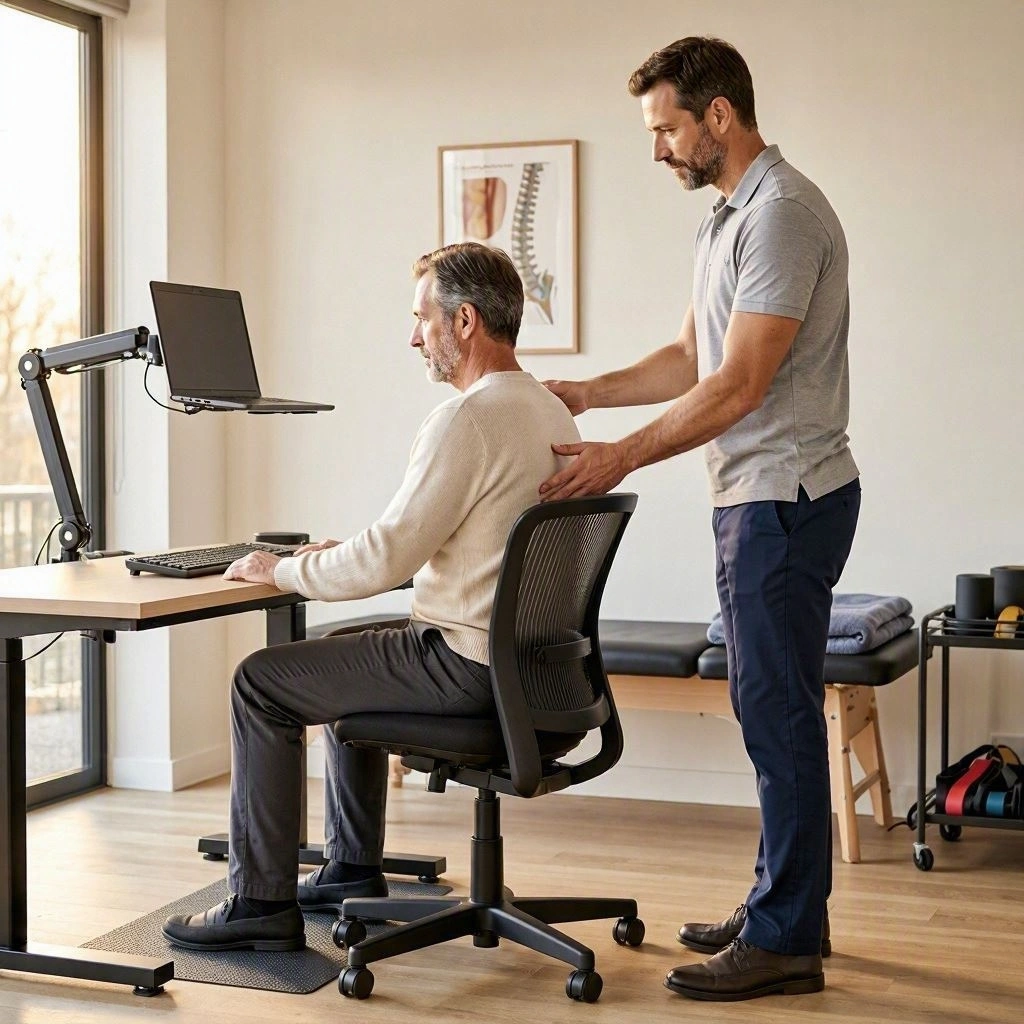
Neck Exercises and Workplace Ergonomics
Exercise works best when combined with appropriate daily habits.
If your work requires long periods at a desk:
Position your monitor comfortably.
Keep frequently used items within easy reach.
Use a comfortable chair.
Take regular movement breaks.
Avoid prolonged phone use in one position.
These strategies can reduce the amount of stress placed on your body during the workday.
Neck Exercises After an Injury (Best Exercises for Neck Pain)
Exercise after an injury should be introduced carefully.
Following a significant accident, seek appropriate medical evaluation before beginning an independent rehabilitation program.
After assessment, a physiotherapist may gradually introduce:
Mobility exercises
Isometric strengthening
Shoulder exercises
Upper-back strengthening
Functional training
Progress should depend on recovery and symptoms.
Neck Exercises for Athletes
Athletes may need additional neck strength and endurance because their sport can involve rapid movements, contact, or prolonged positions.
A sports rehabilitation program may include:
Neck strengthening
Shoulder conditioning
Upper-back exercises
Core stability
Movement control
Sport-specific exercises
Training should be appropriate for the athlete’s sport and experience.
Neck Exercises for Older Adults
Older adults can also benefit from appropriate neck and upper-body exercise.
The focus may include:
Gentle mobility
Strength
Balance
General physical activity
Functional movement
Exercises should be adapted to the individual’s health, fitness, and mobility.
When to Avoid Exercising the Neck (Best Exercises for Neck Pain)
Independent exercise may not be appropriate when neck pain is accompanied by serious symptoms.
Seek professional assessment if you experience:
Significant weakness
Persistent numbness
Severe radiating pain
Major trauma
Loss of coordination
Difficulty walking
Severe unexplained pain
Some conditions require diagnosis before exercise can safely be prescribed.
When Should You See a Physiotherapist?
Consider consulting a physiotherapist if your neck pain:
Does not improve
Keeps returning
Limits your movement
Affects your work
Interferes with sleep
Prevents exercise
Causes arm symptoms
A physiotherapist can assess your movement and create a customized exercise program.
When to Seek Urgent Medical Attention
Some symptoms require urgent medical care.
Seek urgent attention if neck pain occurs with:
Severe pain after major trauma
Sudden weakness
Significant loss of sensation
Difficulty walking
Loss of coordination
Loss of bladder or bowel control
Severe headache with neurological symptoms
Difficulty speaking
Sudden vision changes
Loss of consciousness
These symptoms should not be assumed to be simple muscle tension.
Sample Beginner Neck Exercise Routine (Best Exercises for Neck Pain)
A general beginner routine might include:
1: Neck Rotation
Perform slow, comfortable rotations.
2: Chin Tucks
Practice controlled head positioning.
3: Shoulder Blade Squeezes
Activate the upper-back muscles.
4: Gentle Side Bending
Move through a comfortable range.
5: Thoracic Rotation
Improve upper-back mobility.
6: Walking
Add regular physical activity throughout the day.
This is a general example, not a personalized rehabilitation prescription.
Sample Intermediate Neck Strengthening Routine
For someone who has progressed beyond basic mobility, a routine might include:
Chin tucks
Neck isometrics
Resistance-band rows
Shoulder strengthening
Thoracic mobility
Core exercises
Walking or other cardiovascular activity
The resistance and volume should be increased gradually.
Common Mistakes When Exercising With Neck Pain (Best Exercises for Neck Pain)
Forcing the Range of Motion
More movement is not always better.
Exercising Through Severe Pain
Pain should not be ignored when it is sharp, severe, or associated with neurological symptoms.
Doing Only Stretching
Strength and endurance may also be important.
Ignoring the Upper Back
Neck function is connected to the shoulders and thoracic spine.
Exercising Too Much Too Soon
Rapid increases in training can aggravate symptoms.
Staying Completely Inactive
Avoiding movement for extended periods may contribute to stiffness and reduced physical capacity.
How Physiotherapy Can Improve Neck Exercise Programs
A physiotherapist can help determine which exercises are appropriate for your specific condition.
Treatment may involve:
Physical assessment
Therapeutic exercise
Manual therapy
Mobility training
Strengthening
Ergonomic education
Movement retraining
Functional rehabilitation
The advantage of individualized treatment is that exercises can be adjusted based on your response.
Final Thoughts (Best Exercises for Neck Pain)
The best exercises for neck pain are those that match your symptoms, physical condition, and rehabilitation goals.
For many people, a combination of gentle neck mobility, chin tucks, strengthening exercises, upper-back conditioning, shoulder exercises, and general physical activity can help improve neck function.
Exercises should be performed gradually and consistently rather than aggressively. Mobility work can help maintain comfortable movement, while strengthening can improve the neck and upper body’s ability to tolerate everyday demands.
It is also important to look beyond exercise. If computer use, prolonged sitting, smartphone use, poor sleep, or repetitive activities contribute to your symptoms, modifying these factors can make your exercise program more effective.
Physiotherapy can be especially useful when symptoms persist, repeatedly return, or interfere with daily activities. A qualified physiotherapist can assess your neck, shoulders, upper back, movement patterns, strength, and functional requirements before developing a personalized rehabilitation plan.
Most importantly, exercise should be appropriate for your condition. Significant trauma, persistent numbness, weakness, severe radiating symptoms, coordination problems, or other neurological warning signs require professional medical assessment rather than an independent exercise program.
With a gradual approach that combines mobility, strength, endurance, healthy movement habits, and professional guidance when necessary, exercise can become an important part of maintaining a healthier and more functional neck.