Advanced Sports Physiotherapy: A Complete Guide to Athletic Recovery, Performance, and Injury Prevention
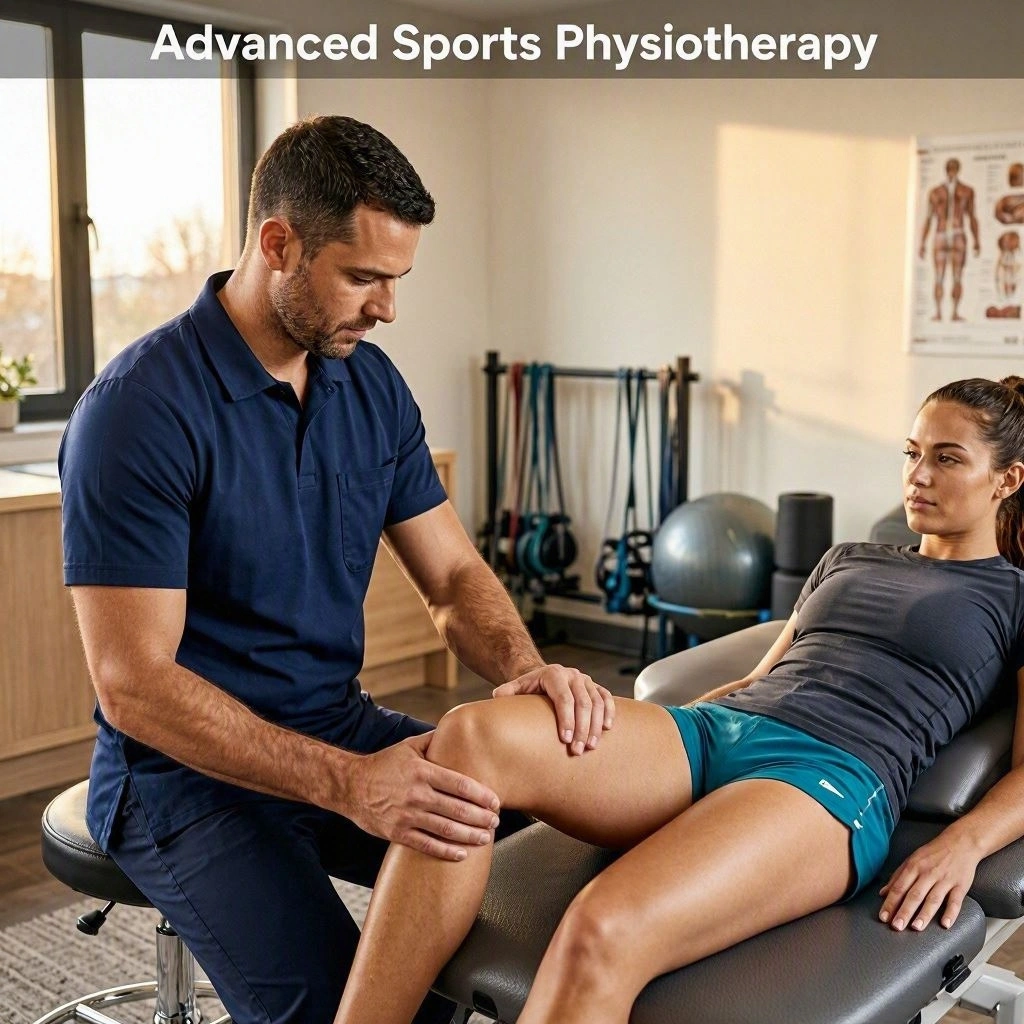
Advanced sports physiotherapy is a specialized approach to rehabilitation designed to help athletes and active individuals recover from injuries, restore physical capacity, improve movement, and safely return to their desired activities. Sports place specific demands on the body, including repeated acceleration, jumping, running, changing direction, lifting, and high-intensity movement. Effective rehabilitation therefore needs to address more than pain alone.
A comprehensive sports physiotherapy program can assess strength, mobility, balance, coordination, endurance, movement control, and sport-specific performance. Treatment may combine therapeutic exercise, progressive resistance training, mobility work, manual therapy, movement retraining, balance exercises, conditioning, and return-to-sport testing.
The goal is to create a progressive pathway from injury recovery toward confident participation in training and competition.
What Is Advanced Sports Physiotherapy?
Advanced sports physiotherapy focuses on the assessment and rehabilitation of sports-related injuries and performance limitations.
It may be appropriate for:
Professional athletes
Competitive athletes
Recreational athletes
Runners
Gym users
Team-sport players
Fitness enthusiasts
Active adults
Treatment is personalized according to the athlete’s condition, sport, training schedule, physical abilities, and goals.
Unlike a general rehabilitation program, sports physiotherapy often considers the specific physical demands an athlete must meet before returning to full participation.
Why Sports Physiotherapy Requires a Specialized Approach
Different sports place different demands on the body.
A football player may need repeated sprinting, rapid changes of direction, and kicking. A tennis player may require rotational power, agility, and overhead movement. A runner may require repeated impact tolerance and endurance.
Therefore, rehabilitation should eventually reflect the demands of the athlete’s activity.
A comprehensive assessment may consider:
Strength
Power
Mobility
Balance
Coordination
Speed
Agility
Endurance
Movement control
Sports Injury Assessment (Advanced Sports Physiotherapy)
A detailed assessment is an important first step.
The physiotherapist may review:
Injury history
Current symptoms
Training habits
Previous injuries
Movement patterns
Muscle strength
Joint mobility
Balance
Functional performance
Depending on the injury, specific tests may be used to evaluate the affected body part.
The assessment creates a starting point for rehabilitation and helps determine appropriate exercise progression.
Common Sports Injuries
Athletes can experience many different types of injuries.
Common examples include:
Muscle strains
Ligament injuries
Tendon problems
Joint injuries
Stress-related conditions
Overuse injuries
Sprains
Running-related injuries
Shoulder injuries
Knee injuries
Ankle injuries
The rehabilitation approach depends on the type and severity of the injury.
Acute Sports Injury Rehabilitation
Early rehabilitation focuses on protecting the injured area while maintaining appropriate movement and physical activity when possible.
Depending on the injury, treatment may include:
Appropriate activity modification
Gentle movement
Progressive loading
Strength exercises
Education
Functional rehabilitation
The goal is not necessarily complete rest.
In many situations, appropriately dosed movement and loading can be gradually reintroduced according to symptoms and tissue recovery.
Progressive Loading (Advanced Sports Physiotherapy)
Progressive loading is central to many sports rehabilitation programs.
The body adapts to physical demands when training is appropriately structured.
Progression may involve increasing:
Resistance
Repetitions
Exercise range
Speed
Training duration
Movement complexity
Sport-specific demands
Progression should be based on the athlete’s current capacity rather than an arbitrary schedule.
Strength Training for Athletes
Strength is an important component of athletic performance and rehabilitation.
Sports physiotherapy may use exercises targeting:
Quadriceps
Hamstrings
Glutes
Calves
Core
Back
Shoulders
Chest
Arms
Exercises can include:
Squats
Lunges
Deadlifts
Step-ups
Split squats
Resistance-band exercises
Calf raises
Pressing movements
Pulling movements
Training should be adapted to the athlete’s sport and rehabilitation stage.
Strength Testing (Advanced Sports Physiotherapy)
Strength testing can help identify differences between sides or muscle groups.
Depending on the clinic, assessment may involve:
Manual muscle testing
Functional strength tests
Resistance exercises
Dynamometry
Repetition-based testing
Testing can provide useful information for monitoring progress.
However, strength results should be interpreted alongside symptoms, movement quality, and functional performance.
Mobility for Athletic Performance
Adequate mobility can help athletes perform many movements effectively.
Important areas may include:
Ankles
Hips
Thoracic spine
Shoulders
Wrists
Mobility requirements vary between sports.
For example, overhead athletes may have different mobility requirements from runners.
A physiotherapist can identify relevant restrictions and prescribe targeted mobility exercises.
Balance and Proprioception
Balance and proprioception contribute to athletic movement.
They can be particularly important after injuries involving the:
Ankle
Knee
Hip
Lower limb
Exercises may include:
Single-leg standing
Balance-board activities
Reaching drills
Dynamic stepping
Landing exercises
The difficulty can be increased gradually.
Core Stability for Athletes (Advanced Sports Physiotherapy)
Core stability contributes to the control of the trunk during movement.
Athletic core training may include:
Planks
Side planks
Bird dogs
Dead bugs
Carries
Rotational exercises
Anti-rotation exercises
The objective is not simply to develop abdominal strength but to improve trunk control during sport-specific movements.
Running Rehabilitation
Running rehabilitation may be necessary following lower-limb injuries or periods of reduced activity.
A gradual program may progress from:
Walking
Walk-jog intervals
Continuous jogging
Controlled running
Faster running
Acceleration
Sport-specific running
The progression depends on the athlete’s injury and physical readiness.
Jumping and Landing Training
Jumping and landing are important for many sports.
Rehabilitation may begin with controlled movements and progress toward:
Bilateral jumping
Single-leg jumping
Vertical jumps
Horizontal jumps
Landing drills
Repeated jumps
The physiotherapist may evaluate movement control and confidence.
Agility Training (Advanced Sports Physiotherapy)
Many sports require rapid changes in direction.
Agility rehabilitation may include:
Side-to-side movements
Shuttle drills
Cone drills
Deceleration exercises
Direction changes
Reactive movement
These activities can gradually prepare athletes for unpredictable sporting situations.
Speed and Acceleration Training
Athletes returning to sport may need to rebuild speed gradually.
Training can progress from controlled movement toward:
Acceleration
Sprinting
Deceleration
Repeated sprinting
Speed training should be introduced when the athlete has sufficient strength, control, and tolerance for higher loads.
Return-to-Sport Rehabilitation
Returning to sport is a major goal of sports physiotherapy.
However, being pain-free does not necessarily mean an athlete is ready for full competition.
Return-to-sport decisions may consider:
Strength
Mobility
Balance
Power
Agility
Endurance
Sport-specific performance
Psychological readiness
Training tolerance
The process should be individualized.
Return-to-Training Progression
An athlete may return to training in stages.
For example:
Stage One: Individual Training
Controlled exercises with limited intensity.
Stage Two: Modified Team Training
Participation with reduced contact or intensity where appropriate.
Stage Three: Full Training
Normal training demands.
Stage Four: Competition
Gradual return to competitive activity.
The exact progression depends on the sport and injury.
Injury Prevention
Advanced sports physiotherapy can also support injury-prevention strategies.
Potential areas include:
Strength
Mobility
Balance
Conditioning
Training-load management
Movement technique
Recovery strategies
No program can guarantee complete injury prevention.
However, improving physical preparation can help athletes better tolerate their sporting demands.
Managing Training Load
Training load is an important consideration in sports rehabilitation.
A sudden increase in training volume or intensity can place additional stress on the body.
Physiotherapists may help athletes consider:
Training frequency
Training duration
Exercise intensity
Competition schedules
Recovery periods
Training should be progressed according to the athlete’s current capacity.
Overuse Injuries (Advanced Sports Physiotherapy)
Overuse injuries can develop when repeated physical stress exceeds the body’s ability to recover and adapt.
Examples may include certain tendon and bone stress conditions.
Management may involve:
Temporary activity modification
Strength training
Mobility exercises
Gradual reloading
Conditioning
Return-to-sport progression
The goal is to gradually rebuild tolerance rather than simply stopping activity indefinitely.
Tendon Rehabilitation
Tendon problems often require progressive loading.
A rehabilitation program may progress through different forms of resistance exercise depending on the individual’s condition.
Exercises can include:
Isometric exercises
Slow resistance training
Functional strengthening
Sport-specific loading
Progress should be based on symptoms and physical capacity.
Muscle Injury Rehabilitation
Muscle strains are common in sports.
Rehabilitation may involve:
Controlled mobility
Progressive strengthening
Functional movement
Running progression
Sport-specific drills
The athlete can gradually return to higher-speed and higher-load activities.
Knee Injury Rehabilitation (Advanced Sports Physiotherapy)
Knee injuries can significantly affect athletic performance.
Rehabilitation may focus on:
Quadriceps strength
Hamstring strength
Hip strength
Balance
Mobility
Landing control
Running
Agility
More demanding activities can be introduced as the athlete progresses.
Ankle Injury Rehabilitation
Ankle injuries can affect balance, strength, mobility, and confidence.
Physiotherapy may include:
Ankle mobility
Calf strengthening
Single-leg balance
Dynamic stability
Jumping
Running
The goal is to restore both physical capacity and confidence.
Shoulder Rehabilitation for Athletes
Shoulder rehabilitation is particularly important for athletes involved in:
Tennis
Swimming
Volleyball
Baseball
Basketball
Weightlifting
Treatment may address:
Shoulder strength
Rotator cuff function
Scapular control
Thoracic mobility
Overhead tolerance
Sport-specific exercises can be introduced gradually.
Manual Therapy in Sports Physiotherapy
Manual therapy may be used alongside active rehabilitation.
Techniques can address temporary limitations involving:
Joint mobility
Soft tissue
Muscle tension
Manual therapy should generally complement rather than replace strengthening and functional rehabilitation.
Recovery and Conditioning
Recovery is an important part of athletic rehabilitation.
Athletes need appropriate:
Sleep
Rest
Nutrition
Hydration
Training management
Physiotherapists may provide general guidance on activity progression and recovery, while nutrition-specific concerns should be addressed by appropriately qualified professionals.
Sports Physiotherapy and Performance
Sports physiotherapy can contribute to performance by helping athletes address physical limitations.
Potential areas include:
Strength
Mobility
Balance
Movement efficiency
Conditioning
Injury rehabilitation
Performance training should remain appropriate to the athlete’s sport and training environment.
Technology in Advanced Sports Physiotherapy (Advanced Sports Physiotherapy)
Modern sports rehabilitation may use technology to support assessment.
Depending on the facility, this can include:
Video movement analysis
Force measurements
Jump testing
Running analysis
Wearable sensors
Digital strength testing
Technology can provide useful data, but results should be interpreted within the context of the athlete’s overall clinical assessment.
Home Exercises for Athletes
Athletes may receive exercises to complete between physiotherapy appointments.
These may include:
Strength exercises
Mobility drills
Balance exercises
Core training
Running drills
The program should complement the athlete’s existing training schedule.
Psychological Readiness (Advanced Sports Physiotherapy)
Physical recovery is only one part of returning to sport.
Some athletes may feel nervous about reinjury after returning to competition.
Confidence can influence movement and performance.
Communication between the athlete, physiotherapist, coach, and other relevant professionals can help create a structured return-to-sport plan.
Psychological concerns that significantly affect recovery may require support from an appropriately qualified mental health professional.
How Long Does Sports Physiotherapy Take?
Recovery timelines vary considerably.
Factors include:
Injury type
Injury severity
Previous injuries
Age
Training history
General health
Rehabilitation consistency
Sport demands
A minor injury may require a relatively short rehabilitation period, while significant injuries can require months of progressive rehabilitation.
A fixed timeline should not be assumed for every athlete.
Measuring Athletic Recovery
Progress can be measured through:
Strength
Mobility
Balance
Jump performance
Running tolerance
Agility
Exercise capacity
Sport-specific drills
Functional testing can help determine whether the athlete is ready to progress.
Testing should be combined with clinical judgment rather than used as the sole basis for return-to-sport decisions.
Choosing an Advanced Sports Physiotherapist (Advanced Sports Physiotherapy)
When selecting a sports physiotherapist, consider their:
Qualifications
Sports rehabilitation experience
Experience with your specific injury
Assessment methods
Rehabilitation approach
Communication style
Experience with athletes
It can also be helpful to ask how they coordinate rehabilitation with coaches, doctors, strength coaches, or other professionals when necessary.
When Should an Athlete See a Physiotherapist?
A physiotherapy assessment may be appropriate for:
Persistent sports pain
Recurrent injuries
Muscle strains
Joint injuries
Reduced athletic performance
Difficulty returning to training
Movement limitations
Strength deficits
Balance problems
Early professional assessment can help identify appropriate rehabilitation strategies.
Warning Signs Requiring Medical Evaluation
Certain symptoms require medical attention rather than routine sports rehabilitation.
These include:
Severe pain after major trauma
Sudden loss of strength
Significant deformity
Loss of consciousness
Chest pain
Difficulty breathing
Sudden neurological symptoms
Severe swelling following an injury
A medical professional should assess serious or unexplained symptoms.
Conclusion (Advanced Sports Physiotherapy)
Advanced sports physiotherapy provides a structured approach to helping athletes recover from injury, rebuild physical capacity, and safely return to training and competition. Unlike rehabilitation focused only on pain reduction, sports physiotherapy considers the complete physical demands of athletic performance.
Treatment may include progressive strength training, mobility exercises, balance work, running rehabilitation, jumping and landing drills, agility training, conditioning, functional movement, and sport-specific exercises. Manual therapy and technology-assisted assessment may also be incorporated when appropriate.
Successful rehabilitation is usually progressive. Athletes need to rebuild physical capacity step by step rather than immediately returning to the highest level of activity.
A strong return-to-sport program considers strength, mobility, power, balance, endurance, movement control, training tolerance, and sport-specific demands. It may also consider confidence and psychological readiness.
Whether an athlete is recovering from a muscle strain, ligament injury, tendon problem, knee injury, ankle injury, or postoperative procedure, individualized rehabilitation can provide a clear pathway toward returning to activity.
The ultimate objective of advanced sports physiotherapy is not simply to get an athlete moving again. It is to help the athlete develop the physical capacity and confidence required to participate in their chosen sport as safely and effectively as possible.