Chiropractic Spinal Adjustment: Complete Guide to Techniques, Benefits, and Safety
Back pain, neck stiffness, restricted movement, and joint discomfort can make everyday activities more difficult. Sitting at a desk, exercising, lifting objects, driving, or even sleeping can become uncomfortable when the spine and surrounding joints are not moving well. One treatment that is commonly used in chiropractic care is a chiropractic spinal adjustment.
A chiropractic spinal adjustment is a hands-on technique in which a trained practitioner applies a controlled force or movement to a spinal joint. The purpose is generally to influence joint movement and function rather than simply provide temporary comfort. Depending on the individual’s condition, spinal manipulation may be used alongside exercise, mobility work, education, and other conservative approaches.
However, a spinal adjustment is not appropriate for everyone, and it should not be treated as a universal solution for every type of back or neck pain. A proper assessment is important before treatment so that the practitioner can understand the patient’s symptoms, medical history, physical condition, and goals.
Research summarized by the National Center for Complementary and Integrative Health (NCCIH) suggests that spinal manipulation may produce small improvements in pain and function for some people with acute or chronic low-back pain. Evidence for neck pain also suggests potential benefits, although the quality and consistency of research varies.
This guide explains what a chiropractic spinal adjustment is, how it works, what to expect during treatment, potential benefits, safety considerations, and how adjustments can fit into a broader rehabilitation plan.
What Is a Chiropractic Spinal Adjustment?
A chiropractic spinal adjustment is a manual technique used to influence the movement of a joint in the spine.
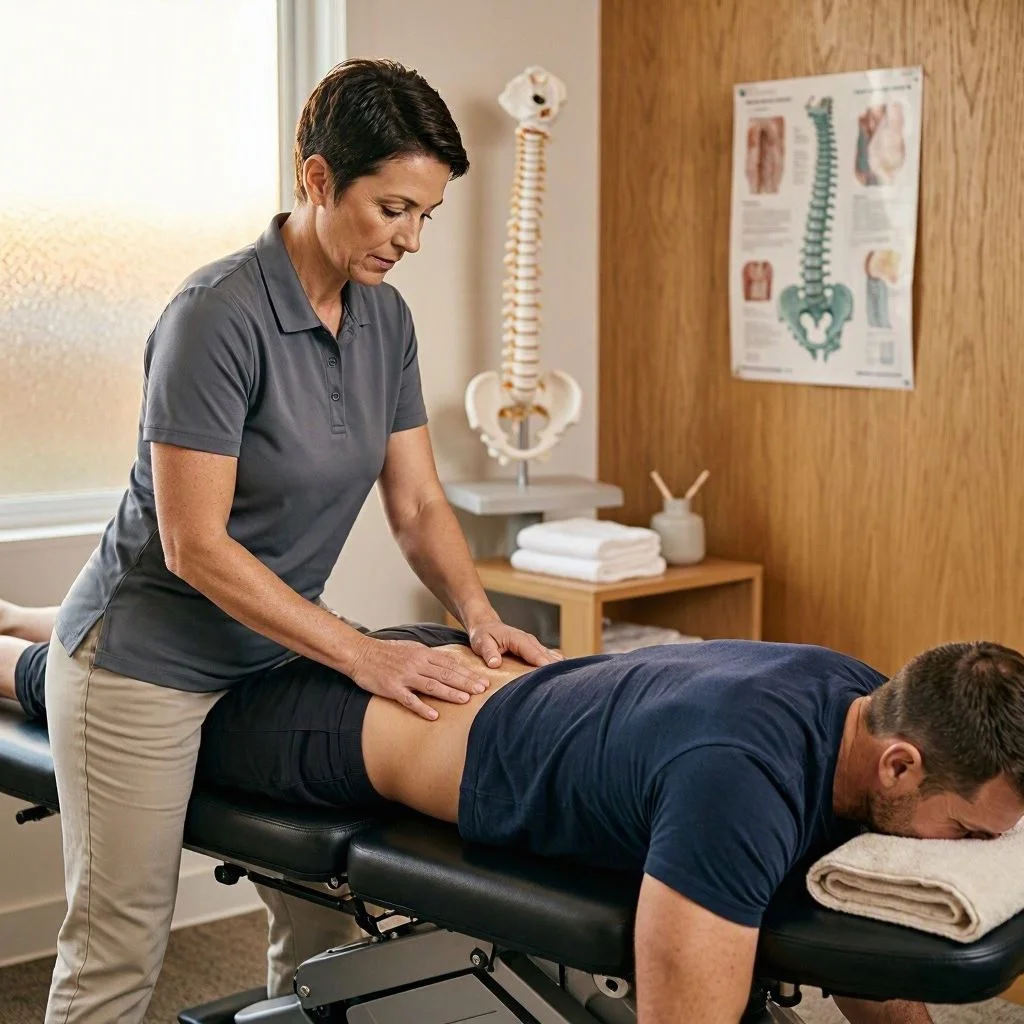
The practitioner may use their hands or, in some cases, an instrument to apply a controlled force to a specific joint. The technique may be quick and precise, or it may involve slower and more gentle movements depending on the patient’s condition and the approach being used.
NCCIH defines spinal manipulation as a technique in which a practitioner uses their hands or a device to apply a controlled thrust to a spinal joint. The force can move the joint farther than it would move on its own.
Spinal manipulation is different from spinal mobilization.
Spinal Adjustment vs. Spinal Mobilization
Both techniques are manual approaches, but they are not exactly the same.
Spinal manipulation generally involves a controlled thrust delivered to a joint.
Spinal mobilization uses controlled movement within the joint’s available range and does not involve the same type of thrust.
A chiropractor may choose one technique, the other, or a combination depending on the patient’s presentation.
This distinction is important because not every patient requires a high-velocity adjustment. Some people may respond better to gentler mobilization, exercise, or other forms of conservative care.
How Does a Chiropractic Spinal Adjustment Work?
The spine consists of multiple vertebrae connected by joints, discs, ligaments, and surrounding muscles. These structures work together to allow the body to bend, rotate, extend, and support everyday movement.
When a person develops pain or stiffness, movement can change.
For example, someone with lower back discomfort may begin avoiding certain movements. A person with neck pain may rotate their head less because movement feels uncomfortable. These changes can influence surrounding muscles and joints.
A chiropractic adjustment is intended to influence joint movement and may temporarily change how the surrounding tissues and nervous system respond to mechanical input.
The exact biological mechanisms behind spinal manipulation are complex and are not completely understood.
Therefore, it is more accurate to describe an adjustment as a technique that may influence pain, joint movement, and physical function rather than claiming that it physically “puts every vertebra back into place.”
A modern treatment plan should focus on the patient’s symptoms, function, and goals rather than relying on the idea that every pain problem is caused by a single “misaligned” bone.
What Happens During a Chiropractic Spinal Adjustment?
Before an adjustment, a chiropractor should assess whether the technique is appropriate.
The first appointment may involve questions about:
- Your main symptoms
- When the problem started
- Previous injuries
- Current medications
- Medical conditions
- Previous surgeries
- Physical activity
- Work requirements
- Previous treatment
- Your goals
A physical assessment may then examine:
- Spinal movement
- Joint mobility
- Muscle function
- Strength
- Balance
- Posture
- Functional movement
- Areas of tenderness or discomfort
The purpose of this assessment is to determine whether chiropractic care is appropriate and which treatment approach may be suitable.
At Ritz Clinic’s chiropractic service, chiropractic care is described as an individualized approach that can include spinal adjustments, joint mobilization, soft-tissue techniques, postural assessment, and exercise depending on the patient’s needs.
After assessment, the chiropractor may explain the treatment plan before performing an adjustment.
What Does a Spinal Adjustment Feel Like?
People experience adjustments differently.
During some techniques, a person may feel a brief movement or pressure around a joint. Some spinal manipulation techniques can also produce a popping or cracking sound.
This sound is not necessarily evidence that a bone has “gone back into place.”
It can be associated with rapid changes in pressure within a joint and the release of gas from joint fluid.
The adjustment itself is usually brief.
Afterward, some people report feeling looser or noticing temporary changes in movement. Others may experience mild soreness, stiffness, or discomfort.
NCCIH reports that temporary mild-to-moderate effects such as increased pain or discomfort, stiffness, or headache can occur after spinal manipulation, and these effects commonly resolve within about 24 hours.
Potential Benefits of Chiropractic Spinal Adjustment
The potential benefits depend on the condition being treated and the individual patient.
Improving Spinal Mobility
One reason people seek chiropractic treatment is restricted spinal movement.
An adjustment may temporarily improve movement in a joint and make certain movements feel easier.
However, mobility improvements are only one part of rehabilitation.
If stiffness is related to weakness, inactivity, poor movement habits, or another underlying issue, exercise and movement training may also be necessary.
Supporting Back Pain Management
Low-back pain is one of the most commonly researched applications of spinal manipulation.
NCCIH reports that spinal manipulation may result in small improvements in both pain and function for people with acute or chronic low-back pain.
Function can include activities such as:
- Walking
- Standing
- Sleeping
- Working
- Household activities
- Exercising
The goal is therefore not necessarily to eliminate every sensation of pain but to help the person function better.
Supporting Neck Pain Management
Spinal manipulation or mobilization may also be used for some forms of neck pain.
Research summarized by NCCIH suggests that manipulation may help some people with acute neck pain and that manipulation or mobilization may provide benefits for chronic neck pain. However, evidence quality varies.
Because the cervical spine is close to important blood vessels and neurological structures, careful assessment is especially important before any neck manipulation.
Reducing Stiffness
Joint stiffness can affect daily movement.
A person may notice stiffness when:
- Getting out of bed
- Turning their head
- Standing after sitting
- Bending forward
- Rotating the trunk
- Exercising
Manual treatment may temporarily improve mobility, particularly when combined with active movement.
Supporting Functional Movement
Improved movement can make everyday tasks easier.
For example, someone with back stiffness may find it easier to bend or rotate after treatment.
However, lasting improvements in function generally require more than passive treatment alone.
Strengthening and movement practice can help the person use the improved mobility during everyday activities.
Chiropractic Spinal Adjustment for Back Pain
Lower back pain has many possible causes.
It can develop after:
- Lifting
- Repetitive activity
- Sports
- Prolonged sitting
- Sudden movements
- Reduced physical activity
- Previous injury
In many cases, the exact source of back pain cannot be identified through a single physical finding.
For some people with uncomplicated low-back pain, spinal manipulation may be one conservative treatment option.
NCCIH reports that evidence suggests modest benefits for pain and function, while also emphasizing that spinal manipulation is one of several possible non-drug approaches rather than a uniquely superior treatment.
A broader treatment plan may therefore combine an adjustment with:
- Therapeutic exercise
- Core strengthening
- Hip strengthening
- Mobility exercises
- Activity modification
- Education
- Ergonomic advice
- Gradual return to activity
This approach addresses both short-term symptoms and physical capacity.
Chiropractic Spinal Adjustment for Neck Pain
Neck pain can result from several factors, including prolonged sitting, repetitive activities, muscle tension, injuries, and other musculoskeletal conditions.
A chiropractic assessment may evaluate:
- Neck mobility
- Shoulder movement
- Upper-back mobility
- Muscle function
- Posture
- Symptoms during movement
If manipulation is considered appropriate, the chiropractor should explain the technique and its potential benefits and risks.
Not every neck problem requires cervical manipulation.
Gentler mobilization, exercise, strengthening, posture education, or other approaches may be considered instead.
Because rare but serious vascular events have been reported in association with cervical manipulation, patients should be informed about the potential risk. NCCIH notes that cervical artery dissection is rare and that the evidence does not establish a simple causal relationship between manipulation and these events.
Chiropractic Spinal Adjustment and Headaches
Some headaches are associated with musculoskeletal problems involving the neck.
These are sometimes called cervicogenic headaches.
Spinal manipulation has been studied for this type of headache, and NCCIH reports that research suggests it may reduce the frequency and intensity of cervicogenic headaches. Evidence for migraine is more preliminary.
However, headaches can have many causes.
A new, severe, sudden, or unusual headache should not automatically be assumed to be caused by the spine.
Medical evaluation may be necessary when headache symptoms are concerning or significantly different from previous headaches.
Chiropractic Spinal Adjustment for Sciatica
Sciatica refers to symptoms associated with irritation or compression involving the sciatic nerve or its nerve roots.
Symptoms may include:
- Lower back pain
- Buttock pain
- Leg pain
- Tingling
- Numbness
- Weakness
Spinal manipulation has been studied as one possible treatment for some people with sciatica, but evidence is more limited than for uncomplicated low-back pain.
Treatment should therefore be based on an appropriate assessment.
If sciatica is associated with progressive weakness, significant numbness, or changes in bladder or bowel control, urgent medical assessment is required.
Chiropractic Spinal Adjustment After an Injury
After an injury, the first priority is determining the nature and severity of the injury.
A chiropractic adjustment should not automatically be performed simply because someone has pain after an accident or sports injury.
Depending on the injury, rehabilitation may include:
- Rest or activity modification
- Mobility exercises
- Strengthening
- Balance training
- Manual therapy
- Gradual return to activity
For some people, chiropractic care may form part of a broader rehabilitation program.
Ritz Clinic’s injury rehabilitation service can be considered when rehabilitation needs to address strength, mobility, and functional recovery after an injury.
The appropriate treatment should depend on the injury assessment.
Is Chiropractic Spinal Adjustment Safe?
For many healthy people, spinal manipulation is generally associated with temporary and relatively mild side effects.
These can include:
- Muscle soreness
- Temporary stiffness
- Increased local discomfort
- Headache
- Fatigue
NCCIH reports that these effects commonly resolve within 24 hours.
However, serious adverse events have been reported, although they are considered very rare.
The risk may also be different depending on the part of the spine being treated and the individual’s underlying health.
This is why a proper health history and physical assessment are important before treatment.
What About Neck Adjustment and Stroke Risk?
Cervical spinal manipulation deserves particular attention because of the rare reports of cervical artery dissection.
A cervical artery dissection involves a tear in the wall of an artery in the neck and can potentially lead to stroke.
NCCIH states that cervical manipulation has been linked to these rare events, but also notes that sudden neck movements from other causes can be associated with artery dissection and that researchers disagree about whether manipulation itself causes the condition.
Therefore, the most responsible approach is neither to describe cervical manipulation as completely risk-free nor to imply that a serious complication is common.
Patients should be informed about the potential risk and should discuss relevant medical history with their healthcare provider.
Who May Need Extra Caution?
A practitioner should consider a patient’s overall health before performing spinal manipulation.
Extra caution or alternative treatment may be appropriate for people with certain:
- Bone conditions
- Blood-vessel disorders
- Neurological conditions
- Recent serious injuries
- Fractures
- Infections
- Bleeding disorders
- Medical conditions affecting joint stability
Pregnancy may also require modification of treatment.
NCCIH recommends discussing potential risks and benefits with a healthcare provider during pregnancy because rigorous evidence regarding spinal manipulation in pregnancy is limited.
The important point is that treatment should be based on individual assessment rather than automatically applying the same technique to every patient.
Chiropractic Spinal Adjustment vs. Chiropractic Mobilization
Spinal adjustment and mobilization are related but different techniques.
An adjustment generally involves a controlled thrust.
Mobilization involves controlled movement without the same thrust.
Some patients may prefer or require gentler techniques.
For example, a patient with significant sensitivity or limited tolerance may benefit from a treatment approach that emphasizes mobility, exercise, and gradual rehabilitation.
At Ritz Clinic’s chiropractic care service, treatment may include spinal adjustments, soft-tissue work, corrective exercises, and movement guidance depending on the individual’s needs.
The decision should be made after assessment.
Why Exercise Matters After a Spinal Adjustment
An adjustment is generally a passive treatment.
The patient does not actively build strength during the adjustment itself.
For long-term physical function, active rehabilitation can therefore be important.
Exercises may target:
- Core strength
- Hip strength
- Back strength
- Posture
- Balance
- Mobility
- Endurance
- Functional movement
For example, if a person experiences temporary improvement in back movement after an adjustment, exercises can help them develop the strength and control needed to use that movement during everyday activities.
This is why an adjustment can be considered one component of a broader treatment strategy rather than the entire rehabilitation process.

Chiropractic Spinal Adjustment and Posture
Poor posture is often blamed for many types of pain.
However, posture is more complex than simply having a “good” or “bad” position.
People naturally move between different positions throughout the day.
Instead of trying to maintain one rigid posture continuously, treatment may focus on movement variety, strength, mobility, workstation setup, and tolerance to different positions.
A chiropractor may assess sitting, standing, walking, and other movement patterns.
If prolonged sitting contributes to discomfort, practical strategies may include:
- Taking regular movement breaks
- Adjusting the workstation
- Changing sitting positions
- Strengthening appropriate muscles
- Increasing general physical activity
Spinal adjustment may be used when clinically appropriate, but daily movement habits are also important.
How Many Chiropractic Spinal Adjustments Do You Need?
There is no universal number of adjustments that every patient should receive.
The appropriate frequency depends on:
- The condition
- Symptom severity
- Treatment response
- Functional limitations
- Medical history
- Rehabilitation goals
A treatment plan should be reassessed as the patient progresses.
If symptoms and function are improving, the treatment approach may change.
Patients should be cautious of treatment plans that promise that a specific number of adjustments will permanently “realign” the spine without considering symptoms, function, and clinical findings.
A personalized approach is more appropriate.
What Should You Tell Your Chiropractor Before an Adjustment?
Before treatment, provide accurate information about your health.
Tell the chiropractor about:
- Previous spinal injuries
- Recent accidents
- Surgeries
- Fractures
- Osteoporosis or other bone problems
- Neurological symptoms
- Blood-vessel conditions
- Current medications
- Pregnancy
- Previous reactions to manual therapy
- New or unusual symptoms
Also explain exactly what you are experiencing.
For example, mention whether pain travels into an arm or leg, whether you experience numbness, or whether you have noticed weakness.
This information can help determine whether spinal adjustment is appropriate.
What Should You Expect After a Chiropractic Spinal Adjustment?
After treatment, some people notice immediate changes in movement or comfort.
Others may feel mild soreness or stiffness.
Temporary discomfort does not necessarily mean that the treatment was harmful.
However, severe or unusual symptoms should not be ignored.
If you experience symptoms such as:
- New neurological weakness
- Significant numbness
- Severe or unusual headache
- Difficulty speaking
- Loss of coordination
- Vision changes
- Fainting
- Severe dizziness
- Chest pain
- Difficulty breathing
seek appropriate urgent medical evaluation.
These symptoms should not simply be attributed to a normal response to treatment.
How to Support the Results of Chiropractic Treatment
Treatment sessions are only one part of maintaining physical function.
Between appointments, patients may benefit from appropriate:
Regular Physical Activity
Staying active within your abilities can help maintain strength and mobility.
Therapeutic Exercises
Exercises prescribed for your specific condition can support rehabilitation.
Movement Breaks
If you spend many hours sitting, regular movement breaks can help reduce stiffness.
Ergonomic Adjustments
Workstation setup can influence comfort during prolonged computer work.
Healthy Sleep Habits
Adequate sleep supports overall recovery and physical well-being.
Gradual Activity Progression
When returning to exercise after an injury, gradually increasing workload can be more manageable than immediately returning to previous intensity.
Chiropractic Spinal Adjustment at Ritz Clinic
At Ritz Clinic’s chiropractic service, spinal adjustments are presented as one component of individualized chiropractic care.
Depending on the patient’s assessment, treatment may also include joint mobilization, soft-tissue techniques, postural guidance, therapeutic exercise, and rehabilitation.
The goal is to address the patient’s movement limitations and symptoms while supporting functional improvement.
A chiropractic examination can help establish the patient’s history, symptoms, physical findings, and treatment goals before a treatment plan is developed.
This individualized approach is important because an adjustment is not appropriate for every person or every type of pain.
When Should You Consider Chiropractic Spinal Adjustment?
A chiropractic assessment may be appropriate when you are experiencing musculoskeletal symptoms such as:
- Persistent back discomfort
- Neck stiffness
- Restricted spinal movement
- Certain types of joint discomfort
- Movement limitations
- Some forms of mechanical musculoskeletal pain
However, the presence of pain does not automatically mean that spinal adjustment is the right treatment.
An assessment should determine whether manipulation, mobilization, exercise, or another approach is appropriate.
When Should You Not Rely on Chiropractic Adjustment Alone?
Some symptoms require medical assessment rather than routine manual treatment.
Seek appropriate medical care if you have:
- Severe pain after major trauma
- Progressive weakness
- Significant loss of sensation
- Loss of bladder or bowel control
- Saddle-area numbness
- Fever with severe back pain
- Unexplained weight loss with persistent pain
- Severe or unusual headache
- New neurological symptoms
These symptoms can indicate conditions that require medical investigation.
Chiropractic care can be part of conservative musculoskeletal management, but it should not replace urgent medical evaluation when warning signs are present.
Final Thoughts
A chiropractic spinal adjustment is a manual technique designed to influence movement and function in spinal joints.
Research suggests that spinal manipulation may provide small improvements in pain and function for some people with acute or chronic low-back pain. It may also help some people with neck pain, although the evidence varies depending on the condition and treatment approach.
The most important consideration is not simply whether an adjustment can be performed, but whether it is appropriate for the individual patient.
A thorough assessment should consider symptoms, medical history, physical findings, activity level, and personal goals.
For some patients, an adjustment may be combined with exercise, mobility training, soft-tissue treatment, postural education, and rehabilitation.
This broader approach can help address both immediate symptoms and the physical factors that affect movement and function.
Spinal manipulation is not completely risk-free. Temporary soreness and stiffness can occur, while serious complications are very rare. Cervical manipulation also carries a rare potential risk involving cervical artery dissection, and patients should be informed about this before treatment.
Ultimately, chiropractic spinal adjustment should be considered as one possible tool within individualized musculoskeletal care rather than a universal solution for every spinal problem.

Frequently Asked Questions About Chiropractic Spinal Adjustment
What is a chiropractic spinal adjustment?
A chiropractic spinal adjustment is a manual technique in which a trained practitioner applies a controlled force or movement to a spinal joint. It is generally used to influence joint movement and function.
Is a chiropractic spinal adjustment the same as spinal manipulation?
The terms are often used interchangeably in clinical and public discussions. Spinal manipulation generally refers to a controlled thrust applied to a spinal joint, while mobilization involves controlled movement without the same thrust.
Does a spinal adjustment hurt?
An adjustment is not generally intended to be painful. Some people experience pressure or brief discomfort during treatment, while temporary soreness or stiffness can occur afterward.
Can chiropractic spinal adjustment help back pain?
Research suggests that spinal manipulation may provide small improvements in pain and function for some people with acute or chronic low-back pain.
Can chiropractic adjustments help neck pain?
Spinal manipulation or mobilization may help some people with neck pain. However, treatment should be individualized, and cervical manipulation requires careful consideration of potential risks.
Does an adjustment permanently realign the spine?
It is not appropriate to assume that every pain problem is caused by a vertebra being permanently “out of alignment.” Adjustments can influence joint movement, but long-term function also depends on strength, mobility, activity, and other factors.
How often should I get a chiropractic adjustment?
There is no universal schedule. Frequency should depend on the condition, treatment response, goals, and clinical assessment.
Do I need exercise after a chiropractic adjustment?
Exercise may be an important part of long-term rehabilitation. Strengthening and movement training can help patients develop the physical capacity needed for daily activities.
Are chiropractic spinal adjustments safe?
Spinal manipulation is generally associated with temporary mild side effects in many people, but serious adverse events have been reported rarely. Individual health conditions can affect risk.
Can a neck adjustment cause a stroke?
Cervical manipulation has been associated with rare reports of cervical artery dissection, which can lead to stroke. However, the evidence does not establish a simple causal relationship, and spontaneous artery dissection can also occur with other sudden neck movements. Patients should be informed of the potential risk.
Can I receive a chiropractic adjustment after an injury?
It depends on the injury. A proper assessment should be performed first, especially after significant trauma. Some injuries require medical imaging or other medical evaluation before manual treatment.
Can chiropractic adjustment help sciatica?
Spinal manipulation has been studied for sciatica, but the available evidence is more limited than for general low-back pain. Treatment should be based on an individual assessment.
Can chiropractic adjustments help headaches?
There is some evidence that spinal manipulation may help cervicogenic headaches. Evidence for migraine is more preliminary. Headaches with unusual or concerning features should receive appropriate medical evaluation.
What should I tell my chiropractor before an adjustment?
Tell your chiropractor about previous injuries, surgeries, fractures, neurological symptoms, medical conditions, medications, pregnancy, and any new or unusual symptoms.
Should everyone with back pain receive a spinal adjustment?
No. Back pain has many possible causes, and treatment should be selected after an appropriate assessment. Exercise, education, activity modification, mobilization, or other approaches may be more appropriate depending on the individual.
What should I do after a chiropractic adjustment?
Follow the recommendations provided by your practitioner. Depending on your condition, this may include appropriate movement, exercises, hydration, activity modification, and monitoring your symptoms.