Physiotherapy Movement Assessment: Complete Guide to Movement, Function, and Recovery
Movement affects almost every part of daily life. Walking, climbing stairs, sitting at a desk, lifting an object, reaching for something on a shelf, exercising, and participating in sports all require the body to coordinate muscles, joints, balance, and the nervous system. When pain, injury, weakness, stiffness, or reduced mobility changes the way a person moves, everyday activities can become more difficult. A physiotherapy movement assessment helps a physiotherapist understand how a person moves, identify relevant limitations, and determine which areas may need further assessment or rehabilitation.
A movement assessment is not simply a test of whether someone can perform an exercise correctly. Instead, it is part of a broader physiotherapy examination that considers symptoms, medical history, physical findings, movement patterns, functional abilities, and individual goals. APTA describes movement screening as a tool that can help identify movement impairments during functional activities and guide the selection of additional tests and measures.
A physiotherapy movement assessment may be useful for people recovering from injuries, experiencing musculoskeletal pain, returning to sport, preparing for activity, or dealing with limitations in everyday movement.
The purpose is not to label every movement as “good” or “bad.” Instead, the physiotherapist considers whether a specific movement limitation is relevant to the person’s symptoms, physical function, and goals.
What Is a Physiotherapy Movement Assessment?
A physiotherapy movement assessment is a structured evaluation of how a person moves during specific activities or functional tasks.
Depending on the patient’s needs, the assessment may examine:
- Joint mobility
- Range of motion
- Muscle strength
- Flexibility
- Balance
- Coordination
- Posture
- Walking patterns
- Functional movement
- Motor control
- Stability
- Pain during movement
- Physical limitations
The assessment may include simple movements such as walking, standing, squatting, reaching, stepping, bending, or getting up from a chair.
However, there is no universal movement assessment that every patient needs.
A physiotherapist selects tests according to the individual’s symptoms, medical history, physical abilities, and goals. APTA notes that physical therapists use history, physical examination, tests, and measures to determine the factors affecting an individual’s function and to develop an appropriate plan of care.
This means that a movement assessment should be individualized rather than treated as a checklist of exercises.
Why Is Movement Assessment Important in Physiotherapy?
Movement assessment can provide information that may not be obvious when a person is sitting still.
For example, a patient may have normal-looking posture while standing but experience difficulty when squatting or climbing stairs. Another person may have adequate muscle strength during isolated testing but struggle with balance during walking.
Functional movement can therefore provide additional information about how the body works during real activities.
Identifying Movement Limitations
A movement assessment can help identify limitations in:
- Joint mobility
- Muscle performance
- Balance
- Coordination
- Stability
- Motor control
- Functional capacity
These findings can help guide further testing and treatment.
Understanding How Symptoms Affect Movement
Pain can change movement.
A person with knee pain may avoid loading one side of the body. Someone with shoulder pain may avoid reaching overhead. A person with back pain may move more cautiously when bending.
The assessment can help the physiotherapist observe these adaptations.
Establishing a Baseline
Movement tests can provide a baseline before treatment begins.
Later in rehabilitation, the same or similar measures can be repeated to determine whether movement, strength, balance, or function has changed.
APTA emphasizes the importance of outcome measurement in physical therapy because objective information can help guide individual patient management and evaluate changes over time.
Creating a Personalized Treatment Plan
Assessment findings help determine which interventions may be appropriate.
For example, if an assessment identifies reduced ankle mobility and poor single-leg balance, rehabilitation may include ankle mobility exercises and progressive balance training.
If shoulder movement is restricted, treatment may focus on mobility before progressing to strengthening.
What Happens During a Physiotherapy Movement Assessment?
A movement assessment usually forms part of a larger physiotherapy evaluation.
The first step is often a conversation about the patient’s symptoms and goals.
The physiotherapist may ask:
- What brought you to physiotherapy?
- When did your symptoms begin?
- Was there an injury?
- What activities make symptoms worse?
- What activities make them better?
- Have you had previous injuries?
- What does your normal daily activity look like?
- What type of work do you perform?
- Do you participate in sports?
- What would you like to be able to do again?
The NHS explains that during an initial physiotherapy appointment, a physiotherapist may ask about symptoms, medical history, and lifestyle before assessing areas such as strength and balance.
After gathering this information, the physiotherapist may perform a physical examination.
The exact assessment varies from one patient to another.
Common Components of a Physiotherapy Movement Assessment
Range of Motion
Range of motion refers to how far a joint can move in a particular direction.
The physiotherapist may assess active movement, where the patient moves independently, and in some cases passive movement, where the therapist assists the movement.
Common areas assessed include:
- Neck
- Shoulder
- Elbow
- Wrist
- Spine
- Hip
- Knee
- Ankle
Limited range of motion can affect functional activities.
For example, restricted shoulder mobility may make reaching overhead difficult, while reduced ankle mobility may affect squatting or walking.
Muscle Strength
Strength testing helps determine whether specific muscles or muscle groups can generate sufficient force.
Strength may be assessed manually or through functional movements and resistance exercises.
Depending on the patient’s needs, the physiotherapist may assess:
- Lower-limb strength
- Upper-limb strength
- Core function
- Hip strength
- Knee strength
- Shoulder strength
- Grip strength
Strength findings are interpreted alongside other information rather than considered in isolation.
Balance
Balance allows the body to maintain control while standing and moving.
A physiotherapist may assess balance during:
- Standing
- Single-leg stance
- Walking
- Stepping
- Reaching
- Changing direction
More advanced balance tests may be used when appropriate.
APTA identifies balance, gait, mobility, muscle performance, and other movement-related measures as areas that can be included in physical therapist examination.
Coordination
Coordination refers to the ability to organize movement efficiently.
It involves communication between the nervous system and muscles.
Coordination may be relevant when assessing:
- Walking
- Reaching
- Stepping
- Sport movements
- Fine motor tasks
- Repetitive movements
Coordination problems may require further neurological assessment depending on the clinical situation.
Flexibility
Flexibility relates to the ability of muscles and surrounding tissues to allow movement.
Reduced flexibility may contribute to difficulty performing certain movements.
However, flexibility is not automatically a problem simply because one person has less range than another.
The physiotherapist considers whether the limitation affects the patient’s function or goals.
Posture and Position
Posture may be observed during:
- Sitting
- Standing
- Walking
- Reaching
- Lifting
The purpose is not necessarily to identify one “perfect” posture.
Instead, the physiotherapist may look at how a person changes position, how long they can tolerate a position, and whether certain positions are associated with symptoms.
Functional Movement Assessment
Functional movement assessment focuses on activities that resemble real-life tasks.
These movements can provide useful information because the body rarely works through isolated muscles during everyday activities.
Walking Assessment
Walking can reveal information about:
- Balance
- Step length
- Joint movement
- Weight distribution
- Coordination
- Lower-limb control
A physiotherapist may observe walking at different speeds or on different surfaces depending on the person’s goals.
For someone recovering from a lower-limb injury, walking may be one of the first functional movements assessed.
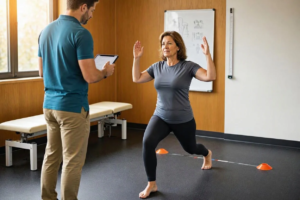
Squat Assessment
A squat requires coordination between:
- Ankles
- Knees
- Hips
- Pelvis
- Trunk
A physiotherapist may observe how the person moves through the squat and whether pain, stiffness, weakness, or balance limitations affect the movement.
A squat assessment does not mean that everyone needs to perform a deep squat.
The depth and difficulty should be appropriate for the patient.
Lunge Assessment
A lunge challenges:
- Single-leg control
- Balance
- Hip strength
- Knee control
- Ankle mobility
- Coordination
Lunges may be particularly useful for athletes or patients working toward higher-level lower-limb function.
Step-Up Assessment
A step-up can help assess the ability to control the body while moving onto an elevated surface.
It may be relevant for patients who have difficulty with stairs or lower-limb activities.
Sit-to-Stand Assessment
Getting up from a chair is a common everyday movement.
It requires coordination between the hips, knees, ankles, and trunk.
Difficulty performing this movement may be related to:
- Lower-body weakness
- Pain
- Reduced mobility
- Balance limitations
- Reduced confidence
The movement can also be progressed during rehabilitation.
Reaching Assessment
Reaching can provide information about:
- Shoulder mobility
- Shoulder strength
- Upper-back movement
- Coordination
- Trunk control
A physiotherapist may assess reaching in different directions depending on the patient’s activities and goals.
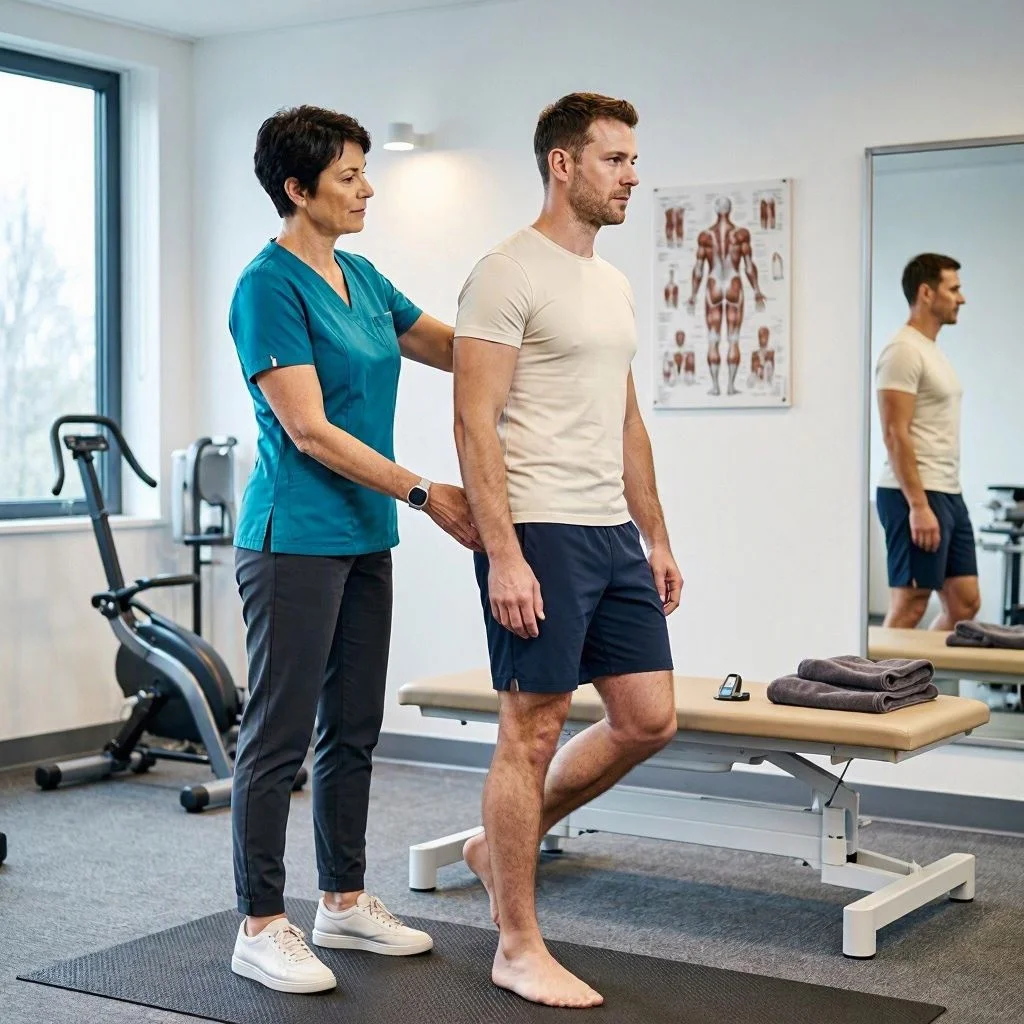
Single-Leg Balance
Standing on one leg requires:
- Ankle control
- Hip strength
- Coordination
- Proprioception
- Balance
It can be useful when evaluating lower-limb function.
More advanced tests may challenge balance through movement rather than simply standing still.
Physiotherapy Movement Assessment for Back Pain
Back pain can change the way a person moves.
During a movement assessment, a physiotherapist may observe:
- Bending
- Standing
- Walking
- Sitting-to-standing
- Trunk rotation
- Hip movement
- Functional lifting
The goal is not to assume that one specific movement causes the pain.
Instead, the physiotherapist considers the relationship between movement, symptoms, strength, mobility, and functional limitations.
A person with back pain may have difficulty bending because of pain, stiffness, reduced confidence, or a combination of factors.
The treatment plan can then be developed around the relevant findings.
Physiotherapy Movement Assessment for Neck Pain
For neck pain, movement assessment may include:
- Neck rotation
- Flexion
- Extension
- Side bending
- Shoulder movement
- Upper-back mobility
- Posture
- Functional reaching
The physiotherapist may also consider neurological symptoms when appropriate.
If neck symptoms are associated with significant weakness, numbness, severe trauma, unusual headache, dizziness, or other concerning symptoms, further medical assessment may be necessary.
Physiotherapy Movement Assessment for Shoulder Pain
Shoulder assessment often involves several different movements.
A physiotherapist may examine:
- Reaching overhead
- Reaching behind the back
- Shoulder rotation
- Arm elevation
- Scapular movement
- Upper-back movement
- Shoulder strength
The goal is to understand which movements are limited and how those limitations affect daily activities.
For example, someone may have difficulty putting on a shirt, reaching a shelf, or lifting an object.
These functional limitations can become important rehabilitation goals.
Physiotherapy Movement Assessment for Knee Pain
A knee assessment may include:
- Walking
- Squatting
- Step-ups
- Sit-to-stand
- Lunging
- Single-leg balance
The physiotherapist may also examine hip and ankle movement because lower-limb function involves multiple joints.
For example, reduced ankle mobility or hip weakness may influence how someone performs a squat or step.
This does not mean that every movement limitation is the cause of knee pain. Instead, the assessment helps determine which findings are relevant to the individual’s symptoms and goals.
Physiotherapy Movement Assessment for Sports Injuries
Athletes often require more detailed movement assessments because sports involve high physical demands.
A rehabilitation assessment may examine:
- Running
- Jumping
- Landing
- Acceleration
- Deceleration
- Cutting
- Balance
- Strength
- Coordination
- Sport-specific movement
For example, a soccer player may need to demonstrate controlled running and changes of direction before returning to full training.
A basketball player may need jumping and landing assessment.
A runner may need analysis of running mechanics, strength, training load, and endurance.
The assessment should reflect the actual demands of the sport.
Physiotherapy Movement Assessment After an Injury
After an injury, movement may change even when pain begins to improve.
A person may develop:
- Weakness
- Stiffness
- Reduced balance
- Reduced coordination
- Protective movement patterns
- Reduced confidence
A movement assessment can help identify these limitations.
For example, after an ankle injury, a patient may be able to walk normally but still struggle with single-leg balance or running.
The rehabilitation plan can then progress from basic movement toward higher-level activities.
At Ritz Clinic’s injury rehabilitation service, assessment can include mobility, strength, flexibility, balance, movement patterns, and functional limitations as part of developing an individualized rehabilitation plan.
Movement Assessment and Injury Prevention
Movement assessment can sometimes identify physical limitations that may be relevant to injury risk.
These can include:
- Poor balance
- Reduced strength
- Limited mobility
- Reduced coordination
- Poor movement control
- Difficulty tolerating physical demands
However, a movement assessment should not be presented as a tool that can predict every future injury.
Human movement is influenced by many factors, including training load, environment, previous injuries, fatigue, sleep, sport demands, and individual characteristics.
APTA describes movement screening as a way to identify movement impairments and help determine which additional tests and measures may be useful.
The findings should therefore be interpreted within the context of the individual rather than treated as a simple injury prediction score.
How Movement Assessment Influences Treatment
One of the main purposes of assessment is to guide treatment.
Suppose a patient has difficulty climbing stairs.
The physiotherapist may identify:
- Reduced knee strength
- Hip weakness
- Balance limitations
- Pain
- Reduced confidence
The treatment plan could then include progressive strengthening, balance training, functional step exercises, and education.
Another patient with the same difficulty climbing stairs may have a different combination of limitations.
Their treatment may therefore be different.
This is why personalized assessment matters.
Movement Assessment and Physiotherapy Exercise Programs
Movement assessment and exercise prescription are closely connected.
A physiotherapist can use assessment findings to determine:
- Which muscles require strengthening
- Which joints need mobility work
- Which movements should be practiced
- How much resistance is appropriate
- How difficult an exercise should be
- Which functional activities should be progressed
For example, a patient with poor single-leg control may begin with supported balance exercises.
As control improves, exercises can become more dynamic.
The progression may eventually include stepping, lunging, running, or sport-specific movement.
The exercises should evolve with the patient.
How Is Progress Measured After a Movement Assessment?
Progress can be measured in several ways.
Pain
Pain intensity may change, but it should not be the only measure of improvement.
Range of Motion
The physiotherapist can compare movement over time.
Strength
Strength can be reassessed through appropriate tests.
Balance
Balance performance can be compared across appointments.
Functional Performance
The patient may be able to:
- Walk farther
- Climb stairs
- Lift objects
- Reach overhead
- Run
- Exercise
Patient-Reported Outcomes
Patients can also report changes in symptoms and function.
APTA emphasizes that standardized outcome measures can provide a common way to evaluate physical therapy outcomes and guide patient management.
How Long Does a Physiotherapy Movement Assessment Take?
There is no fixed duration.
A simple assessment may be relatively brief, while a complex case may require more time.
The length depends on:
- The patient’s condition
- Number of symptoms
- Medical history
- Functional limitations
- Complexity of the problem
- Number of tests required
APTA notes that the length of a physical therapy examination can vary depending on the information required and the complexity of the patient’s presentation.
A comprehensive assessment is not necessarily about performing as many tests as possible.
The goal is to collect useful information that can support clinical decision-making.
What Should You Wear to a Movement Assessment?
Comfortable clothing that allows movement is usually helpful.
Depending on the body area being assessed, the physiotherapist may need to see or access the relevant joint and surrounding area.
For example:
- Shorts may be useful for a knee or lower-limb assessment.
- A comfortable shirt may help with shoulder assessment.
- Flexible clothing can make functional movement easier.
The exact requirements depend on the type of assessment.
What Should You Tell Your Physiotherapist?
Provide as much relevant information as possible.
Tell your physiotherapist about:
- Current symptoms
- Previous injuries
- Surgeries
- Medical conditions
- Medications when relevant
- Exercise habits
- Work requirements
- Sports participation
- Changes in symptoms
- Activities you want to return to
Also mention symptoms that may seem unrelated.
A physical therapist’s examination can include a systems review to determine whether symptoms indicate the need for additional medical evaluation or referral.
Can Movement Assessment Diagnose Every Problem?
No.
A movement assessment provides useful information about physical function, but it is not a universal diagnostic test.
Some conditions require:
- Medical examination
- Imaging
- Blood tests
- Neurological evaluation
- Orthopedic consultation
- Other specialist assessment
A physiotherapist should refer or collaborate with another healthcare professional when the patient’s presentation suggests that further evaluation is necessary.
This is an important part of safe clinical practice.
Common Misunderstandings About Movement Assessment
There Is One Perfect Way to Move
Human movement varies between individuals.
Differences do not automatically indicate a problem.
The key question is whether the movement is relevant to symptoms or functional goals.
A Poor Movement Means an Injury Will Happen
Movement assessment cannot guarantee whether someone will or will not experience an injury.
It is better viewed as a way to identify potentially relevant movement limitations and guide further assessment.
Every Asymmetry Is a Problem
Small differences between sides are common.
A physiotherapist considers whether an asymmetry is meaningful in the context of symptoms, function, history, and activity demands.
More Tests Mean a Better Assessment
Not necessarily.
A useful assessment includes the tests that provide relevant information.
APTA states that physical therapists select tests and measures based on the purpose of the visit, the complexity of the condition, and clinical decision-making.
Physiotherapy Movement Assessment at Ritz Clinic
At Ritz Clinic’s physiotherapy movement therapy service, movement assessment is used to understand how a patient’s symptoms and physical limitations affect functional movement.
Depending on the individual, assessment may consider:
- Range of motion
- Strength
- Flexibility
- Balance
- Coordination
- Posture
- Walking
- Functional movements
- Joint mobility
The findings can then be used to develop a personalized treatment and rehabilitation approach.
For someone recovering from an injury, the assessment can also help determine which exercises and functional activities should be introduced or progressed.
The goal is not simply to identify an abnormal movement. Instead, the focus is on understanding the patient’s current abilities and limitations and connecting those findings to meaningful goals.
When Should You Consider a Physiotherapy Movement Assessment?
A movement assessment may be useful if you are experiencing:
- Persistent pain
- Reduced mobility
- Muscle weakness
- Difficulty walking
- Balance problems
- Recurrent injuries
- Difficulty returning to exercise
- Sports performance limitations
- Reduced movement after surgery
- Difficulty performing everyday activities
It may also be useful when you feel that your movement has changed even if the symptoms are relatively mild.
Early assessment can provide information about current physical function and help determine whether physiotherapy is appropriate.
When Should You Seek Medical Assessment Instead?
Not every movement problem should be managed through routine physiotherapy alone.
Seek appropriate medical attention when symptoms are:
- Severe or rapidly worsening
- Associated with major trauma
- Associated with significant neurological changes
- Accompanied by unexplained fever or serious illness
- Associated with new significant weakness
- Associated with loss of bladder or bowel control
- Associated with severe chest pain or breathing difficulty
- Associated with a major deformity
These symptoms may require medical investigation before or alongside physiotherapy.
A physiotherapy movement assessment should support appropriate healthcare rather than delay necessary medical evaluation.

How to Prepare for Your Physiotherapy Movement Assessment
You can make the appointment more useful by preparing a few details.
Know Your Main Goal
Think about what you want to improve.
Your goal might be:
- Walking without difficulty
- Returning to the gym
- Running again
- Climbing stairs
- Working without pain
- Returning to sport
- Improving balance
Track Your Symptoms
If possible, notice:
- When symptoms occur
- Which movements aggravate them
- What makes them better
- How long symptoms last
- Whether symptoms change throughout the day
Bring Relevant Medical Information
If you have previous imaging, surgical information, or relevant medical documentation, share it when appropriate.
Wear Comfortable Clothing
Choose clothing that allows the relevant body area to move easily.
Final Thoughts
A physiotherapy movement assessment is an important part of understanding how a person’s body moves and functions.
Rather than focusing only on the location of pain, a movement assessment can examine how strength, mobility, balance, coordination, joint movement, and functional ability interact.
The assessment may include simple activities such as walking, squatting, reaching, stepping, lunging, standing, or getting up from a chair. More advanced testing can be used when necessary for athletes or patients with specific rehabilitation goals.
Importantly, there is no single “perfect” movement pattern that applies to everyone.
A physiotherapist interprets movement within the context of the patient’s symptoms, history, physical abilities, environment, and goals.
The findings can then help guide treatment, exercise selection, rehabilitation progression, and outcome measurement.
The assessment is only the beginning.
Its value comes from using the information gathered to create an appropriate treatment plan and then reassessing progress over time.
If pain, stiffness, weakness, balance problems, or movement limitations are affecting your daily activities, work, exercise, or sports participation, a professional physiotherapy movement assessment can provide a clearer picture of your current physical function and help guide the next stage of rehabilitation.
Frequently Asked Questions About Physiotherapy Movement Assessment
What is a physiotherapy movement assessment?
A physiotherapy movement assessment is an evaluation of how a person moves during specific activities and functional tasks. It may examine range of motion, strength, balance, coordination, mobility, posture, gait, and functional movement.
Why is movement assessment important in physiotherapy?
It helps the physiotherapist understand how symptoms and physical limitations affect movement. The findings can then guide additional testing, treatment, exercise selection, and rehabilitation goals.
What does a physiotherapist look for during a movement assessment?
Depending on the patient, a physiotherapist may assess strength, joint mobility, flexibility, balance, coordination, gait, posture, movement control, and functional performance.
Is a movement assessment painful?
Most movement assessments involve controlled activities that are appropriate for the patient’s abilities. Some movements may reproduce familiar symptoms, but the physiotherapist should adjust the assessment according to the patient’s condition and tolerance.
Do I need a movement assessment if I have back pain?
A movement assessment can be useful for understanding how back pain affects movement and function. However, the appropriate assessment depends on the symptoms and medical history.
Can movement assessment identify the cause of pain?
It can provide important information about physical impairments and functional limitations, but movement assessment alone cannot identify every possible cause of pain. Some conditions require additional medical evaluation or diagnostic testing.
Does poor movement mean I will get injured?
No. A movement difference does not automatically mean that an injury will occur. Movement should be interpreted in the context of the person’s symptoms, physical demands, history, and goals.
Can movement assessment help athletes?
Yes. Athletes may benefit from movement assessment that examines strength, balance, mobility, coordination, running, jumping, landing, agility, and sport-specific movements.
How long does a physiotherapy movement assessment take?
The duration varies according to the patient’s condition and the number of tests required. A simple assessment may be shorter, while a complex rehabilitation assessment may require more time.
What should I wear to a physiotherapy movement assessment?
Wear comfortable clothing that allows you to move easily and gives the physiotherapist reasonable access to the body area being assessed.
Can children have movement assessments?
Yes. Physiotherapy assessments can be adapted for children according to their age, development, condition, and functional goals.
Can movement assessment help after surgery?
Yes. Movement assessment can help determine changes in mobility, strength, balance, and function during rehabilitation after appropriate medical clearance.
Will the physiotherapist assess my posture?
Posture may be included when it is relevant to the patient’s symptoms or goals. However, posture is only one part of a comprehensive movement assessment.
What happens after a movement assessment?
The physiotherapist reviews the findings and may discuss a diagnosis or movement-related problem, treatment options, rehabilitation goals, exercises, and a plan for monitoring progress.
Do I need to do exercises after a movement assessment?
Not necessarily in every case, but exercise is commonly included in physiotherapy when appropriate. The exercises should be selected according to the assessment findings and the patient’s goals.
How often should movement be reassessed?
There is no universal schedule. Reassessment may occur when clinically appropriate to determine whether symptoms, movement, strength, function, or other relevant measures have changed.
Can I get a movement assessment without having pain?
Yes. Physiotherapy assessment can also be relevant for people with movement limitations, rehabilitation goals, sports-related needs, or functional concerns even when significant pain is not present.