
Why Does My Ankle Feel Stiff After Sitting for a Long Time?
Have you ever stood up after working at your desk, watching television, or sitting in a car for several hours and noticed that your ankles feel tight, uncomfortable, or difficult to move? Ankle stiffness after sitting is a common experience, particularly among people who spend much of their day in one position.
Sometimes, the stiffness disappears after taking a few steps. However, if it happens frequently, lasts longer than usual, or comes with pain and swelling, it may indicate an underlying problem involving the ankle joint, surrounding muscles, tendons, or other structures.
The ankle plays an essential role in walking, maintaining balance, climbing stairs, and performing everyday activities. Therefore, even a relatively small restriction in ankle movement can affect how comfortably you move.
The good news is that many causes of ankle stiffness can be managed with appropriate movement, exercise, activity adjustments, and professional guidance.
In this article, we explain why your ankle may feel stiff after prolonged sitting, which conditions can contribute to the problem, what you can do to improve mobility, and when it is important to seek medical attention.
Why Does My Ankle Feel Stiff After Sitting for a Long Time?
Your ankle may feel stiff after sitting because prolonged inactivity allows the surrounding muscles and joints to remain in relatively fixed positions. Reduced movement can temporarily affect joint mobility, muscle flexibility, and the way your body responds when you start moving again.
When you stand up, your ankle must immediately adapt to your body weight and the demands of walking. If the joint or surrounding tissues are sensitive, irritated, or less mobile, those first few movements may feel uncomfortable.
Several factors can contribute to this experience:
- Reduced movement during prolonged sitting.
- Tightness in the calf muscles and Achilles tendon.
- Previous ankle injuries.
- Joint inflammation or irritation.
- Ankle osteoarthritis.
- Reduced ankle mobility.
- Muscle weakness or deconditioning.
- Swelling around the ankle joint.
For many people, temporary stiffness improves after walking for a few minutes. This is sometimes described as a start-up stiffness response.
However, persistent stiffness should not automatically be attributed to sitting. An underlying joint or soft tissue condition may be responsible.
What Happens to Your Ankle When You Sit for Long Periods?
The ankle is designed to move regularly throughout the day. During walking, its muscles, tendons, ligaments, and joint surfaces work together to support body weight and allow smooth movement.
When you remain seated for an extended period, your ankle usually moves much less than it does during normal daily activities.
Depending on your sitting position, your feet may remain flat on the floor, rest underneath your chair, or stay in a relatively pointed position.
This can contribute to temporary changes in comfort and movement.
1. Reduced Joint Movement
Joints generally function best when they move through an appropriate range of motion.
During prolonged sitting, the ankle experiences fewer movements involving dorsiflexion and plantarflexion.
Dorsiflexion means bringing your toes toward your shin. Plantarflexion means pointing your toes downward.
When these movements are limited for long periods, the first movements after standing may feel less comfortable.
2. Calf Muscle Tightness
Your calf muscles play an important role in controlling ankle movement.
The gastrocnemius and soleus muscles connect to the heel through the Achilles tendon.
If these muscles are relatively tight or have reduced flexibility, you may experience difficulty bringing your knee forward over your foot when walking, climbing stairs, or squatting.
Prolonged sitting may make existing calf tightness more noticeable when you stand.
3. Reduced Circulation During Inactivity
Muscle contractions help support blood flow in the lower legs.
When you sit without moving for long periods, your calf muscles contract less frequently.
This may contribute to a feeling of heaviness or temporary discomfort in the lower legs.
However, ankle stiffness is not necessarily a circulation problem. Persistent swelling, particularly when it affects one leg, requires appropriate medical assessment.
4. Increased Awareness of Existing Joint Problems
Sitting may not directly cause an ankle condition, but it can make an existing problem more noticeable.
For example, someone with previous ankle damage or osteoarthritis may experience stiffness when restarting movement after rest.
This is one reason why recurring symptoms deserve attention rather than being dismissed as a normal consequence of sitting.
Common Causes of Ankle Stiffness After Sitting
Although prolonged inactivity can contribute to temporary stiffness, several medical and musculoskeletal conditions may produce similar symptoms.
Understanding the possible causes can help you recognize when further assessment may be necessary.
1. Ankle Osteoarthritis
Osteoarthritis is a condition involving changes to the tissues within and around a joint.
In the ankle, these changes may affect the cartilage and underlying bone, leading to discomfort, reduced movement, and stiffness.
Ankle osteoarthritis can develop following a previous fracture or significant ankle injury. It may also occur as part of age-related joint changes.
Common symptoms include:
- Stiffness after sitting or resting.
- Pain during walking or standing.
- Reduced ankle flexibility.
- Swelling around the joint.
- Difficulty walking on uneven surfaces.
- Discomfort when climbing stairs.
People with ankle osteoarthritis often notice that stiffness improves somewhat after gentle movement, although symptoms may return after prolonged activity or inactivity.
Importantly, stiffness alone does not mean you have arthritis. A healthcare professional can assess your symptoms and determine whether further investigation is needed.
2. Tight Calf Muscles and Achilles Tendon
Tightness in the calf muscles can influence how freely your ankle moves.
The Achilles tendon connects the calf muscles to the heel bone. It plays a major role in walking, running, and pushing your body forward.
If the calf muscles or Achilles tendon are sensitive or have reduced flexibility, you may experience:
- Tightness behind the ankle.
- Difficulty bringing your knee forward over your foot.
- Discomfort during the first steps after sitting.
- Reduced flexibility when squatting.
- Stiffness during walking uphill or climbing stairs.
Achilles tendinopathy is another possible explanation, particularly when discomfort is located along the tendon or near its attachment to the heel.
People with Achilles tendon problems may experience morning stiffness or stiffness after periods of rest.
3. Previous Ankle Sprains or Injuries
An old ankle injury can continue to affect movement even after the initial pain and swelling have disappeared.
An ankle sprain occurs when the ligaments supporting the joint are stretched or torn.
Depending on the severity of the injury, a person may experience lasting changes in:
- Joint mobility.
- Ligament stability.
- Muscle strength.
- Balance and coordination.
- Confidence during movement.
Some people also develop persistent stiffness because they have gradually reduced ankle movement or avoided certain activities during recovery.
If your ankle repeatedly feels stiff after sitting and you have a history of sprains, a movement and mobility assessment may help identify the limitations involved.
4. Reduced Ankle Mobility
Ankle mobility refers to the ability to move the joint through an appropriate range of motion with control.
Restricted mobility may develop for several reasons, including previous injuries, joint stiffness, muscle tightness, swelling, or prolonged immobilization.
One important movement is ankle dorsiflexion.
Limited dorsiflexion can make certain activities more difficult, such as:
- Walking comfortably.
- Squatting.
- Climbing stairs.
- Walking downhill.
- Performing lunges.
- Maintaining balance.
Reduced mobility does not always cause pain. Nevertheless, when it affects everyday movement, it may be worth investigating.
5. Inflammation or Joint Irritation
Inflammation can cause swelling, discomfort, and restricted joint movement.
Several conditions may contribute to ankle inflammation, including inflammatory arthritis, gout, and injuries involving the joint or surrounding tissues.
For example, gout can cause sudden episodes of severe joint pain, redness, warmth, and swelling.
Inflammatory arthritis may cause stiffness after periods of inactivity, sometimes affecting multiple joints.
A particularly important warning sign is a hot, swollen, painful joint accompanied by fever or feeling generally unwell. This requires urgent medical evaluation because joint infection is one possible cause.
6. Muscle Weakness and Reduced Physical Activity
Strong calf and lower-leg muscles help stabilize the ankle during everyday movement.
When physical activity decreases, muscle strength and endurance may gradually decline.
This can make normal activities feel more demanding.
For example, someone who spends most of the day sitting may notice reduced endurance when walking, standing for long periods, or climbing stairs.
Strengthening exercises can help improve the ability of the muscles surrounding the ankle to support movement.
Common Symptoms Associated With Ankle Stiffness
Ankle stiffness does not always occur on its own.
Depending on the underlying cause, you may experience additional symptoms.
Common signs include:
- Tightness when moving the ankle.
- Discomfort during the first few steps after sitting.
- Difficulty pointing the toes upward or downward.
- Reduced flexibility.
- Swelling around the ankle.
- Pain behind the heel or along the Achilles tendon.
- Difficulty walking comfortably.
- A feeling of heaviness in the lower leg.
- Reduced balance or ankle stability.
Pay attention to when the symptoms occur.
For example, stiffness that disappears after a few steps may have a different explanation from stiffness accompanied by persistent swelling, increasing pain, or significant movement restrictions.
The location of the discomfort also matters. Pain at the back of the ankle may suggest a different problem from pain directly within the joint or around the inner ankle.
How to Relieve Ankle Stiffness After Sitting
The most appropriate treatment depends on the cause of your symptoms.
If the stiffness is mild and there are no warning signs of injury or illness, gentle movement and regular activity breaks may help.
Here are several practical strategies.
1. Move Your Ankles Before Standing Up
One simple way to reduce stiffness is to move your ankles gently before getting out of your chair.
While seated:
- Keep both feet comfortably supported.
- Slowly point your toes downward.
- Bring your toes back toward your shins.
- Repeat the movement 10–15 times.
- Perform gentle ankle circles in both directions.
These movements encourage the ankle to move through a comfortable range before you place your full body weight on it.
Avoid forcing the joint or continuing if the movement produces sharp pain.
2. Take Regular Movement Breaks
Avoid remaining in the same position for several hours whenever possible.
Try standing up and walking briefly throughout your working day.
For example, you could:
- Walk around your office between tasks.
- Stand while taking phone calls.
- Walk for a few minutes after long meetings.
- Perform gentle ankle movements while seated.
- Alternate your sitting and standing positions.
There is no single break schedule that works for everyone. The important principle is to reduce uninterrupted periods of inactivity.
3. Apply Gentle Heat When Appropriate
Some people find that gentle warmth helps relieve muscular tightness and temporary stiffness.
A warm shower or comfortably warm towel may help relax the surrounding muscles before movement.
However, heat is not appropriate for every situation.
If your ankle is newly injured, significantly swollen, red, or unusually warm, avoid applying heat and seek appropriate advice.
4. Wear Comfortable and Supportive Footwear
Footwear can influence how forces are distributed through your feet and ankles.
Shoes that are uncomfortable, poorly fitted, or unsuitable for your activities may aggravate existing symptoms.
Consider footwear that provides:
- Adequate cushioning.
- A comfortable fit.
- Appropriate support.
- Sufficient room for your toes.
- Stability during walking.
If you have persistent symptoms, a healthcare professional can help determine whether footwear changes or orthotic support may be useful.
5. Manage Your Activity Levels
If your ankle becomes stiff after prolonged sitting, suddenly starting an intense workout may not be the best approach.
Instead, gradually increase your activity.
Begin with comfortable walking and gentle movement. As your symptoms improve, you may gradually introduce strengthening exercises and more demanding activities.
The aim is to improve movement without repeatedly aggravating the ankle.
Best Exercises for Ankle Stiffness After Sitting
Exercise can help improve ankle mobility, muscle strength, and movement control.
However, exercises should match your symptoms and physical abilities.
If you have recently injured your ankle, undergone surgery, or been diagnosed with a specific ankle condition, follow the rehabilitation advice provided by your healthcare professional.
Exercise 1: Ankle Pumps
Ankle pumps are a simple exercise that can be performed while sitting or lying down.
How to perform:
- Sit comfortably with your legs extended or supported.
- Slowly point your toes away from your body.
- Bring your toes toward your shin.
- Repeat the movement 10–15 times.
- Keep the movement controlled and comfortable.
Potential benefits:
- Encourages ankle movement.
- Helps maintain range of motion.
- Provides a convenient movement break during prolonged sitting.
Exercise 2: Ankle Circles
Ankle circles help move the joint in different directions.
How to perform:
- Sit in a comfortable position.
- Lift one foot slightly off the floor.
- Slowly rotate your ankle clockwise.
- Perform 10 circles.
- Repeat in the opposite direction.
- Switch feet.
Avoid making large or forceful circles if your ankle is painful.
Exercise 3: Seated Heel Raises
This exercise activates the calf muscles without requiring you to stand.
How to perform:
- Sit with both feet flat on the floor.
- Keep your toes in contact with the ground.
- Slowly lift your heels.
- Pause briefly at the top.
- Lower your heels with control.
- Repeat 10–15 times.
As your strength improves, you may gradually increase the repetitions.
Exercise 4: Standing Calf Stretch
Calf stretching may be helpful when reduced calf flexibility contributes to ankle movement restrictions.
How to perform:
- Stand facing a wall.
- Place both hands against the wall.
- Step one foot backward.
- Keep the back knee straight and the heel on the floor.
- Gently lean forward until you feel a stretch in the calf.
- Hold for 20–30 seconds.
- Repeat on the other side.
The stretch should feel gentle rather than painful.
If you have an Achilles tendon injury or significant heel pain, ask a healthcare professional whether this stretch is appropriate.
Exercise 5: Gentle Knee-to-Wall Ankle Mobility
This movement helps assess and gently improve ankle dorsiflexion.
How to perform:
- Stand facing a wall.
- Place one foot a short distance from the wall.
- Keep your heel firmly on the floor.
- Slowly move your knee toward the wall.
- Allow your knee to travel over your toes.
- Stop before your heel lifts or pain develops.
- Repeat 8–10 times.
You can gradually adjust your foot position as your comfort and mobility improve.
Do not force the knee forward or push through significant pain.
Exercise 6: Standing Heel Raises
Standing heel raises help strengthen the calf muscles and improve functional ankle strength.
How to perform:
- Stand near a stable surface for support.
- Place your feet approximately hip-width apart.
- Slowly raise both heels.
- Hold briefly at the top.
- Lower your heels gradually.
- Repeat 8–12 times.
Begin with both feet and progress only when the movement feels comfortable and controlled.
If you experience increasing Achilles pain, stop and seek advice about modifying the exercise.
When Is Physiotherapy Helpful for Ankle Stiffness?
If ankle stiffness keeps returning, affects walking, or does not improve with simple movement strategies, physiotherapy may help identify the underlying problem.
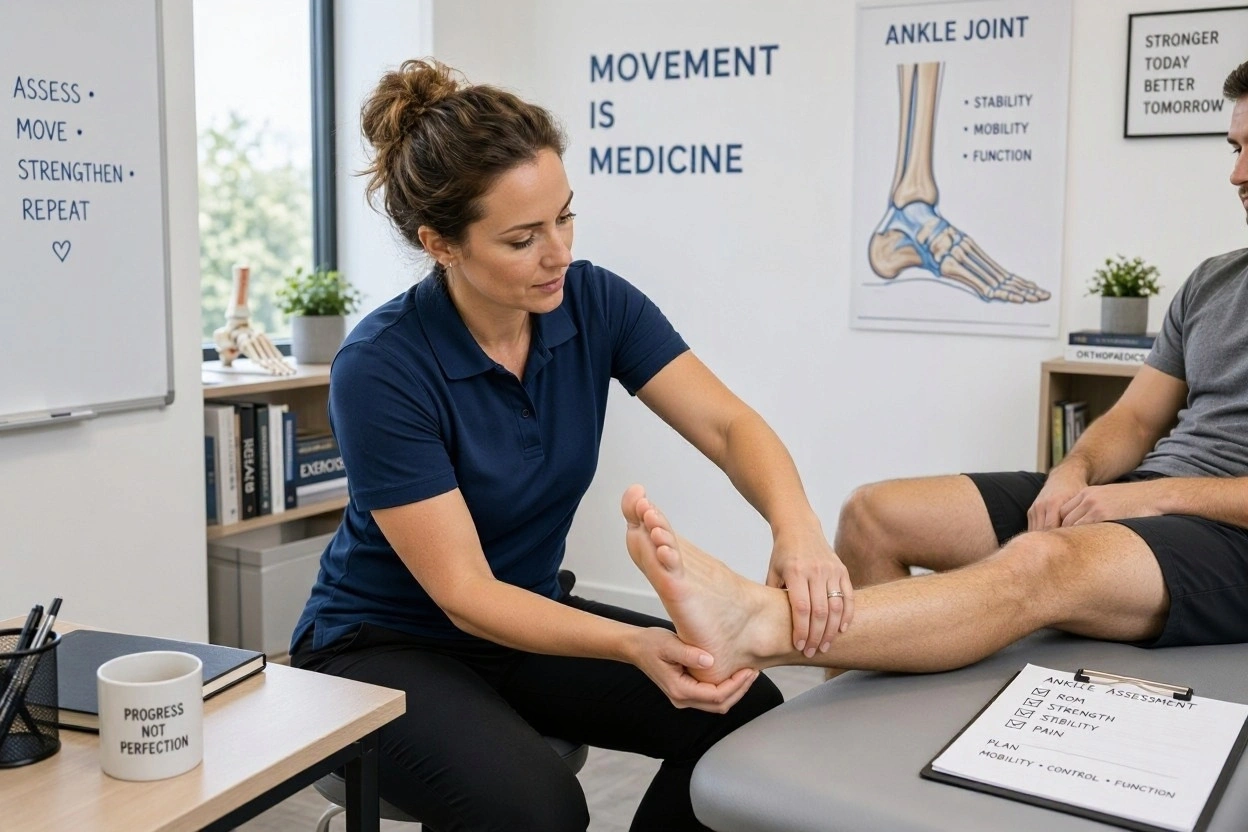
A physiotherapist can assess several aspects of ankle function, including:
- Active and passive range of motion.
- Calf muscle flexibility.
- Achilles tendon symptoms.
- Ankle strength.
- Joint stability.
- Balance and coordination.
- Walking mechanics.
- Functional movement patterns.
The assessment helps determine whether the main limitation involves joint mobility, muscle strength, tendon function, previous injury, or another factor.
Physiotherapy Treatment Options
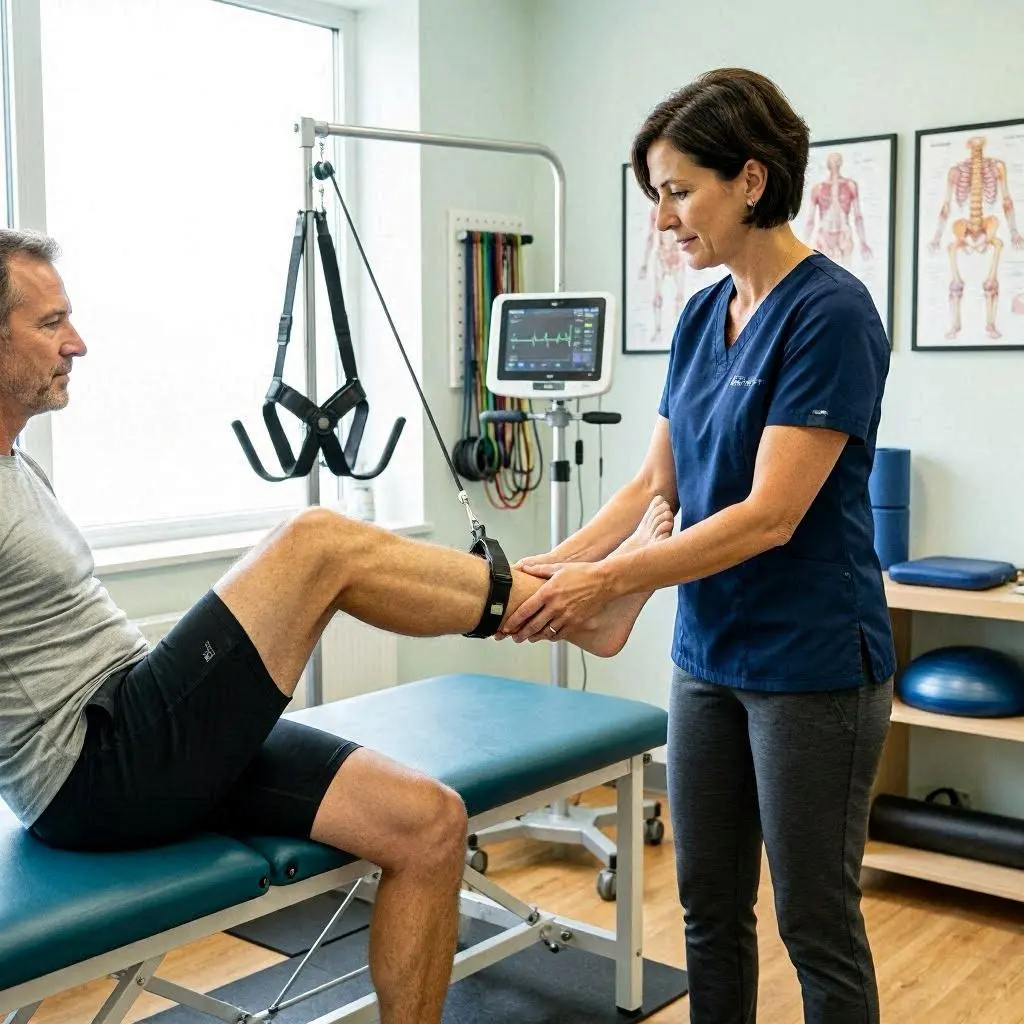
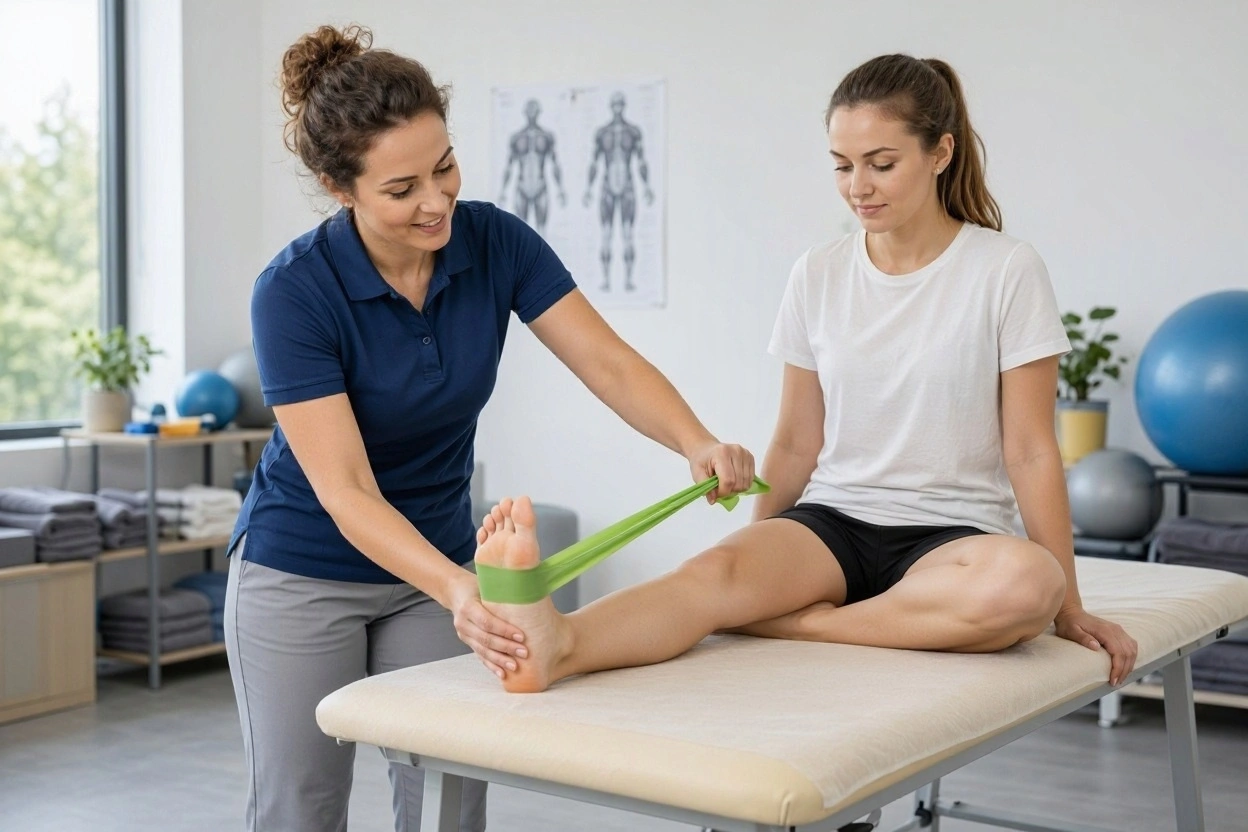
An appropriate ankle mobility assessment can help identify restrictions in joint movement, muscle flexibility, strength, and balance. Based on the assessment findings, a physiotherapist can recommend a treatment plan tailored to your specific needs.
Treatment options may include:
Therapeutic Exercises: Targeted mobility, stretching, strengthening, and balance exercises designed to improve ankle function and support everyday movement.
Manual Therapy: Gentle joint mobilization and soft tissue techniques may help improve ankle mobility and reduce discomfort in selected cases.
Progressive Strengthening: Gradually increasing the workload placed on the calf and surrounding muscles can improve strength, stability, and functional capacity.
Movement Education: Learning how to modify daily activities, take regular movement breaks, and return to exercise safely can help manage recurring ankle stiffness.
Gait Training: Addressing walking patterns and movement limitations can help improve walking comfort when restricted ankle mobility affects normal movement.
Not everyone needs the same treatment. A personalized rehabilitation program based on an individual’s symptoms, physical assessment, and functional goals is generally more appropriate than following a generic exercise routine without identifying the underlying cause of the problem.
How to Prevent Ankle Stiffness After Sitting
Although you cannot prevent every cause of ankle stiffness, several daily habits may reduce the likelihood of recurring symptoms.
Stay Physically Active
Regular movement helps maintain muscle strength and joint mobility.
Walking, cycling, swimming, and other comfortable activities can help you remain active.
Choose activities that match your fitness level and current symptoms.
Avoid Prolonged Uninterrupted Sitting
If your work involves sitting for most of the day, make movement part of your routine.
Short walking breaks and seated ankle exercises can help reduce long periods of inactivity.
Maintain Calf and Ankle Strength
Regular strengthening exercises help maintain the muscles needed for walking, balance, and everyday movement.
Include appropriate calf raises and ankle mobility exercises in your routine.
Address Previous Ankle Injuries
If you have previously sprained your ankle, make sure you regain appropriate strength, balance, and mobility before returning to demanding activities.
Incomplete rehabilitation may leave some people with persistent movement limitations or instability.
Increase Exercise Gradually
Avoid sudden increases in walking distance, running intensity, or exercise volume.
Gradual progression allows your muscles, tendons, and joints to adapt to increased demands.
When Should You See a Doctor for Ankle Stiffness?
“According to the NHS, ankle pain may be managed with appropriate self-care, gentle stretching, and suitable footwear, although persistent or severe symptoms may require medical assessment.”
Occasional stiffness that quickly improves with gentle movement may not require immediate medical attention.
However, recurring or persistent symptoms deserve assessment.
Arrange a medical or physiotherapy evaluation if:
- Your ankle stiffness keeps returning.
- Pain is interfering with everyday activities.
- Symptoms are getting progressively worse.
- You have persistent swelling.
- Your ankle movement is becoming increasingly restricted.
- You experience repeated ankle instability.
- You have tingling, numbness, or altered sensation.
- Symptoms do not improve with appropriate self-care.
Seek urgent medical attention if you experience:
- Severe ankle pain, particularly following an injury.
- An obvious deformity.
- Inability to bear weight or walk.
- Significant swelling or bruising after trauma.
- A hot, red, swollen ankle accompanied by fever.
- Sudden calf swelling, warmth, or tenderness.
Sudden calf swelling can sometimes indicate a blood clot. If it occurs with chest pain, shortness of breath, or coughing up blood, seek emergency medical care immediately.
People with diabetes should also seek prompt advice about new foot or ankle problems, particularly if they have reduced sensation, skin damage, or signs of infection.
Early assessment can help identify conditions that need specific treatment and prevent unnecessary delays in care.
Frequently Asked Questions About Ankle Stiffness After Sitting
1. Why are my ankles stiff when I stand up after sitting?
Your ankles may feel stiff because they have remained relatively inactive while you were sitting. Existing calf tightness, reduced joint mobility, previous injuries, or arthritis can make this feeling more noticeable. Gentle ankle movements and a short walk may help if there are no concerning symptoms.
2. Is ankle stiffness after sitting normal?
Occasional mild stiffness that improves after a few steps can occur, particularly after prolonged inactivity. However, frequent stiffness, persistent pain, swelling, or increasing movement restrictions should not automatically be considered normal. These symptoms may require professional assessment.
3. Can sitting too long cause ankle pain?
Prolonged sitting can contribute to temporary stiffness and discomfort, especially when the ankle remains in one position. However, sitting alone does not explain every case of ankle pain. Previous injuries, tendon problems, arthritis, and other medical conditions may also contribute.
4. Why is my ankle stiff in the morning?
Morning ankle stiffness may occur after several hours of limited movement during sleep. It can also be associated with osteoarthritis, inflammatory arthritis, Achilles tendon problems, or other musculoskeletal conditions.
If stiffness lasts more than 30 minutes, regularly affects multiple joints, or comes with swelling, discuss it with a healthcare professional.
5. Can ankle stiffness be caused by arthritis?
Yes. Ankle osteoarthritis can cause stiffness after rest, discomfort during walking, swelling, and reduced mobility. Inflammatory arthritis may also cause stiffness, particularly after periods of inactivity. However, symptoms alone cannot confirm arthritis. An appropriate clinical assessment is needed.
6. What is the best exercise for stiff ankles?
There is no single best exercise for everyone. Ankle pumps, ankle circles, seated heel raises, calf stretches, and gentle knee-to-wall movements may help improve mobility and strength when appropriate.
The best exercise depends on the underlying cause and your tolerance.
7. How long does ankle stiffness after sitting last?
Mild stiffness associated with inactivity may improve after a few minutes of gentle movement. If symptoms persist for longer periods, repeatedly return, or become more painful, further assessment may be appropriate.
Recovery time depends on the underlying condition rather than sitting duration alone.
8. Should I walk if my ankle feels stiff?
If the stiffness is mild and walking does not increase your symptoms, a short, comfortable walk may help restore normal movement.
However, avoid forcing yourself to walk through significant pain, severe swelling, or symptoms following a serious injury. Seek medical advice when these warning signs are present.
9. Can tight calf muscles cause ankle stiffness?
Yes. Tight calf muscles can limit ankle dorsiflexion, making movements such as squatting, walking uphill, and climbing stairs more difficult. Gentle calf stretching and appropriate strengthening may help, although other causes of restricted ankle movement should also be considered.
10. When should I see a physiotherapist for stiff ankles?
Consider seeing a physiotherapist when stiffness repeatedly affects walking, exercise, balance, or daily activities. A physiotherapist can assess ankle mobility, strength, flexibility, and movement patterns to help develop an appropriate rehabilitation plan.
Conclusion: Don’t Ignore Persistent Ankle Stiffness
Ankle stiffness after sitting for a long time is often related to reduced movement and may improve once you start walking. However, recurring symptoms can also be associated with calf tightness, previous ankle injuries, reduced mobility, Achilles tendon problems, or joint conditions such as osteoarthritis.
The most useful first steps are to introduce regular movement breaks, perform gentle ankle mobility exercises, maintain appropriate muscle strength, and avoid remaining in the same position for extended periods.
If your symptoms persist, become more painful, or interfere with everyday activities, consider getting a professional assessment rather than relying on stretching alone.
At Ritz Clinic, an individualized assessment can help identify movement restrictions and determine whether physiotherapy or other rehabilitation strategies may be appropriate for your needs.
The goal is not simply to make your ankles feel less stiff temporarily. It is to help you move comfortably, maintain strength, and return to your normal activities with greater confidence.
Medical Disclaimer
This article is intended for general educational and informational purposes only. It does not replace professional medical advice, diagnosis, or treatment.
Ankle stiffness can have several possible causes, and the appropriate treatment depends on an individual’s symptoms, medical history, and physical examination findings.
Do not ignore persistent or worsening symptoms, and seek appropriate medical care if you experience severe pain, significant swelling, an inability to bear weight, fever, or other warning signs.
Always consult a qualified healthcare professional before starting a new exercise or rehabilitation program, particularly if you have a recent injury, a diagnosed medical condition, or have undergone surgery.