Injury Performance Assessment: Complete Guide to Evaluating Recovery and Physical Performance
Introduction
Recovering from an injury involves more than waiting for pain to disappear. A person may feel better during everyday activities while still experiencing weakness, reduced mobility, poor balance, limited endurance, or difficulty performing movements at higher intensity. These limitations can become particularly important when returning to exercise, work, or competitive sports. An Injury Performance Assessment provides a structured way to evaluate physical performance during or after injury rehabilitation. It can help a qualified rehabilitation professional understand how an injury has affected movement and physical capacity and determine whether the individual is progressing toward their functional goals.
Performance assessment may examine several physical qualities, including strength, mobility, flexibility, balance, coordination, endurance, power, agility, and movement control. The specific tests depend on the injury, the person’s current recovery stage, and the demands of their daily activities or sport.
This comprehensive guide explains what an Injury Performance Assessment is, why it matters, what professionals may evaluate, how testing can support rehabilitation, and how performance can be safely rebuilt after an injury.
What Is an Injury Performance Assessment?
An Injury Performance Assessment is a structured evaluation of physical abilities following an injury. It examines how well an individual can perform movements and physical tasks and identifies limitations that may affect recovery or return to activity.
Unlike an assessment that focuses on only one factor, such as joint range of motion or muscle strength, performance assessment can combine several components.
Depending on the individual, testing may evaluate:
-
Strength
-
Mobility
-
Flexibility
-
Balance
-
Coordination
-
Endurance
-
Power
-
Agility
-
Stability
-
Movement quality
-
Functional capacity
-
Sport-specific performance
The goal is not simply to determine whether someone can complete an exercise. Instead, the assessment aims to understand how effectively and safely the person can perform activities relevant to their goals.
A person may have adequate strength during a basic exercise but struggle when the same movement becomes faster, heavier, repetitive, or more complex. Performance assessment helps identify these differences.
Why Is Injury Performance Assessment Important?
Pain reduction is an important part of recovery, but it does not always indicate complete restoration of physical performance.
For example, an athlete may have little pain while walking but still lack the strength and coordination required for sprinting or jumping.
Similarly, a worker may be able to perform daily activities but struggle with repetitive lifting required by their job.
An Injury Performance Assessment can help identify these remaining limitations.
It may provide information about:
-
Current physical capacity
-
Remaining weaknesses
-
Movement limitations
-
Differences between limbs
-
Endurance deficits
-
Balance problems
-
Reduced coordination
-
Difficulty tolerating workload
-
Functional limitations
This information can help guide rehabilitation and activity progression.
Who Performs an Injury Performance Assessment?
An Injury Performance Assessment may be performed by a qualified rehabilitation or healthcare professional.
Depending on the setting and local scope of practice, professionals may include:
-
Physical therapists
-
Physiotherapists
-
Sports rehabilitation professionals
-
Athletic trainers
-
Sports medicine professionals
-
Other appropriately qualified healthcare providers
The exact assessment methods depend on the professional’s training and the individual’s condition.
A qualified professional should also recognize when a person requires medical assessment before participating in performance testing.
What Happens During an Injury Performance Assessment?
The assessment generally begins with a discussion about the injury and the individual’s goals.
The professional may ask:
-
How did the injury happen?
-
When did symptoms begin?
-
What treatment have you received?
-
Which activities remain difficult?
-
What movements cause discomfort?
-
Have you had previous injuries?
-
What activities do you want to return to?
-
What are your work or sports requirements?
After the history is reviewed, the professional may conduct physical and functional tests.
The testing process should be appropriate for the individual’s injury and current recovery stage.
Reviewing the Injury History
A person’s injury history provides important context.
The professional may need to know whether the injury was caused by:
-
A sudden movement
-
A fall
-
A collision
-
Repetitive activity
-
Sports participation
-
Workplace demands
-
Overuse
-
Surgery
Previous injuries may also influence performance.
For example, an athlete with previous ankle sprains may have persistent balance or strength limitations that affect their current performance.
Understanding the complete history helps the professional interpret assessment results more effectively.
Establishing Performance Goals
Performance assessment should be connected to meaningful goals.
Different people require different levels of physical capacity.
A person recovering from an ankle injury may want to walk comfortably.
A recreational athlete may want to return to running.
A professional athlete may need to sprint, jump, change direction, and tolerate repeated high-intensity efforts.
A warehouse worker may need to lift and carry objects throughout the workday.
Therefore, performance goals should reflect the individual’s actual requirements.
Short-Term Goals
Short-term goals may include:
-
Improving basic strength
-
Restoring mobility
-
Improving balance
-
Increasing exercise tolerance
-
Performing daily activities more comfortably
Long-Term Goals
Long-term goals may include:
-
Returning to work
-
Returning to recreational exercise
-
Returning to competitive sport
-
Restoring physical performance
-
Building long-term physical capacity
-
Reducing the likelihood of future limitations
Assessing Strength
Strength is a fundamental component of physical performance.
Injury can reduce strength because of pain, swelling, inactivity, changes in muscle activation, or reduced training.
An Injury Performance Assessment may evaluate strength using:
-
Manual resistance testing
-
Dynamometers
-
Resistance exercises
-
Functional strength tests
-
Repetition-based exercises
Testing may compare the injured side with the unaffected side when appropriate.
However, side-to-side comparison should be interpreted carefully because natural differences exist between individuals.
Assessing Lower-Body Performance
Lower-body strength is important for walking, running, jumping, climbing stairs, and many sports.
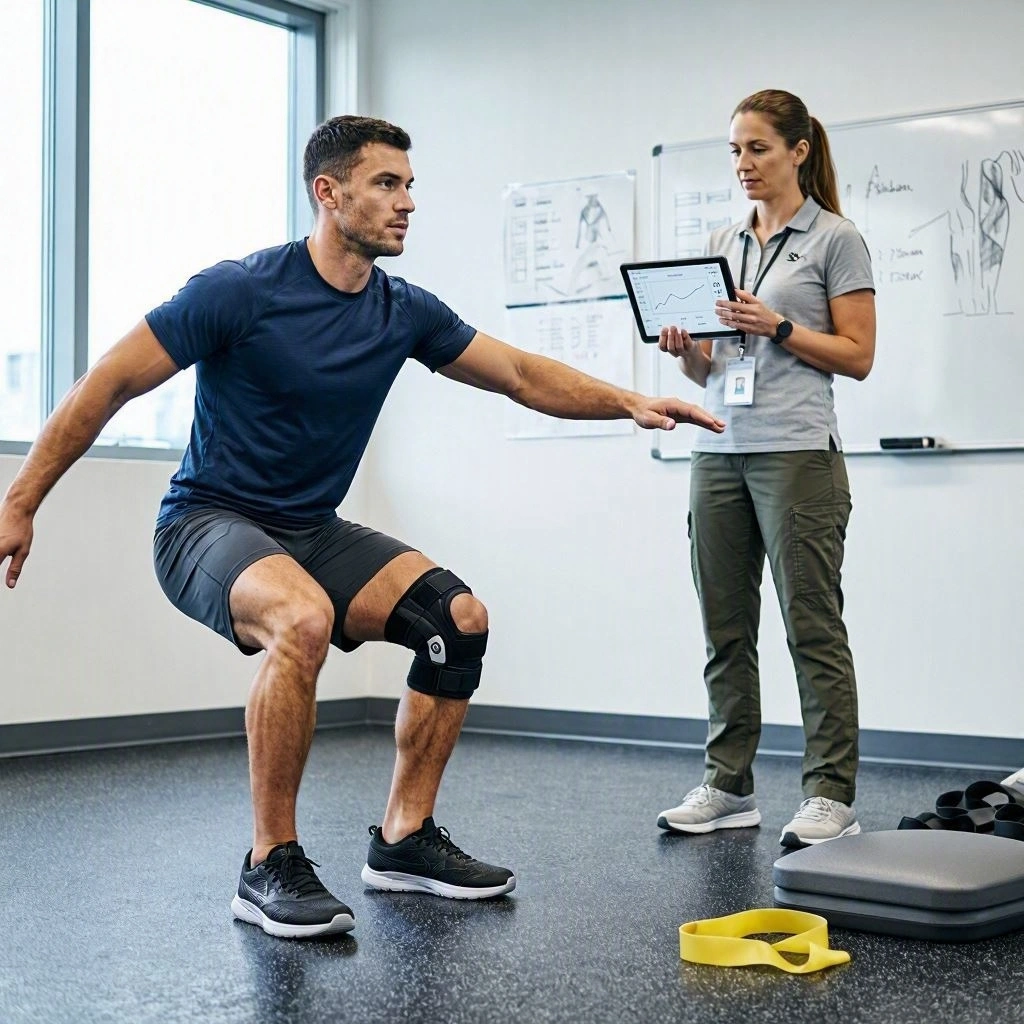
Depending on the injury, performance testing may include:
-
Squats
-
Lunges
-
Step-ups
-
Single-leg exercises
-
Calf raises
-
Jumping tasks
-
Landing tasks
The difficulty should be appropriate for the individual’s recovery stage.
An early rehabilitation assessment may focus on controlled movement, while a later sports assessment may involve higher-speed or higher-load tasks.
Assessing Upper-Body Performance
Upper-body performance is important for lifting, reaching, pushing, pulling, throwing, and many occupational activities.
Depending on the injury, assessment may examine:
-
Shoulder strength
-
Arm strength
-
Grip strength
-
Scapular control
-
Pushing ability
-
Pulling ability
-
Reaching
-
Functional lifting
The assessment should reflect the individual’s goals.
For example, a tennis player may require overhead performance testing, while a manual worker may need functional lifting and carrying assessment.
Assessing Mobility
Mobility affects how efficiently a person can perform physical tasks.
Restricted mobility may influence movement patterns and make certain activities more difficult.
A performance assessment may examine:
-
Joint range of motion
-
Dynamic mobility
-
Flexibility
-
Functional movement
However, adequate mobility does not automatically mean that someone is ready for demanding activity.
Mobility must work together with strength, control, stability, and physical capacity.
Assessing Flexibility
Flexibility may be evaluated when it is relevant to the individual’s movement limitations.
A rehabilitation professional may assess specific muscle groups or movement patterns.
Reduced flexibility can sometimes affect technique or range of motion, but flexibility should not be treated as the explanation for every movement problem.
Joint structure, strength, pain, swelling, and coordination can also influence performance.
Balance and Stability Testing
Balance is an important component of performance, particularly after lower-limb injuries.
Assessment may include:
-
Single-leg standing
-
Dynamic balance
-
Reaching tasks
-
Step-down movements
-
Controlled landing
-
Direction changes
As the individual improves, balance tasks can become more complex.
Athletes may eventually perform balance exercises while moving at higher speeds or responding to external stimuli.
Coordination and Movement Control
Coordination allows multiple body segments to work together efficiently.
Injury can change movement patterns because people may protect a painful area or avoid certain positions.
Performance assessment may therefore observe:
-
Movement timing
-
Coordination
-
Control
-
Symmetry
-
Stability
-
Technique
Improving coordination can be especially important when returning to complex activities.
Endurance Assessment
Endurance refers to the ability to sustain physical activity over time.
A person may have adequate strength but fatigue quickly after injury.
Endurance assessment may involve:
-
Repeated movements
-
Timed exercises
-
Walking
-
Cycling
-
Running
-
Sport-specific drills
The specific test depends on the individual’s condition.
For athletes, endurance can be especially important because sports often involve repeated efforts rather than one isolated movement.
Power Assessment
Power combines force and speed.
It is important in activities such as:
-
Jumping
-
Sprinting
-
Throwing
-
Rapid acceleration
-
Explosive lifting
Power testing should generally be introduced only when the individual has progressed sufficiently through rehabilitation.
A person who is not ready for high-intensity loading should not be pushed into explosive testing simply because it is part of an athletic assessment.
Agility Assessment
Agility involves changing body position or direction efficiently.
It can be important for sports such as football, basketball, tennis, hockey, and many other activities.
Agility testing may eventually include:
-
Lateral movement
-
Direction changes
-
Acceleration
-
Deceleration
-
Cutting
-
Reactive movement
These tests should be introduced progressively.
Movement Quality Assessment
Performance is not simply about completing a task.
How a movement is performed can also provide valuable information.
A professional may observe:
-
Alignment
-
Control
-
Stability
-
Coordination
-
Movement strategy
-
Compensation
-
Consistency
For example, an athlete may be able to complete a jump but demonstrate poor landing control.
Identifying this limitation may influence rehabilitation before returning to unrestricted sports participation.
Functional Performance Testing
Functional performance testing connects rehabilitation with everyday activities.
Tests may include:
-
Sit-to-stand
-
Squatting
-
Stair climbing
-
Walking
-
Lifting
-
Carrying
-
Reaching
-
Stepping
-
Running
Functional tests should reflect the person’s real-world requirements.
This makes the assessment more meaningful than relying exclusively on isolated muscle measurements.
Injury Performance Assessment for Athletes
Athletes often require detailed performance assessment before returning to full participation.
An athlete may need to demonstrate sufficient:
-
Strength
-
Mobility
-
Balance
-
Endurance
-
Power
-
Agility
-
Coordination
-
Sport-specific control
The requirements differ according to sport.
A runner may need progressive running and impact tolerance.
A basketball player may need jumping, landing, acceleration, and change-of-direction ability.
A swimmer may need shoulder mobility, strength, and repeated upper-body endurance.
Return-to-Sport Performance Testing
Returning to sport should usually be progressive.
An athlete may move through several stages:
-
Basic rehabilitation
-
Strength development
-
Functional movement
-
Running or sport-specific conditioning
-
Agility
-
High-speed movement
-
Practice participation
-
Full competition
The exact progression depends on the injury and sport.
Performance testing can provide useful information during this process, but no single test can guarantee that reinjury will not occur.
Injury Performance Assessment for Runners
Running places repetitive loads on the lower body.
A runner returning after injury may need assessment of:
-
Calf strength
-
Quadriceps strength
-
Hamstring strength
-
Hip strength
-
Single-leg control
-
Balance
-
Running tolerance
The return to running should generally progress gradually.
Mileage, speed, terrain, and training frequency may need to be adjusted during recovery.
Injury Performance Assessment for Team Sports
Team sports often involve unpredictable movements.
Players may need to sprint, stop, jump, land, change direction, and react to opponents.
Therefore, performance assessment may eventually include:
-
Sprinting
-
Deceleration
-
Cutting
-
Jumping
-
Landing
-
Reactive movement
-
Sport-specific drills
The goal is to gradually expose the athlete to the physical demands of competition.
Performance Assessment After Surgery
Surgery may temporarily reduce strength, mobility, endurance, and confidence.
Performance testing after surgery must follow appropriate medical and rehabilitation guidelines.
Early assessments may focus on basic function.
Later assessments may involve progressively more demanding movements.
The exact timeline depends on the procedure and individual recovery.
Performance Assessment After a Fracture
After a fracture, reduced activity can affect muscle strength and endurance.
Once medically appropriate, rehabilitation can gradually rebuild these qualities.
Performance assessment may examine:
-
Strength
-
Mobility
-
Balance
-
Walking
-
Functional movement
-
Endurance
Testing should respect the healing process.
Performance Assessment After a Muscle Strain
Muscle strains may reduce force production and tolerance for high-speed movement.
An athlete recovering from a hamstring strain, for example, may eventually need assessment of strength, running ability, acceleration, and deceleration.
The progression should be gradual.
High-speed testing should not be introduced before the individual is adequately prepared.
Performance Assessment After a Ligament Injury
Ligament injuries can affect stability, strength, and confidence.
Performance assessment may include:
-
Strength testing
-
Balance
-
Functional movements
-
Jumping
-
Landing
-
Direction changes
More advanced testing may be used during later rehabilitation stages.
Performance Assessment and Previous Injuries
Previous injuries can influence current performance.
A person who has experienced repeated injuries may develop movement strategies that persist after symptoms improve.
Performance assessment can help identify these patterns.
The goal is not to label every difference as a problem. Instead, the assessment should identify meaningful limitations that affect the individual’s goals.
Progressive Loading and Performance
Physical performance improves through appropriate training.
After an injury, the body may temporarily have a lower tolerance for physical stress.
Rehabilitation therefore often uses progressive loading.
Training demands can gradually increase through changes in:
-
Resistance
-
Repetitions
-
Duration
-
Speed
-
Range of motion
-
Complexity
-
Frequency
The appropriate progression depends on symptoms and performance.
Monitoring Symptoms During Performance Testing
Symptoms should be monitored during rehabilitation.
A professional may consider:
-
Pain
-
Swelling
-
Fatigue
-
Movement quality
-
Exercise tolerance
-
Recovery after activity
A significant worsening of symptoms may indicate that the workload needs to be modified or that further evaluation is necessary.
Performance Assessment and Injury Prevention
Performance assessment may also help identify areas that could be improved before a person returns to full activity.
Potential areas include:
-
Strength
-
Balance
-
Mobility
-
Conditioning
-
Movement control
-
Workload tolerance
However, no assessment can predict every future injury.
Injury prevention involves multiple factors, including training load, recovery, technique, environment, previous injury, and individual characteristics.
Common Mistakes During Injury Performance Assessment
Testing Too Aggressively
High-intensity testing may be inappropriate during early recovery.
Focusing on One Measurement
No single number represents complete physical performance.
Ignoring Movement Quality
Completing a task does not necessarily mean it is performed effectively.
Returning to Activity Too Quickly
Good performance in one test does not always mean the body is ready for full competition or workload.
Using Generic Standards
Performance requirements differ according to age, occupation, sport, fitness level, and individual goals.
Ignoring Fatigue
An individual may perform well during a short test but struggle after repeated efforts.
How to Prepare for an Injury Performance Assessment
Preparation depends on the type of testing planned.
Wear comfortable clothing and appropriate footwear.
Bring relevant information about previous treatment, surgery, imaging, and rehabilitation.
It can also help to know your current symptoms and activity limitations.
Do not attempt an unusually intense workout immediately before the assessment unless specifically instructed to do so.
The goal is to obtain a useful representation of your current physical capacity.
Questions to Ask Your Rehabilitation Professional
Patients may want to ask:
-
What aspects of my performance will you assess?
-
Which areas are currently limited?
-
How does my performance compare with my previous ability?
-
Which areas need additional rehabilitation?
-
What activities can I safely perform now?
-
How will we monitor progress?
-
What criteria will determine my return to sport or work?
-
How should I progress my training?
Clear communication can make the rehabilitation process easier to understand.
How Performance Testing Tracks Recovery
Repeated performance assessment can provide objective information about progress.
For example, a patient may demonstrate:
-
Increased strength
-
Better balance
-
Improved mobility
-
Greater endurance
-
Improved movement control
-
Better exercise tolerance
Progress can be tracked through repeated testing when appropriate.
This information can help professionals modify the rehabilitation program.
How Performance Assessment Supports Individualized Rehabilitation
A performance assessment provides information that can be used to personalize rehabilitation.
Suppose an athlete demonstrates adequate strength but poor landing control.
The program may focus more heavily on landing mechanics and dynamic stability.
Another athlete may demonstrate good mobility but insufficient strength.
That person may require greater emphasis on progressive resistance training.
Individualized programming allows rehabilitation to target the limitations that matter most.
The Psychological Side of Performance Recovery
Physical performance is not the only challenge after injury.
People may lose confidence in their body or become afraid of repeating the injury.
Athletes may worry about returning to competition.
Gradual exposure to increasingly demanding activities can help rebuild confidence.
Communication between the patient and rehabilitation professional is important when fear or anxiety affects participation.
Recovery, Sleep, and Performance
Recovery outside the rehabilitation session also matters.
Sleep supports general health, energy, concentration, and physical performance.
Poor sleep may make exercise feel more difficult and can affect training consistency.
Maintaining regular sleep habits and allowing adequate recovery between demanding sessions can support the rehabilitation process.
Nutrition and Physical Performance
Adequate nutrition supports general recovery and physical performance.
A balanced diet can provide:
-
Protein
-
Carbohydrates
-
Healthy fats
-
Vitamins
-
Minerals
-
Fluids
Nutritional requirements vary according to the individual’s health and activity level.
People with complex nutritional needs should consult an appropriately qualified healthcare or nutrition professional.
Returning to Normal Physical Activity
Not everyone needs to return to competitive sports.
Some people simply want to return to walking, gym workouts, recreational activities, or normal daily life.
Performance assessment can still be useful because it helps identify whether physical capacity has improved enough for the person’s specific goals.
The appropriate level of performance is therefore personal.
When Should You Consider an Injury Performance Assessment?
A professional assessment may be useful when:
-
You are returning to sports
-
You remain weak after an injury
-
Your movement feels different
-
You have difficulty with physical tasks
-
You are returning to work
-
You have repeated injuries
-
You are unsure whether you are ready to exercise
-
You want objective progress measurements
Professional evaluation can provide more useful information than relying entirely on how an injury feels.
When to Seek Medical Evaluation
Performance assessment should not replace medical care.
If an injury involves severe or rapidly worsening symptoms, significant deformity, major trauma, uncontrolled bleeding, loss of consciousness, sudden neurological symptoms, or an inability to use an affected limb after significant trauma, appropriate medical evaluation may be necessary.
Sudden unexplained weakness also requires prompt medical attention, especially when accompanied by neurological symptoms.
Choosing a Performance Rehabilitation Professional
When selecting a professional, consider:
-
Qualifications
-
Experience
-
Injury specialization
-
Sports rehabilitation experience
-
Assessment methods
-
Communication
-
Progress monitoring
For athletes, experience with the specific sport can be valuable because different sports have different physical requirements.
Frequently Asked Questions
What is an Injury Performance Assessment?
An Injury Performance Assessment is a structured evaluation of physical performance after an injury. It may assess strength, mobility, balance, endurance, power, agility, coordination, and functional movement.
Why is Injury Performance Assessment important?
It can identify physical limitations that may remain even after symptoms improve. The results can help guide rehabilitation and gradual return to activity.
Who performs an Injury Performance Assessment?
Qualified physical therapists, physiotherapists, sports rehabilitation professionals, athletic trainers, and other appropriately trained healthcare professionals may perform performance assessments depending on their qualifications and scope of practice.
What does an Injury Performance Assessment measure?
It can measure strength, mobility, flexibility, balance, endurance, power, agility, coordination, movement quality, and functional performance.
Is performance testing only for athletes?
No. Performance testing can also be useful for people returning to work, exercise, recreational activities, or normal daily function.
Can performance testing determine whether I am ready to return to sports?
Performance testing can provide useful information, but return-to-sport decisions should consider the entire clinical picture, including symptoms, strength, mobility, balance, endurance, movement quality, and sport-specific demands.
Can performance improve after an injury?
Yes. With appropriate rehabilitation and progressive training, many people can rebuild physical capacity following injury. Recovery depends on the type and severity of the injury and individual circumstances.
How long does performance rehabilitation take?
There is no universal timeline. Recovery can range from weeks to many months depending on the injury, treatment, physical demands, and individual response.
Can an Injury Performance Assessment prevent reinjury?
Assessment can identify physical limitations that may be addressed through rehabilitation. However, no assessment can guarantee that another injury will not occur.
Should performance testing be painful?
Testing should be appropriate for the individual’s condition. Significant or worsening pain should not be ignored and may require modification or additional evaluation.
Can performance testing be repeated?
Yes. Repeated testing can help track changes in strength, mobility, endurance, balance, and functional performance during rehabilitation.
What happens after the assessment?
The professional may explain the findings and use them to develop or modify an individualized rehabilitation program.
Final Thoughts
An Injury Performance Assessment provides a broader understanding of recovery by looking beyond pain and basic movement. An injury can affect strength, mobility, balance, endurance, coordination, power, agility, and confidence, even after everyday symptoms have improved.
The most effective approach is individualized and progressive. Performance should be rebuilt gradually, allowing the body to adapt to increasing physical demands. Strength is important, but successful recovery may also require adequate mobility, balance, endurance, coordination, stability, and movement control.
If an injury continues to affect your physical performance or you are uncertain about returning to work, exercise, or sports, a qualified rehabilitation professional can help evaluate your current abilities and develop an appropriate recovery strategy.
Ultimately, the purpose of an Injury Performance Assessment is not simply to produce a score. It is to understand what the individual can currently do, identify meaningful limitations, measure progress, and provide useful information for a safe and effective return to activity.