Physiotherapy for Tennis Elbow: Treatment, Exercises, and Recovery
Tennis elbow can make everyday activities surprisingly difficult. Holding a coffee cup, opening a jar, lifting a shopping bag, using a computer mouse, or shaking hands may cause pain around the outside of the elbow. For people who work with their hands or participate in racquet sports, these symptoms can interfere with both professional and recreational activities. Physiotherapy for tennis elbow focuses on reducing pain, improving wrist and forearm strength, increasing tolerance to everyday activities, and gradually restoring normal function. A well-designed rehabilitation programme usually combines education, activity modification, progressive exercises, and, when appropriate, hands-on treatment.
Although tennis elbow often improves over time, recovery can take several months. Continuing to overload the affected tendon may prolong symptoms, while avoiding all movement for too long can reduce strength and confidence. Finding the right balance is an important part of rehabilitation.
This guide explains what tennis elbow is, why it develops, how physiotherapy may help, which exercises are commonly used, and how to return to work, sport, and daily activities safely.
What Is Tennis Elbow?
Tennis elbow, medically known as lateral elbow tendinopathy, is a condition that causes pain around the outside of the elbow. It commonly involves the tendons that connect the forearm muscles responsible for extending the wrist and fingers to the lateral side of the elbow.
These muscles help control the wrist when gripping objects, lifting items, typing, using tools, or playing tennis. Repeated or excessive loading can irritate the tendon and reduce its ability to tolerate everyday demands.
Despite its name, tennis elbow does not only affect tennis players. It can develop in office workers, tradespeople, gardeners, musicians, cooks, and anyone who regularly performs demanding gripping or wrist movements.
The condition is often described as an overuse injury. However, it is not always caused by one specific activity. A sudden increase in workload, insufficient recovery time, changes in exercise technique, or reduced tolerance to repetitive tasks may all contribute.
Tennis elbow is also not simply an inflammation problem. Tendon changes can involve altered tissue structure and pain sensitivity, which helps explain why symptoms may persist even after the initial aggravating activity has stopped.
What Causes Tennis Elbow?
Understanding the factors that contribute to tennis elbow can help patients make useful changes during rehabilitation.
Repetitive Wrist and Forearm Movements
Repeated wrist extension, gripping, and forearm rotation can place demands on the muscles and tendons near the outside of the elbow.
Common examples include:
- Playing tennis, badminton, or other racquet sports.
- Using a screwdriver, drill, or other hand tools.
- Carrying heavy shopping bags.
- Repeatedly lifting objects with the palm facing downward.
- Performing manual work involving sustained gripping.
- Repeatedly using a computer mouse or keyboard when the setup and workload aggravate symptoms.
These activities do not automatically cause tennis elbow. Problems are more likely when the total workload exceeds the person’s current capacity.
Sudden Increases in Activity (Physiotherapy for Tennis Elbow)
A person may develop symptoms after starting a new sport, increasing training frequency, changing racquet equipment, or taking on a demanding project at work.
Even familiar activities can become problematic when the intensity or duration increases rapidly.
A gradual increase in workload gives the body more opportunity to adapt.
Limited Recovery Time
Tendons need time to adapt to physical demands. Repeated heavy gripping without sufficient recovery may contribute to persistent discomfort.
This does not mean complete rest is always necessary. In many cases, adjusting the intensity and frequency of activities is more useful than stopping all arm movement.
Muscle Strength and Endurance
If the forearm muscles have limited strength or endurance for a particular task, repetitive activities may become difficult to tolerate.
Physiotherapy can assess these limitations and develop a programme that gradually improves the arm’s ability to handle the required workload.
Workstation and Equipment Factors
A poorly positioned mouse, an uncomfortable desk setup, an unsuitable tool handle, or a change in racquet technique may increase discomfort during certain activities.
Equipment changes are not a guaranteed cure, but practical adjustments may help reduce unnecessary strain while rehabilitation progresses.
Common Symptoms of Tennis Elbow
The most recognizable symptom is pain around the bony prominence on the outside of the elbow. The discomfort may remain near the elbow or spread into the upper forearm.
Other common symptoms include:
- Pain when gripping or carrying objects.
- Discomfort when lifting a kettle or cup.
- Pain when extending the wrist against resistance.
- Reduced grip strength because of pain.
- Tenderness around the outside of the elbow.
- Difficulty lifting objects with the palm facing downward.
- Symptoms that worsen after repetitive activity.
Some people experience pain only during specific tasks, while others notice discomfort during ordinary activities or after exercise.
The amount of pain does not always reflect the extent of tendon changes. A person with significant discomfort may still have good arm strength, while another person may notice reduced function with relatively mild pain.

When Elbow Pain May Have Another Cause
Not all pain around the outside of the elbow is tennis elbow. Other conditions can produce similar symptoms, including nerve irritation, joint problems, ligament injuries, and referred pain from the neck.
A healthcare professional may examine your neck, shoulder, elbow, wrist, sensation, and strength to identify the likely source of symptoms.
Seek prompt medical assessment if elbow pain follows a significant injury, the elbow is visibly deformed, you cannot move the arm normally, or you develop substantial swelling, redness, warmth, fever, or new weakness or numbness.
How Physiotherapy for Tennis Elbow Works (Physiotherapy for Tennis Elbow)
Physiotherapy aims to improve the tendon and forearm’s ability to tolerate daily activity. Treatment should be based on the patient’s symptoms, physical findings, work requirements, and personal goals.
1. Assessment and Diagnosis
A physiotherapist typically asks when the pain started, which activities aggravate it, and how the symptoms affect work, sport, and daily life.
The assessment may include:
- Checking elbow and wrist movement.
- Assessing grip strength.
- Testing wrist extension against resistance.
- Examining the shoulder, neck, and upper limb when appropriate.
- Identifying work or sport activities that provoke symptoms.
- Reviewing previous treatment and relevant medical history.
Imaging is not routinely necessary for every typical case. A clinician may recommend further investigation if the diagnosis is uncertain, symptoms follow significant trauma, or the condition does not improve as expected.
2. Activity Modification
One of the first goals is to identify activities that repeatedly aggravate symptoms and adjust them without unnecessarily stopping all activity.
For example, a person who performs manual work may temporarily reduce heavy gripping, use a tool with a more comfortable handle, or divide demanding tasks into shorter periods.
An office worker may benefit from adjusting the mouse position, supporting the forearm, and taking brief movement breaks.
Athletes may need to modify training frequency, stroke technique, or the intensity of gripping and wrist movements.
The goal is to reduce excessive tendon loading while maintaining as much useful activity as possible.
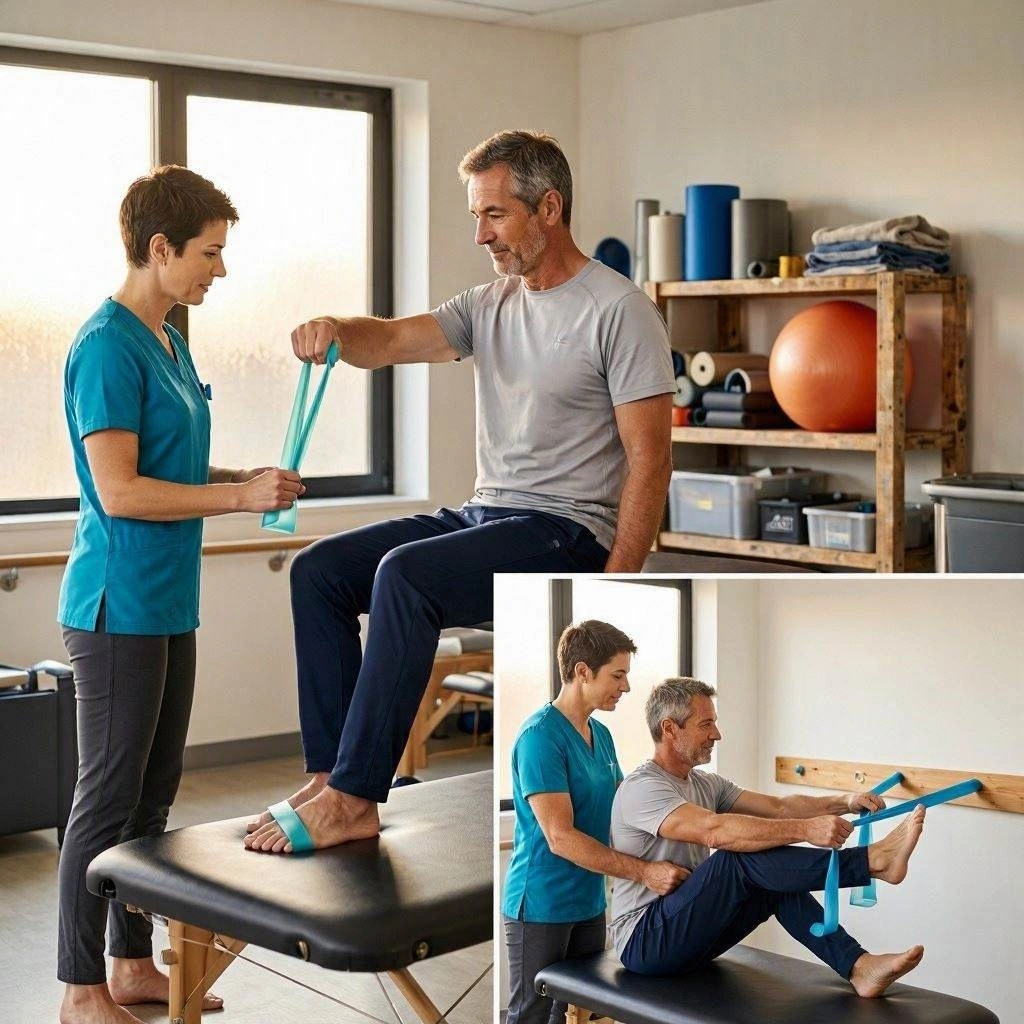
3. Progressive Strengthening
Progressive exercise is a central part of rehabilitation for persistent tennis elbow.
Exercises may include static muscle contractions, controlled wrist movements, and gradually heavier resistance training. The programme is adjusted according to symptom irritability and the person’s response to previous sessions.
The aim is to build strength and endurance so that the forearm can better tolerate the demands of work, sport, and daily activities.
4. Manual Therapy
A physiotherapist may use selected hands-on techniques to address pain or movement limitations.
These techniques can sometimes provide short-term symptom relief or make it easier to perform exercises. However, manual therapy should generally support an active rehabilitation programme rather than replace progressive strengthening and activity modification.
5. Education and Self-Management
Understanding the condition helps patients make more confident decisions about activity.
A physiotherapist can explain how to monitor symptoms, adjust exercise loads, manage repetitive tasks, and return to demanding activities gradually.
This approach is particularly valuable for people whose symptoms fluctuate depending on work demands or sports training.
For further information about rehabilitation services, visit Ritz Clinics Physiotherapy.
The Best Physiotherapy Exercises for Tennis Elbow (Physiotherapy for Tennis Elbow)
The exercises below are common examples used in tennis elbow rehabilitation. They are not suitable for every person at every stage, so begin conservatively and seek individualized guidance if symptoms are severe or persistent.
Use a comfortable range of motion and avoid forcing a movement through sharp pain. A mild, manageable increase in discomfort may be acceptable in some exercise programmes, but symptoms should not become progressively worse or remain significantly aggravated afterward.
1. Gentle Wrist Extension Stretch
This stretch targets the muscles along the back of the forearm.
How to perform it:
- Extend the affected arm in front of you.
- Keep the elbow straight or slightly bent, whichever is more comfortable.
- Turn the palm toward the floor.
- Gently bend the wrist downward using the other hand.
- Stop when you feel a mild stretch along the forearm.
- Hold for approximately 15–30 seconds, if comfortable.
- Relax and repeat two or three times.
Potential benefit: The stretch may help maintain forearm flexibility and provide temporary relief for some people.
Do not pull forcefully on the wrist. If the stretch produces sharp elbow pain, tingling, or numbness, ease off and ask a clinician whether a different position would be more appropriate.
2. Isometric Wrist Extension
An isometric exercise involves activating a muscle without visibly moving the joint. It may be useful when the forearm is sensitive to heavier movement.
How to perform it:
- Sit comfortably with the affected forearm supported on a table.
- Keep the wrist in a neutral position.
- Place your other hand over the back of the affected hand.
- Gently try to lift the affected wrist while the other hand prevents movement.
- Hold the contraction for five to ten seconds.
- Relax fully before repeating.
Start with five repetitions using light effort. Increase the effort only if symptoms remain manageable.
Potential benefit: Isometric loading allows the wrist extensor muscles to work without repeatedly moving the wrist through its full range.
It is not necessary to contract as hard as possible. Begin at a comfortable level and adjust the intensity according to your response.
3. Wrist Extension With a Light Weight
Controlled resistance exercises can help improve the strength and endurance of the wrist extensor muscles.
How to perform it:
- Sit with the forearm supported on a table or armrest.
- Hold a very light dumbbell or another suitable household weight.
- Position the palm facing downward, with the wrist near the edge of the support.
- Slowly raise the back of the hand.
- Lower the weight under control.
- Keep the forearm supported throughout the movement.
Begin with one set of eight to ten repetitions if appropriate. Increase repetitions or resistance gradually as the exercise becomes easier to tolerate.
Potential benefit: Progressive wrist extension helps train the muscles and tendon for gripping and lifting tasks.
Avoid swinging the weight or lifting through sharp pain. If even a light weight aggravates symptoms, return to a lower-load variation.
4. Eccentric Wrist Extension
Eccentric exercise focuses on the phase when a muscle produces force while lengthening. It is commonly included in tendon rehabilitation.
How to perform it:
- Support your forearm on a table with the palm facing downward.
- Use the unaffected hand to help raise the affected wrist.
- Remove the assisting hand.
- Slowly lower the affected wrist over approximately three to five seconds.
- Use the unaffected hand to return the wrist to the starting position.
- Repeat with a light load if tolerated.
A clinician may prescribe a progression such as two or three sets of ten to fifteen repetitions, but the appropriate dose depends on symptoms and training experience.
Potential benefit: Eccentric loading helps develop the forearm’s capacity to manage controlled resistance.
Eccentric exercises are not necessarily superior for everyone. Isometric and concentric exercises may also be useful, and a combined programme is often selected according to individual needs.
5. Concentric Wrist Extension (Physiotherapy for Tennis Elbow)
Concentric exercise trains the muscle while it shortens.
How to perform it:
- Rest your forearm on a stable surface.
- Hold a light weight with your palm facing downward.
- Begin with the wrist slightly bent downward, within a comfortable range.
- Slowly lift the wrist upward.
- Lower it again under control.
Start with a small number of repetitions and avoid moving into an uncomfortable end range.
Potential benefit: Combining lifting and lowering phases helps train the wrist extensors through controlled movement.
Progress the resistance gradually rather than increasing the weight simply because the exercise feels easy on one occasion.
6. Gentle Grip Training
Grip exercises may be useful because tennis elbow frequently affects activities that require holding or carrying objects.
How to perform it:
- Hold a soft foam ball or folded towel.
- Squeeze gently without causing sharp pain.
- Hold the squeeze for approximately three to five seconds.
- Release completely.
- Repeat a few times.
Start with a low level of effort. Avoid repeatedly squeezing a hard object or training to exhaustion when symptoms are irritable.
Potential benefit: Gradual grip training can help restore confidence and capacity for tasks such as carrying bags, using tools, and holding sports equipment.
7. Forearm Rotation
Forearm rotation involves turning the palm upward and downward. It can help maintain comfortable movement needed for everyday tasks.
How to perform it:
- Sit with your elbow bent and close to your body.
- Keep the wrist relaxed.
- Slowly turn the palm upward.
- Return to the starting position.
- Turn the palm downward.
- Repeat within a comfortable range.
Begin without a weight. A light hammer or similar object may be introduced later if a physiotherapist recommends it.
Potential benefit: The exercise practises controlled forearm movement used when turning door handles, using utensils, and handling tools.
Avoid using a heavy object or forcing the movement when the elbow is painful.
8. Shoulder and Upper-Back Strengthening
The shoulder and upper-back muscles contribute to arm control during lifting, throwing, and racquet sports. A physiotherapist may include shoulder exercises if the assessment identifies weakness or reduced control.
Examples may include gentle resistance-band rows or other low-load shoulder exercises.
How to approach the exercise:
- Choose a resistance level that allows controlled movement.
- Keep your shoulders relaxed.
- Avoid gripping the resistance band harder than necessary.
- Perform slow, comfortable repetitions.
- Stop if the exercise increases elbow symptoms.
Potential benefit: Addressing relevant shoulder and upper-limb limitations may help improve overall movement efficiency.
Shoulder strengthening is not required for every patient. Exercises should target the limitations identified during assessment.
How to Progress Your Tennis Elbow Exercises
Rehabilitation works best when the exercise programme gradually matches the demands of everyday life.
Early Stage: Reduce Irritation
When symptoms are easily aggravated, begin with manageable activity changes, gentle movement, and possibly low-load isometric contractions.
Avoid suddenly increasing resistance or performing large volumes of gripping exercises.
Middle Stage: Build Strength
As symptoms become more manageable, your physiotherapist may introduce controlled wrist extension, forearm rotation, and grip training.
Increase the number of repetitions or the resistance gradually. Change one aspect of the programme at a time so you can assess how the arm responds.
Later Stage: Improve Endurance (Physiotherapy for Tennis Elbow)
People who work with tools, lift objects regularly, or play racquet sports may need to develop greater endurance.
This may involve progressively longer exercise sets, heavier resistance, or simulated work tasks. The progression should reflect the person’s actual goals.
Return to High-Demand Activity
The final stage may involve practising the specific activities that originally caused symptoms.
A tennis player may gradually return to hitting drills before increasing match duration. A tradesperson may progressively increase lifting and tool use. An office worker may gradually resume longer work periods if these were previously aggravating.
Progress should be based on symptoms, strength, endurance, and functional ability rather than a fixed date.
What Should You Avoid if You Have Tennis Elbow?
Complete rest is not always necessary, but some changes may help reduce repeated aggravation.
Avoid Repeated Heavy Gripping During a Flare-Up
If heavy gripping causes substantial pain, temporarily reduce the load or divide the task into shorter periods.
Gradually reintroduce the activity as your tolerance improves.
Avoid Increasing Exercise Resistance Too Quickly
Tendons need time to adapt. A sudden jump in weight, repetitions, or training frequency can make symptoms more difficult to manage.
Increase the workload in small steps and observe the response over the following day.
Avoid Forceful Stretching
A stretch should not require you to pull hard through pain. Strong stretching does not necessarily improve recovery and may aggravate sensitive symptoms.
Avoid Relying Only on Passive Treatments
Massage, braces, or other supportive treatments may help some people manage symptoms. However, passive treatment alone may not adequately restore strength and load tolerance.
An active programme involving appropriate exercises and activity modification is generally an important part of rehabilitation.
Avoid Ignoring Symptoms That Suggest Another Problem (Physiotherapy for Tennis Elbow)
Persistent numbness, substantial weakness, severe swelling, or symptoms that do not fit the typical pattern of tennis elbow deserve further assessment.
Do not assume every arm symptom is caused by a tendon problem.
How Long Does Tennis Elbow Take to Heal?
Recovery varies considerably between individuals.
Some people notice improvement within a few weeks after adjusting aggravating activities. Others experience symptoms for several months, particularly when the condition has been present for a long time or their work repeatedly loads the affected tendon.
Factors that can influence recovery include:
- How long symptoms have been present.
- The level of pain and functional limitation.
- The demands of work, sport, and hobbies.
- The ability to modify aggravating activities.
- Consistency with an appropriate exercise programme.
- Other health conditions or sources of pain.
Improvement does not always occur in a straight line. Symptoms may fluctuate as activity levels change.
A useful sign of progress is being able to perform more activities with less discomfort and without a prolonged increase in symptoms afterward.
If the condition has not improved after several weeks of appropriate self-management, or pain is interfering with work and daily activities, consider a clinical assessment. A physiotherapist can review your diagnosis, adjust the programme, and determine whether referral for further investigation is appropriate.

Can a Tennis Elbow Brace Help?
A counterforce strap or wrist support may help some people perform particular tasks with less discomfort. However, braces do not cure the underlying tendon problem, and their effectiveness varies.
If you try a brace, ensure that it fits comfortably and does not cause numbness, tingling, swelling, or skin irritation.
A brace should be used alongside appropriate activity modification and rehabilitation rather than as a substitute for strengthening.
A physiotherapist can help determine whether a brace is suitable for your work or sports activities.
Does Tennis Elbow Require Surgery?
Most people do not need surgery for tennis elbow.
Treatment usually begins with conservative measures, including activity modification and exercise-based rehabilitation. Other treatments may be considered according to symptoms, preferences, and clinical findings.
Surgery may be discussed in selected cases when substantial symptoms persist despite an adequate period of non-surgical management. The decision depends on the diagnosis, functional limitations, previous treatments, and potential benefits and risks.
Persistent pain does not automatically mean surgery is necessary. Before considering an operation, a clinician may reassess the diagnosis and review whether the rehabilitation programme adequately addressed the relevant impairments and activity demands.
Frequently Asked Questions About Physiotherapy for Tennis Elbow
1. What is the best physiotherapy treatment for tennis elbow?
There is no single best treatment for everyone. A tailored programme often includes education, activity modification, progressive wrist extensor strengthening, and selected manual therapy when appropriate. The plan should match the severity of symptoms and the patient’s goals.
2. Can physiotherapy cure tennis elbow?
Physiotherapy can help many people reduce symptoms and restore function. However, outcomes vary, and no treatment can guarantee a cure. Rehabilitation aims to improve the tendon’s ability to tolerate activity and help the person return to normal tasks.
3. Should I stop exercising if I have tennis elbow?
You may not need to stop all exercise. Instead, modify activities that repeatedly aggravate the elbow and continue suitable movements where possible. Reduce the workload if symptoms worsen significantly, and seek professional guidance if you are unsure which exercises are appropriate.
4. Are eccentric exercises good for tennis elbow?
Eccentric wrist extension is commonly used in rehabilitation, but it is not the only useful option. Isometric and concentric exercises may also help. The most appropriate combination depends on the person’s symptoms, capacity, and progress.
5. Can tennis elbow occur without playing tennis?
Yes. Tennis elbow can affect people who perform repetitive gripping, lifting, wrist movements, or manual work. It is also seen in people who use computers or perform other tasks that place repeated demands on the forearm.
6. How often should I do tennis elbow exercises?
The recommended frequency depends on the exercise, resistance, and severity of symptoms. Some programmes use regular strengthening sessions over several weeks, but not every patient should follow the same schedule. Begin with a manageable dose and follow your clinician’s instructions.
7. Is massage helpful for tennis elbow?
Massage or other manual techniques may provide short-term relief for some people. They are generally best considered as an adjunct to exercise and activity modification rather than the only treatment.
8. When should I see a physiotherapist for tennis elbow?
Consider physiotherapy if pain persists, gripping or lifting is difficult, symptoms interfere with work or sport, or you are uncertain how to exercise safely. Seek medical assessment sooner if the pain follows significant trauma or is accompanied by marked swelling, numbness, or weakness.
9. Can I play tennis while recovering?
Some people can continue modified tennis activity, while others need a temporary reduction in playing. Adjust training volume, intensity, and technique according to symptoms. Gradually return to full practice and competition when strength, endurance, and functional tolerance have improved.
10. What happens if tennis elbow is left untreated?
Some cases improve over time, but others persist or recur, particularly when the activities that aggravate the tendon continue unchanged. Assessment and a structured rehabilitation programme may help improve function and guide a safer return to normal activity.
Final Thoughts: Choosing the Right Physiotherapy Plan
Tennis elbow can interfere with work, sport, and everyday tasks, but many people improve with appropriate non-surgical management. Physiotherapy focuses on identifying aggravating activities, maintaining comfortable movement, rebuilding wrist and forearm strength, and progressively restoring the ability to tolerate daily demands.
The most useful rehabilitation programme is one that matches your symptoms and goals. Start with manageable exercise loads, progress gradually, and avoid forcing movements that cause sharp or worsening pain. If symptoms persist or your function declines, seek professional assessment rather than relying on the same routine indefinitely.
For guidance on rehabilitation options, visit Ritz Clinics Physiotherapy. A qualified healthcare professional can assess your elbow, identify relevant limitations, and help develop a programme suited to your needs.
Medical disclaimer: This article is for educational purposes and does not replace a medical diagnosis or individualized treatment plan. Exercise suitability varies, particularly when symptoms are severe or another condition may be responsible for the pain.