Physiotherapy Functional Rehabilitation: Complete Guide to Recovery and Physical Function
Physiotherapy Functional Rehabilitation is a movement-focused approach designed to help people regain the physical abilities they need for everyday life, work, exercise, and sport. Instead of focusing only on pain or isolated muscles, functional rehabilitation connects physiotherapy exercises with real-world activities.
Walking, climbing stairs, lifting, carrying, reaching, pushing, pulling, squatting, getting up from a chair, and returning to sport all require several parts of the body to work together. When an injury, surgery, pain, weakness, stiffness, or reduced physical conditioning affects movement, these activities can become more difficult.
Functional rehabilitation helps bridge the gap between basic treatment and normal activity. Depending on the person’s condition, a physiotherapist may work on strength, mobility, balance, coordination, endurance, movement control, and task-specific activities.
At Ritz Clinic, functional rehabilitation can be integrated with movement therapy, therapeutic exercise, injury rehabilitation, and other physiotherapy services according to the individual’s symptoms and goals. Current physiotherapy guidance also emphasizes individualized assessment, exercise, movement training, and gradual progression as important parts of rehabilitation.
What Is Physiotherapy Functional Rehabilitation?
Physiotherapy Functional Rehabilitation is a rehabilitation approach that focuses on improving the physical abilities required for meaningful activities.
Traditional physiotherapy exercises may sometimes target a specific muscle, joint, or movement. These exercises can be extremely useful. However, everyday activities rarely involve one body part working independently.
For example, lifting an object from the floor may require:
- Leg strength
- Hip mobility
- Trunk control
- Shoulder movement
- Grip strength
- Balance
- Coordination
- Movement confidence
Functional rehabilitation considers how these abilities work together.
Therefore, instead of asking only whether a particular muscle has become stronger, a physiotherapist may also ask whether the person can use that strength during an activity that matters to them.
A functional rehabilitation program may include:
- Strengthening exercises
- Mobility exercises
- Balance training
- Coordination exercises
- Walking and gait training
- Squatting
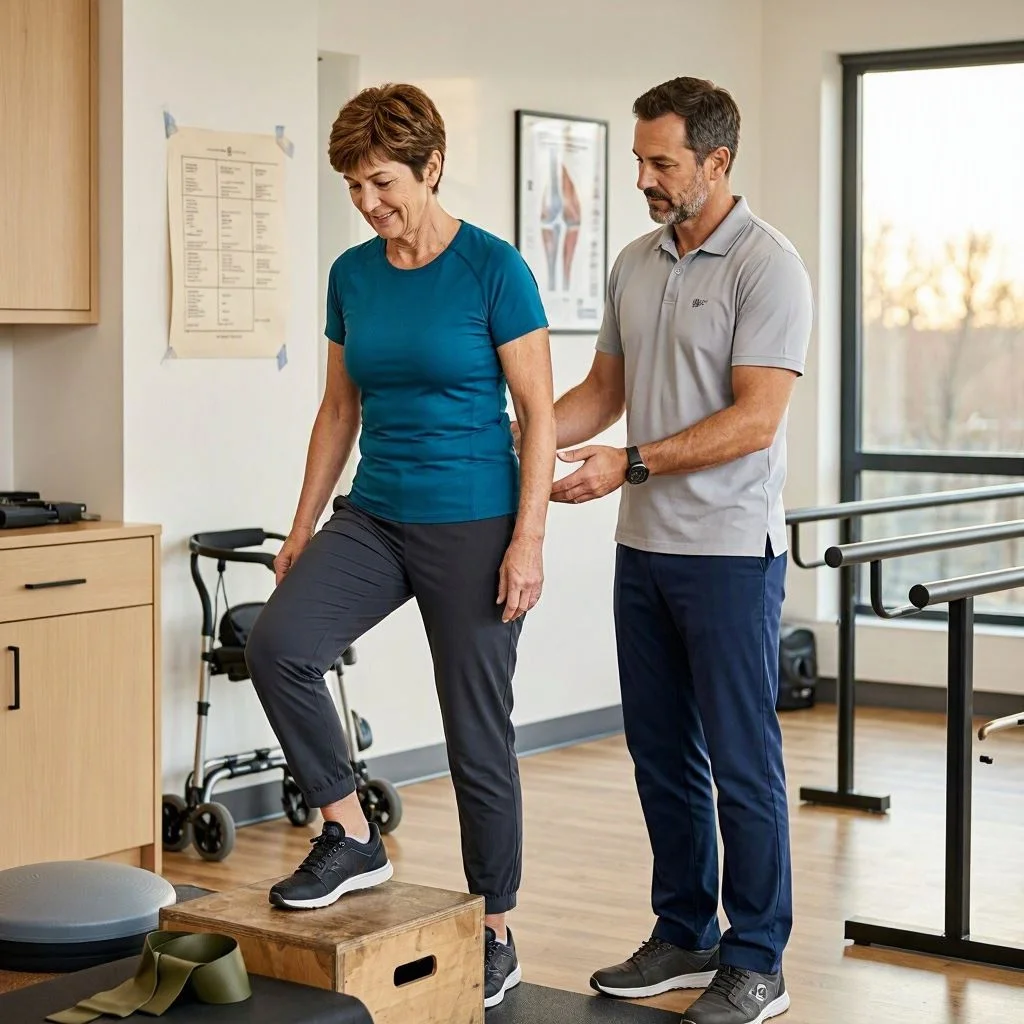
- Step-ups
- Lifting and carrying
- Reaching
- Pushing and pulling
- Stair training
- Sport-specific movements
- Work-related activities
The exact exercises depend on the person’s condition, physical capacity, lifestyle, and rehabilitation goals.
Why Is Functional Rehabilitation Important?
Reducing pain can be an important part of recovery. However, pain relief alone does not always mean that physical function has fully returned.
A person may experience less pain but still have:
- Muscle weakness
- Reduced endurance
- Limited mobility
- Poor balance
- Reduced coordination
- Fear of movement
- Difficulty lifting
- Difficulty climbing stairs
- Reduced exercise tolerance
For example, someone recovering from knee surgery may have less pain but still struggle to stand from a chair.
Similarly, someone recovering from an ankle injury may be able to walk normally but still lack the balance and strength required for running.
Functional rehabilitation helps address this gap.
The goal is to gradually move from basic physical capacity toward the activities that the person needs or wants to perform.
Exercise-based physiotherapy is commonly used to improve strength, mobility, movement confidence, and physical capacity.
How Does Physiotherapy Functional Rehabilitation Work?
Functional rehabilitation usually starts with an assessment.
Your physiotherapist may ask about:
- Your symptoms
- Previous injuries
- Medical history
- Daily activities
- Work requirements
- Exercise habits
- Sports participation
- Current limitations
- Recovery expectations
- Personal goals
The physical assessment may consider:
- Strength
- Range of motion
- Balance
- Coordination
- Walking
- Posture
- Movement patterns
- Functional tasks
- Exercise tolerance
The information gathered during this process helps determine where rehabilitation should begin.
For example, someone with significant weakness may initially need basic strengthening. Later, the same person may progress to standing exercises, step-ups, squats, lifting, carrying, and more demanding functional activities.
Consequently, functional rehabilitation is not simply a list of exercises. It is a progressive process that connects assessment, exercise, movement, and meaningful goals.
Functional Rehabilitation vs. Traditional Physiotherapy
Traditional physiotherapy exercises can focus on specific physical qualities.
For example:
- Leg extensions can develop quadriceps strength.
- Calf raises can improve calf strength.
- Resistance-band exercises can strengthen the hips or shoulders.
- Mobility exercises can address restricted movement.
These exercises can form an important foundation.
Functional rehabilitation then connects those abilities with practical activities.
For example, after developing sufficient leg strength, rehabilitation may progress toward:
- Sit-to-stand movements
- Step-ups
- Squats
- Stair climbing
- Controlled lunges
- Carrying
Both approaches can work together.
The purpose is not to replace conventional therapeutic exercise. Instead, functional rehabilitation can build on it.
Functional Rehabilitation for Everyday Activities
Many people seek physiotherapy because normal activities have become difficult.
Functional rehabilitation can recreate these activities in a controlled environment.
Getting Up From a Chair
Standing from a chair requires coordinated movement of the hips, knees, ankles, and trunk.
A person with reduced leg strength may initially need support or a higher chair.
As strength and confidence improve, the task can gradually become more challenging.
Climbing Stairs
Stair climbing requires:
- Leg strength
- Balance
- Coordination
- Weight transfer
- Mobility
- Endurance
Step-up exercises can help prepare the body for stair-related demands.
Lifting
Lifting may be necessary at home, work, or during exercise.
A physiotherapist can gradually introduce lifting according to the person’s physical capacity.
The goal is not necessarily to teach one universal lifting technique. Instead, rehabilitation can focus on developing sufficient strength, control, confidence, and tolerance for the person’s specific demands.
Carrying
Carrying groceries, luggage, equipment, or workplace materials requires strength and stability.
Functional rehabilitation can gradually introduce carrying tasks using an appropriate load.
Reaching
Reaching can involve the shoulder, upper back, trunk, and lower body.
Functional reaching exercises can help prepare someone for household, workplace, or recreational activities.
Strength Training in Functional Rehabilitation
Strength is one of the foundations of physical function.
When muscles do not have enough strength for a particular activity, everyday movements can become more difficult.
Physiotherapy strengthening exercises may use:
- Bodyweight
- Resistance bands
- Dumbbells
- Cable machines
- Exercise machines
- Weighted objects
- Isometric exercises
The appropriate resistance depends on the person’s condition and current capacity.
Progression may involve changing:
- Resistance
- Repetitions
- Sets
- Range of motion
- Movement speed
- Exercise complexity
- Stability requirements
- Endurance demands
The objective is gradual adaptation.
Starting with an unnecessarily heavy load can make exercise difficult to control. On the other hand, an exercise that remains too easy forever may not provide enough challenge for continued improvement.
Therefore, rehabilitation should progress according to the individual’s response.
Mobility Training
Strength is important, but it is not the only requirement for functional movement.
A person can have adequate strength and still struggle with an activity because of restricted mobility.
Mobility rehabilitation may focus on:
- Hips
- Ankles
- Knees
- Spine
- Shoulders
- Wrists
For example, reduced ankle mobility may affect squatting or stair climbing.
Limited shoulder movement may make reaching overhead difficult.
Reduced hip mobility may influence walking, sitting, squatting, or getting out of a chair.
Mobility exercises can help address these limitations when they are relevant to the individual’s condition.
However, not every person needs the same mobility exercises.
A physiotherapist should select exercises according to the assessment rather than simply following a generic routine.
Balance Training
Balance plays an important role in everyday movement.
It helps people:
- Walk safely
- Turn
- Climb stairs
- Step over obstacles
- Stand from a chair
- Move across uneven surfaces
- Participate in sports
Balance exercises can begin with relatively simple tasks and progress gradually.
Examples include:
- Weight shifting
- Tandem standing
- Single-leg standing
- Step-ups
- Controlled reaching
- Direction changes
- Dynamic balance exercises
The level of difficulty should match the person’s abilities.
For older adults, strength, balance, and coordination activities can also support independence and physical function. Physiotherapy programs can adapt these activities to the person’s current abilities and environment.
Coordination and Movement Control
Functional activities require different parts of the body to work together.
Walking, for example, requires coordination between:
- Feet
- Ankles
- Knees
- Hips
- Pelvis
- Trunk
- Arms
An injury can sometimes change movement patterns.
A person may avoid loading one side of the body, shorten their stride, or use additional movements to compensate.
Functional rehabilitation can provide opportunities to practice controlled movement again.
Exercises may include:
- Stepping patterns
- Reaching
- Balance drills
- Walking exercises
- Direction changes
- Controlled lifting
- Functional transitions
- Sport-specific movements
The goal is to gradually develop movement control while respecting the person’s symptoms and physical capacity.
Physiotherapy Functional Rehabilitation for Back Pain
Back pain can interfere with many everyday activities.
A person may have difficulty:
- Sitting
- Standing
- Bending
- Walking
- Lifting
- Exercising
- Getting out of bed
- Performing household activities
Functional rehabilitation can gradually connect mobility and strengthening exercises with these activities.
A program may progress from basic exercises toward:
- Trunk strengthening
- Hip strengthening
- Controlled bending
- Squatting
- Light lifting
- Carrying
- Activity-specific movements
The progression depends on the person’s symptoms and physical capacity.
For persistent back problems, exercise can help improve strength, movement confidence, and physical function. However, severe, unexplained, rapidly worsening, or concerning symptoms require appropriate medical assessment rather than routine exercise alone.
Functional Rehabilitation for Knee Problems
Knee problems can affect:
- Walking
- Running
- Squatting
- Stair climbing
- Jumping
- Getting up from a chair
A physiotherapy program may address:
- Quadriceps strength
- Hamstring strength
- Hip strength
- Ankle mobility
- Balance
- Coordination
- Movement control
Exercises may include:
- Sit-to-stand
- Squats
- Step-ups
- Lunges
- Leg strengthening
- Balance exercises
- Walking drills
As physical capacity improves, the exercises can become more demanding.
For an athlete, later stages may include running, jumping, landing, acceleration, deceleration, or changes of direction when clinically appropriate.
Functional Rehabilitation for Shoulder Problems
Shoulder rehabilitation often needs to progress beyond isolated exercises.
A person may initially perform controlled strengthening and mobility exercises.
As their physical capacity improves, rehabilitation may progress toward:
- Reaching
- Lifting
- Carrying
- Pushing
- Pulling
- Overhead activities
The specific progression depends on the individual’s condition.
For example, an office worker may need to regain comfortable reaching and desk-related movement, while a construction worker may need greater lifting and overhead capacity.
An athlete may require even more demanding movements.
Therefore, functional rehabilitation should reflect the person’s real requirements.
Functional Rehabilitation After Surgery
Surgery can temporarily affect:
- Strength
- Mobility
- Endurance
- Balance
- Coordination
- Confidence
Physiotherapy can help people gradually rebuild these abilities.
Depending on the procedure, rehabilitation may include:
- Mobility exercises
- Strengthening
- Walking
- Balance training
- Transfers
- Stair training
- Functional movement
- Gradual return to exercise
The timeline varies according to the surgery, healing process, medical instructions, and individual response.
Postoperative rehabilitation should follow appropriate medical guidance.
The aim is to restore useful physical function while respecting the healing process.
Functional Rehabilitation After Sports Injuries
Athletes often need greater physical capacity than is required for everyday activities.
Returning to soccer, for example, may require:
- Running
- Sprinting
- Acceleration
- Deceleration
- Jumping
- Landing
- Cutting
- Direction changes
Returning to tennis may require:
- Rotational movement
- Reaching
- Sprinting
- Stopping
- Lateral movement
- Repeated arm activity
Therefore, returning to sport usually requires more than simply becoming pain-free.
Rehabilitation can gradually introduce sport-specific demands.
At Ritz Clinic, injury rehabilitation can incorporate movement training, strengthening, balance, coordination, and progressive activity according to the individual’s needs. This can help connect rehabilitation with everyday activities, work, exercise, and sports.
Functional Rehabilitation for Workplace Recovery
Different jobs require different physical abilities.
An office worker may need:
- Sitting tolerance
- Walking
- Reaching
- Computer use
- Occasional lifting
A warehouse employee may need:
- Lifting
- Carrying
- Pushing
- Pulling
- Repeated squatting
- Walking
A healthcare worker may need:
- Standing
- Walking
- Patient transfers
- Pushing equipment
- Reaching
- Bending
Functional rehabilitation can reproduce some of these requirements in a controlled environment.
This can help a physiotherapist identify which physical abilities need further development before returning to specific duties.
The goal is not necessarily to reproduce the workplace perfectly.
Instead, exercises can target the physical abilities that the job requires.
Functional Rehabilitation for Older Adults
Functional movement becomes particularly important as people age because everyday independence depends on physical capacity.
Important activities include:
- Walking
- Standing
- Sitting
- Climbing stairs
- Carrying
- Reaching
- Maintaining balance
Strength and balance exercises can help support physical function.
A physiotherapist can adapt exercises to the individual’s current strength, balance, mobility, confidence, and home environment.
For someone who struggles with stairs, for example, stair-related exercises may be more meaningful than exercises that do not relate to their daily life.
Functional Rehabilitation for Chronic Conditions
Functional rehabilitation is not limited to recent injuries.
It may also form part of care for people living with longer-term physical limitations.
Depending on the condition, physiotherapy may address:
- Strength
- Mobility
- Balance
- Endurance
- Coordination
- Physical activity
- Daily function
- Confidence with movement
However, the program should reflect the person’s medical condition and current health.
People with complex or serious medical conditions may require coordination between physiotherapists, physicians, and other healthcare professionals.
Progressive Loading in Functional Rehabilitation
Progressive loading is a key principle of physical rehabilitation.
The body adapts to physical demands.
As a result, rehabilitation may gradually increase the challenge.
Progression can involve:
- Increasing resistance
- Adding repetitions
- Increasing sets
- Expanding movement range
- Increasing movement speed
- Reducing external support
- Adding balance demands
- Increasing endurance
- Introducing more complex movements
For example, rehabilitation after a lower-limb injury might progress from supported standing to:
Standing → Sit-to-Stand → Squat → Step-Up → Stair Training → Walking → Running
The exact sequence varies between individuals.
The important principle is gradual progression rather than rushing toward the final activity.
Functional Rehabilitation and Pain
Pain can influence how people move.
When someone experiences pain, they may:
- Avoid certain movements
- Reduce activity
- Change walking patterns
- Move more cautiously
- Become concerned about exercise
This can sometimes contribute to reduced strength or physical confidence.
Functional rehabilitation can gradually reintroduce meaningful activities.
However, pain should not simply be ignored.
A physiotherapist should consider:
- Where the pain occurs
- How severe it is
- How long it has been present
- What activities affect it
- Whether symptoms are improving or worsening
- Whether other symptoms are present
If symptoms are severe, unexplained, rapidly worsening, or associated with significant weakness, loss of sensation, major trauma, or other concerning signs, further medical assessment may be necessary.
Home Exercise During Functional Rehabilitation
Rehabilitation continues outside the clinic.
A physiotherapist may provide a home exercise program designed around the person’s condition and goals.
It may include:
- Strength exercises
- Mobility exercises
- Balance exercises
- Walking
- Functional movements
- Stretching
- Endurance activities
Home exercises can help people stay active between appointments.
However, exercises should be appropriate for the person’s condition. NHS physiotherapy guidance recommends discussing specific joint, muscle, or other physical problems with a physiotherapist before beginning exercises that may not be suitable for the individual.
Consistency is often more useful than an unnecessarily complicated routine.
A manageable program that fits into everyday life may be easier to maintain over time.
How Is Progress Measured?
Functional rehabilitation should have measurable goals.
A physiotherapist may monitor:
- Strength
- Mobility
- Balance
- Walking
- Endurance
- Exercise tolerance
- Movement control
- Functional tasks
- Work ability
- Sports performance
- Confidence
Progress can also be very practical.
For example, improvement may mean:
- Walking farther
- Climbing stairs more comfortably
- Getting out of a chair without assistance
- Carrying groceries
- Returning to work
- Lifting a specific load
- Returning to running
- Completing daily tasks with less difficulty
The best goals are usually meaningful to the person.
How Long Does Physiotherapy Functional Rehabilitation Take?
There is no single timeline for functional rehabilitation.
Recovery depends on:
- Type of injury
- Severity
- Surgery
- Age
- General health
- Physical conditioning
- Previous injuries
- Work requirements
- Sports requirements
- Consistency with rehabilitation
- Individual response
Some people may make significant progress within weeks, while others require several months.
The program can also change over time.
Early rehabilitation may focus on basic mobility and symptom management.
Later stages may emphasize strength, endurance, balance, functional movement, and activity-specific training.
Therefore, rehabilitation should be based on progress rather than an arbitrary deadline.
When Should You Seek Medical Assessment?
Physiotherapy can help with many movement and musculoskeletal problems. However, some symptoms require medical evaluation.
Seek appropriate medical care if you experience:
- Major trauma
- Suspected fracture
- Severe or rapidly worsening pain
- Sudden significant weakness
- New loss of sensation
- Loss of bladder or bowel control
- Chest pain
- Difficulty breathing
- Loss of consciousness
- Severe unexplained symptoms
- Significant neurological changes
A physiotherapist may also recommend medical assessment if an examination suggests that another healthcare professional should investigate the symptoms.
Functional rehabilitation should support safe recovery, not delay necessary medical care.
Physiotherapy Functional Rehabilitation at Ritz Clinic
Ritz Clinic provides movement-focused physiotherapy services that can be integrated with functional rehabilitation.
The clinic’s current Physiotherapy Functional Training approach focuses on improving the physical abilities needed for everyday activities, work, exercise, and sports. It can include strengthening, mobility, balance, coordination, gait training, functional movement, and progressive activity according to the individual’s condition and goals.
For patients recovering from an injury, functional rehabilitation can also connect with broader injury rehabilitation services at Ritz Clinic.
For movement-focused care, Physiotherapy Movement Therapy can complement functional rehabilitation by emphasizing exercise, movement, and physical function.
This individualized approach can be useful because no two rehabilitation journeys are exactly the same.
A recreational athlete may need a return-to-sport program.
An office worker may need to rebuild sitting and movement tolerance.
An older adult may focus on balance, walking, stairs, and independence.
Someone recovering from surgery may need a carefully controlled progression from basic movement toward normal activities.
How to Get the Most From Functional Rehabilitation
Be Consistent
Regular participation in your rehabilitation program can help maintain progress.
Communicate With Your Physiotherapist
Tell your physiotherapist about changes in symptoms, difficulty with exercises, or activities that remain challenging.
Set Clear Goals
Explain what you want to return to.
“Walk comfortably for 30 minutes” is a more useful rehabilitation target than simply saying “get better.”
Progress Gradually
Avoid making large increases in exercise volume without appropriate guidance.
Stay Active Within Your Limits
Appropriate physical activity can help maintain conditioning while rehabilitation progresses.
Prioritize Recovery
Sleep, nutrition, and appropriate rest can support your ability to tolerate physical activity.
Focus on Function
Do not measure progress only by pain.
Consider whether you can perform meaningful activities more comfortably, confidently, and effectively.
Final Thoughts
Physiotherapy Functional Rehabilitation connects exercise-based physiotherapy with the activities people actually need to perform.
Instead of focusing exclusively on one muscle or one joint, functional rehabilitation can combine strength, mobility, balance, coordination, endurance, and movement control.
The exercises may include squatting, stepping, lifting, carrying, reaching, walking, stair climbing, pushing, pulling, and sport-specific movements.
However, functional rehabilitation is not simply about making exercises harder.
The goal is to gradually build the physical capacity needed for meaningful activities.
For someone recovering from an injury, rehabilitation might progress from basic movement to strengthening, balance, functional tasks, and eventually sport or work-specific activity.
For an athlete, the final stages may involve running, jumping, landing, changing direction, or other sport-specific requirements.
A successful program therefore needs to be individualized.
The most appropriate exercises depend on the person’s symptoms, physical capacity, goals, environment, and recovery stage.
For an older adult, the focus might be walking, stairs, carrying, balance, and independence.
For a worker, rehabilitation may focus on the physical demands of the job.
At Ritz Clinic, functional physiotherapy can be part of a broader movement and rehabilitation approach designed around the individual’s needs.
Ultimately, the goal is practical: to help people build the physical capacity and confidence required to return to the activities that matter to them.
Frequently Asked Questions About Physiotherapy Functional Rehabilitation
What is Physiotherapy Functional Rehabilitation?
Physiotherapy Functional Rehabilitation is an exercise and movement-based approach that helps people rebuild strength, mobility, balance, coordination, endurance, and physical function for everyday activities, work, exercise, or sport.
What exercises are used in functional rehabilitation?
Exercises may include squats, lunges, step-ups, walking, lifting, carrying, reaching, balance exercises, resistance training, stair practice, and sport-specific movements.
Is functional rehabilitation only for athletes?
No. Functional rehabilitation can benefit people recovering from injuries, surgery, workplace problems, joint conditions, reduced physical conditioning, and other movement limitations.
Can functional rehabilitation help after surgery?
Yes. Functional rehabilitation can form part of postoperative physiotherapy when appropriate. The exercises and progression should follow the surgical procedure, healing stage, and medical recommendations.
Can functional rehabilitation help with back pain?
It can help people gradually rebuild strength, mobility, movement confidence, and tolerance for everyday activities. However, severe, worsening, or concerning back symptoms require appropriate assessment.
What is the difference between functional rehabilitation and strength training?
Strength training focuses primarily on developing muscle strength and physical capacity. Functional rehabilitation connects those abilities with meaningful activities such as walking, lifting, climbing stairs, reaching, or returning to sport. Both can be used together.
Can functional rehabilitation improve balance?
Yes. Balance exercises can be included when balance is relevant to the individual’s condition and goals. Exercises can gradually progress from simple standing tasks to more dynamic activities.
Can functional rehabilitation help with workplace injuries?
Yes. Rehabilitation can include activities that reflect workplace requirements such as lifting, carrying, pushing, pulling, standing, walking, reaching, or repeated movements.
Can athletes use functional rehabilitation to return to sport?
Yes. Sports rehabilitation can progressively introduce running, jumping, landing, acceleration, deceleration, cutting, and other sport-specific activities when appropriate.
How long does functional rehabilitation take?
There is no universal timeline. Recovery depends on the injury or condition, severity, physical capacity, medical history, rehabilitation consistency, and individual response.
Does functional rehabilitation hurt?
Rehabilitation exercises can sometimes feel challenging or produce mild temporary discomfort. However, severe, unexpected, or worsening symptoms should be discussed with your physiotherapist.
How often should I do my rehabilitation exercises?
The appropriate frequency depends on your condition, exercise program, goals, and recovery stage. Your physiotherapist can provide individualized recommendations.
Do I still need rehabilitation if my pain is gone?
Possibly. Pain reduction does not always mean that strength, balance, endurance, mobility, or movement control have fully recovered. Functional assessment can help determine whether additional rehabilitation would be useful.
What should I wear for functional physiotherapy?
Comfortable clothing that allows free movement is generally appropriate. Athletic footwear can be useful when the session involves walking, balance, running, or sport-specific activities.
Where can I receive Physiotherapy Functional Rehabilitation in Thornhill?
Ritz Clinic provides physiotherapy and functional movement services in Thornhill. Treatment can be tailored around individual symptoms, physical abilities, lifestyle, and rehabilitation goals.