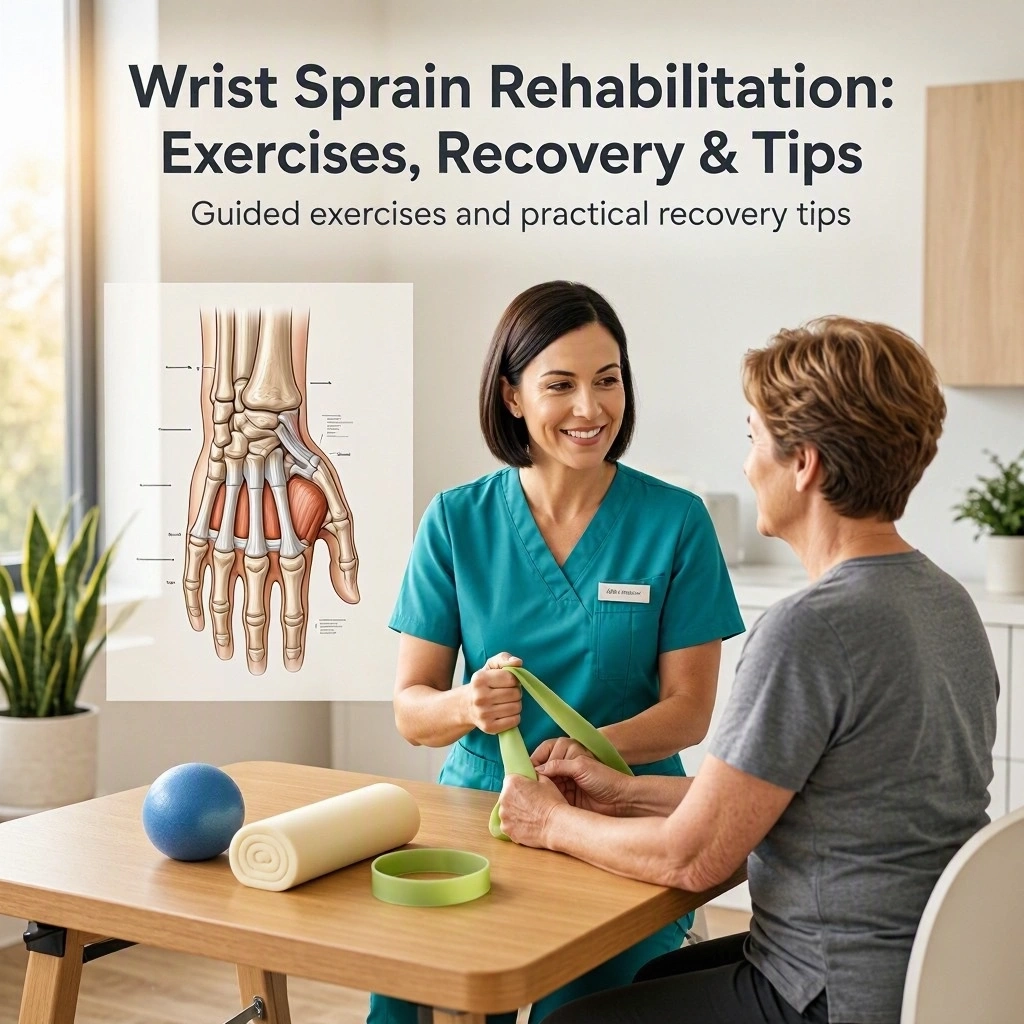
Wrist Sprain Rehabilitation: Exercises, Recovery Time, and Treatment Tips
A wrist sprain can make everyday activities such as typing, writing, lifting objects, cooking, and playing sports uncomfortable. Although many mild wrist sprains improve with conservative treatment, proper rehabilitation is important for restoring movement, rebuilding strength, and reducing the risk of recurring injuries. Understanding how to protect an injured wrist and when to begin gentle exercises can help support a safer recovery .Wrist sprain rehabilitation involves a gradual process of managing symptoms, restoring flexibility, improving grip strength, and returning to normal activities. The right approach depends on the severity of the ligament injury, the person’s symptoms, and whether additional damage has occurred.
In this guide, you will learn about common wrist sprain symptoms, treatment options, rehabilitation stages, recommended exercises, recovery timelines, and practical ways to protect your wrist during healing. You will also discover when medical assessment is necessary and why persistent wrist pain should never be ignored.
What Is a Wrist Sprain?
A wrist sprain occurs when one or more ligaments supporting the wrist joint become overstretched or torn. Ligaments are strong bands of connective tissue that connect bones and help maintain joint stability.
The wrist contains several small bones and a complex network of ligaments. These structures work together to allow the hand to bend, rotate, and perform precise movements. When a ligament is injured, normal wrist movement may become painful or restricted.
Wrist sprains commonly occur after a fall onto an outstretched hand. They can also happen during sports, sudden twisting movements, or accidents that force the wrist beyond its normal range of motion.
Not every painful wrist injury is a sprain. A fracture, dislocation, tendon injury, or more significant ligament tear can produce similar symptoms. An accurate diagnosis is therefore important before starting an exercise program.
Common Causes of Wrist Sprains
Understanding how a wrist sprain happens can help people identify risk factors and make safer decisions during recovery.
Common causes include:
- Falling forward and landing on an outstretched hand.
- Twisting the wrist suddenly while carrying an object.
- Experiencing a direct impact during sports or recreational activities.
- Losing balance while skating or participating in other activities involving falls.
- Sustaining an accident that forces the wrist into an uncomfortable position.
- Repeating demanding wrist movements without adequate recovery.
Some injuries happen during ordinary daily activities, while others occur during contact sports or activities that place considerable stress on the hands.
Previous wrist injuries may also affect stability and movement. If wrist pain repeatedly returns during the same activity, a healthcare professional can assess whether weakness, restricted mobility, or an underlying ligament injury contributes to the problem.
Symptoms of a Sprained Wrist
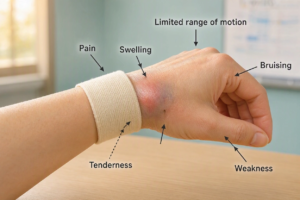
Symptoms vary according to the location and severity of the injury. Some people experience mild discomfort, while others have considerable pain and difficulty using the affected hand.
Common symptoms include:
- Pain around the wrist joint.
- Swelling near the injured area.
- Bruising or tenderness.
- Reduced wrist flexibility.
- Discomfort when gripping or lifting objects.
- Weakness during everyday activities.
- Pain when bending or rotating the wrist.
Symptoms may appear immediately or become more noticeable during the hours following an injury.
A mild sprain can sometimes be difficult to distinguish from a more serious problem. For example, a small wrist fracture may initially resemble a sprain. Persistent pain after a fall should therefore be evaluated rather than automatically treated as a minor ligament injury.
Seek urgent medical assessment if the wrist looks deformed, becomes unusually cold or discolored, feels numb, or has severe or rapidly increasing pain and swelling. Difficulty moving the fingers or using the hand after an injury also warrants prompt assessment.
Grades of Wrist Sprains
Healthcare professionals may classify ligament sprains according to the amount of damage.
Grade 1: Mild Wrist Sprain
A grade 1 sprain generally involves stretching of the ligament without a major tear. Symptoms may include mild pain, tenderness, and limited swelling.
People with mild injuries often regain normal function relatively quickly, although recovery time varies. Protecting the wrist initially and gradually restoring comfortable movement can support recovery.
Grade 2: Moderate Wrist Sprain
A grade 2 sprain involves a partial ligament tear. Pain, swelling, bruising, and reduced grip strength may be more noticeable.
Depending on the injury, treatment may include a wrist brace or splint and supervised rehabilitation. Some people need additional assessment or imaging to determine the extent of the damage.
Grade 3: Severe Wrist Sprain
A grade 3 sprain involves a complete ligament tear or a severe disruption of ligament function. The wrist may feel unstable, and normal activities can become difficult.
Severe injuries require medical evaluation. Depending on the affected ligament and the degree of instability, treatment may involve prolonged protection, specialist care, or surgery.
Rehabilitation should be tailored to the diagnosis. Exercises suitable for a mild sprain may not be appropriate for a severe tear or an injury requiring immobilization.
Why Is Wrist Sprain Rehabilitation Important?
Wrist sprain rehabilitation helps restore the functions needed for daily activities, work, and sports. Pain may improve before flexibility, coordination, and strength have fully returned.
A structured rehabilitation program may help with several goals.
Restoring range of motion: Gentle movement helps address stiffness after the wrist has been protected or immobilized.
Improving strength: Appropriate strengthening exercises help rebuild the muscles supporting the wrist and improve grip function.
Supporting coordination: Controlled movements help the wrist and hand perform tasks that require precision.
Building activity tolerance: Gradual progression allows the wrist to adapt to increasing demands without immediately returning to strenuous activities.
Reducing the risk of reinjury: Learning how to increase activity gradually and recognize warning signs can help people avoid excessive strain during recovery.
Rehabilitation does not guarantee that every injury will heal without complications. Significant ligament damage requires appropriate diagnosis and, in some cases, specialist treatment.
The Main Stages of Wrist Sprain Rehabilitation
Recovery is not identical for everyone. The following stages provide a general overview of how rehabilitation may progress after an uncomplicated wrist sprain.
Stage 1: Protect the Wrist and Manage Symptoms
During the first few days, the main goals are to protect the injured wrist, reduce discomfort, and control swelling.
Stop activities that increase pain, particularly heavy lifting, forceful gripping, and movements that place pressure on the wrist. Keeping the hand elevated when resting may help reduce swelling.
A cold pack wrapped in a thin towel can be applied for approximately 15 to 20 minutes at a time. Never place ice directly against the skin, and stop if the area becomes unusually painful or irritated.
A healthcare professional may recommend a brace or splint to protect the injured ligaments. The type of support and the duration of use depend on the injury. Avoid keeping the wrist immobilized longer than advised, because excessive immobilization can contribute to stiffness.
Gentle finger movements may remain possible if they are comfortable and have not been restricted by a clinician.
Do not force wrist movements during this stage. If pain is severe, swelling is substantial, or the injury has not been assessed and a fracture is possible, seek medical advice before beginning rehabilitation exercises.
Stage 2: Restore Gentle Wrist Movement
Once serious injury has been excluded and movement is considered appropriate, gentle range-of-motion exercises may be introduced.
The aim is to improve flexibility without placing excessive stress on healing ligaments. Begin with small, comfortable movements rather than trying to achieve the wrist’s full normal range immediately.
Depending on the injury, a clinician may recommend bending the wrist forward and backward, moving the hand gently from side to side, or rotating the forearm with the elbow supported.
Move slowly and avoid sudden movements. Mild stretching sensations may occur, but sharp pain or increasing symptoms are reasons to stop and seek guidance.
The timing of this stage depends on the injury. Some mild sprains allow early movement, while more significant injuries may require a period of protection before exercises begin.
Stage 3: Rebuild Wrist and Grip Strength
After pain and swelling have improved and comfortable movement has returned, strengthening may become appropriate.
Strengthening exercises target the muscles that support the wrist, hand, and forearm. These muscles contribute to gripping, lifting, carrying, and controlling objects.
Early exercises may involve gentle isometric contractions, in which the muscles work without noticeable joint movement. Later, light resistance may be introduced using a small weight or resistance band when recommended by a healthcare professional.
Progress gradually. The wrist should not be forced through painful movements, and resistance should not be increased simply because an exercise feels easy on one occasion.
If pain, swelling, or stiffness increases later in the day or the following morning, reduce the exercise intensity and discuss persistent symptoms with a clinician.
Stage 4: Return to Daily Activities and Sports
The final stage focuses on restoring practical function and preparing the wrist for more demanding activities.
Begin with manageable tasks, such as light household activities or short periods of typing, and gradually increase duration and difficulty according to symptoms.
People returning to sports may need additional exercises involving balance, coordination, controlled loading, or sport-specific movements. The appropriate progression depends on the activity and the injured ligament.
Do not return to activities that require forceful gripping, heavy lifting, or substantial wrist loading until the wrist has recovered sufficiently and the relevant healthcare professional has confirmed that progression is appropriate.
Wrist Sprain Rehabilitation Exercises

Exercises can help restore movement and strength, but the correct choice depends on the injury and stage of healing. The following examples are general educational options for an uncomplicated sprain after serious injury has been excluded.
If you have been given a specific rehabilitation plan, follow that plan instead. Do not begin these exercises if a clinician has instructed you to immobilize the wrist.
1. Gentle Wrist Flexion and Extension
This exercise encourages controlled movement in two directions.
- Sit comfortably with your forearm supported on a table.
- Keep your hand relaxed beyond the edge of the table if this position is comfortable.
- Slowly move your hand upward within a comfortable range.
- Return to the starting position.
- Gently move the hand downward if this is comfortable.
- Return to the starting position without forcing the movement.
Begin with a small number of slow repetitions if the exercise has been approved for your injury. Increase the range gradually as symptoms allow.
2. Wrist Side-to-Side Movement
This exercise helps restore movement toward the thumb and little-finger sides of the hand.
- Support your forearm on a table.
- Keep your hand relaxed and your forearm steady.
- Move the wrist gently toward the thumb side.
- Return to the center.
- Move gently toward the little-finger side.
- Return to the center.
Avoid rotating the forearm to create extra movement. The motion should come primarily from the wrist and remain comfortable.
3. Forearm Rotation
Forearm rotation helps restore the movements needed to turn a doorknob or position the palm upward and downward.
- Sit with your elbow bent and close to your body.
- Keep the elbow supported if necessary.
- Slowly turn the palm upward.
- Return to the neutral position.
- Turn the palm downward if comfortable.
- Repeat with controlled movement.
Do not force the rotation if it produces pain near the wrist or forearm. More significant injuries may require a modified exercise or delayed progression.
4. Gentle Finger Movement
Finger movement can help maintain hand mobility while wrist movement remains limited.
- Rest your hand in a comfortable position.
- Slowly open your fingers.
- Gently close them into a loose fist.
- Straighten the fingers again.
- Repeat without squeezing tightly.
This exercise should not place excessive pressure on the wrist. If finger movement increases pain or swelling, stop and ask a healthcare professional for advice.
5. Gentle Grip Exercise
Grip exercises may be introduced when swelling has settled and gripping is comfortable.
- Hold a soft sponge or suitable soft object.
- Keep the wrist in a neutral position.
- Gently squeeze the object without producing pain.
- Relax your fingers completely.
- Repeat only as recommended for your stage of recovery.
Start with very light effort. Avoid hard squeezing or heavy resistance during the early stages of healing.
6. Wrist Isometric Exercise
Isometric exercises activate muscles without requiring substantial wrist movement. They may be useful when a clinician considers gentle muscle activation appropriate.
- Keep your wrist in a neutral position.
- Place your other hand against the back of the injured hand.
- Gently attempt to lift the injured hand while the other hand provides light resistance.
- Hold the contraction briefly without allowing noticeable movement.
- Relax fully.
A healthcare professional can show you the correct direction, amount of resistance, and duration for your particular injury. Do not use this exercise if it causes pain or conflicts with your treatment instructions.
7. Light Resistance Exercises
Resistance exercises may be added later to improve wrist strength and endurance.
Depending on your recovery, a therapist may recommend controlled wrist bending, wrist extension, or forearm rotation using a light resistance band or small weight.
Begin with minimal resistance and a comfortable range. Avoid sudden increases in weight, repetitive forceful movements, or exercises that cause symptoms to worsen after the session.
Not everyone needs the same exercises. A therapist can adapt the program to your job, hobbies, sports, and specific ligament injury.
How Often Should You Perform Wrist Rehabilitation Exercises?
There is no single exercise frequency suitable for every wrist sprain. The recommended schedule depends on the severity of the injury, current symptoms, and the type of exercise being performed.
Gentle mobility exercises may be prescribed more frequently than strengthening exercises. Strengthening often requires recovery time between sessions, particularly when the wrist is still regaining its normal tolerance for activity.
A useful general principle is to prioritize movement quality rather than the number of repetitions. Slow, controlled movement is usually more appropriate than forcing the wrist to complete a larger number of repetitions.
Keep track of how the wrist feels during exercise and over the following 24 hours. If pain or swelling consistently increases, reduce the activity and obtain professional advice.
Do not continue an exercise simply because it appears in an online rehabilitation guide. An exercise that is suitable for a mild sprain may be inappropriate for a fracture, a complete ligament tear, or a wrist that still requires immobilization.
How Long Does Wrist Sprain Rehabilitation Take?
Wrist sprain recovery time varies considerably. The grade of the injury, the ligament involved, treatment requirements, general health, and activity demands can all influence recovery.
Mild sprains may improve substantially within a few weeks. Moderate injuries may take several weeks or longer, particularly when immobilization or supervised therapy is required. Severe ligament injuries can require months of treatment and rehabilitation.
Pain relief does not always mean the wrist is ready for unrestricted activity. Strength, coordination, and tolerance for loading may take longer to recover than everyday comfort.
The following table provides a general overview rather than a guaranteed timetable.
| Injury severity | General recovery pattern |
|---|---|
| Mild sprain | Often improves over several weeks |
| Moderate sprain | May require several weeks or longer |
| Severe sprain | May require specialist treatment and months of recovery |
These ranges are not a substitute for a diagnosis. Some injuries that initially appear mild may involve a more significant ligament tear or an unrecognized fracture.
If symptoms are not improving as expected, or if pain returns whenever normal activities resume, arrange a medical assessment.
Tips for a Safer and More Effective Recovery
Small changes in daily habits can help protect the wrist while rehabilitation progresses.
Avoid Activities That Increase Pain
Temporarily reduce heavy lifting, forceful gripping, repetitive twisting, and activities that place substantial pressure on the injured wrist.
Complete rest is not necessary for every uncomplicated sprain, but activities should be adjusted to the injury and professional advice.
Use a Wrist Brace When Recommended
A suitable brace can help protect an injured wrist during selected activities. However, the need for support varies according to the ligament involved and the severity of the sprain.
Follow instructions about when to wear the brace and when it can be removed. Do not assume that a brace makes heavy lifting or sports safe before the injury has healed.
Return to Activities Gradually
Increase activity in small steps. For example, begin with lighter tasks before progressing to longer periods of work or more demanding physical activities.
If the wrist becomes more painful or swollen after increasing activity, return to a more comfortable level and seek advice if symptoms persist.
Maintain Comfortable Finger and Shoulder Movement
When appropriate, moving the fingers, elbow, and shoulder can help maintain function while wrist activity is restricted.
Follow any immobilization instructions carefully, and do not remove a prescribed cast or alter a brace without professional guidance.
Follow Professional Advice
A physiotherapist, occupational therapist, or other qualified healthcare professional can adjust exercises according to pain, mobility, strength, and the demands of your daily routine.
This is particularly important for athletes, people whose work requires repetitive hand movements, and anyone recovering from a moderate or severe ligament injury.
Protein Needs During Rehabilitation
Adequate protein intake is an important part of nutrition during injury recovery. eating balanced meals with protein-rich foods may support recovery alongside an appropriate exercise program. For more information, read our guide on Protein Needs During Rehabilitation.
When Should You See a Healthcare Professional?
Medical assessment is important when symptoms suggest a fracture, severe ligament injury, or another problem that cannot be safely managed with home care alone.
Seek urgent care if:
- The wrist looks deformed after an injury.
- The hand becomes numb, unusually cold, blue, or pale.
- Pain or swelling is severe or rapidly worsening.
- You cannot move your fingers or use the hand normally.
- You heard a crack during the injury and have significant pain.
- There is an open wound or another serious injury.
Arrange a medical appointment if wrist pain persists, swelling does not improve, the joint feels unstable, or normal function does not gradually return.
A clinician may examine the wrist and recommend imaging. X-rays are commonly used to look for fractures, while additional imaging may be considered when a significant ligament injury is suspected.
Early assessment can help identify injuries that need specific treatment rather than a standard home exercise program.
Can Physiotherapy Help a Sprained Wrist?
Physiotherapy can be valuable when a wrist sprain causes persistent stiffness, weakness, reduced grip strength, or difficulty returning to normal activities.
A physiotherapist may assess wrist movement, forearm strength, grip function, pain responses, and the demands of everyday tasks. Based on these findings, the therapist can create a progressive rehabilitation program.
Treatment may include movement exercises, gradual strengthening, functional training, advice about activity modification, and guidance on returning to work or sport.
Occupational therapy may also help people adapt daily activities while the wrist heals. For example, changes to workstation setup, task duration, or equipment may reduce unnecessary strain.
Not every mild sprain requires formal physiotherapy. However, persistent symptoms or difficulty regaining normal function are good reasons to discuss rehabilitation options with a healthcare professional.
How to Prevent Another Wrist Sprain
Although not every wrist injury can be prevented, several practical measures may reduce the risk of future problems.
- Warm up before activities that place demands on the hands and wrists.
- Increase exercise intensity gradually.
- Use appropriate protective equipment during activities with a risk of falling.
- Keep sports equipment in good condition.
- Pay attention to slippery or uneven surfaces.
- Avoid returning to demanding activities before the wrist has recovered sufficiently.
- Complete prescribed rehabilitation exercises when appropriate.
- Seek assessment for recurring wrist pain or instability.
People who participate in skating, snowboarding, or similar activities may benefit from suitable wrist protection. The correct equipment depends on the activity and should fit properly.
Building strength and coordination after an injury can also help restore function. However, exercises should be selected according to the individual’s recovery rather than performed through pain.
Frequently Asked Questions About Wrist Sprain Rehabilitation
Can a wrist sprain heal without surgery?
Many mild and moderate wrist sprains improve with conservative treatment, which may include activity modification, temporary support, and rehabilitation. Severe ligament tears or injuries associated with instability may require specialist assessment and, in some cases, surgery.
When should I start wrist sprain exercises?
The timing depends on the severity of the injury and whether a fracture or significant ligament tear has been excluded. Some uncomplicated sprains allow gentle movement relatively early, while other injuries require protection or immobilization first.
A healthcare professional can advise when it is safe to begin exercises.
Should I wear a wrist brace all day?
Not necessarily. Brace use depends on the injury, the level of support required, and the treatment plan. Some people need support during selected activities, while others require more continuous protection for a limited period.
Follow the instructions provided by your clinician and seek advice if the brace causes numbness, increased pain, or changes in hand color.
Is it normal for a sprained wrist to remain stiff?
Some stiffness can occur after a wrist injury, particularly when movement has been limited. Gentle, appropriately timed rehabilitation may help restore mobility.
However, persistent or worsening stiffness, significant pain, or difficulty using the hand should be assessed by a healthcare professional.
Can I exercise at the gym with a sprained wrist?
Activities that load the wrist, require forceful gripping, or involve a risk of falling may need to be temporarily avoided. Whether other exercise is appropriate depends on the injury and the treatment plan.
Choose activities that do not compromise wrist protection, and ask a healthcare professional before resuming heavy resistance training.
When can I return to sports?
Return to sports depends on the severity of the injury, pain-free movement, strength, stability, and the demands of the sport. Contact sports and activities involving falls may require additional precautions.
Do not rely on a fixed number of days alone. A gradual, symptom-guided return is safer than immediately resuming full training.
What should I do if wrist pain returns during rehabilitation?
Stop the activity that increases the pain and allow symptoms to settle. Consider whether the exercise intensity or activity level increased too quickly.
If pain repeatedly returns, swelling develops, or wrist function deteriorates, consult a healthcare professional. Continuing to exercise through worsening pain may delay appropriate treatment.
Final Thoughts on Wrist Sprain Rehabilitation
Wrist sprain rehabilitation is a gradual process that aims to restore comfortable movement, strength, coordination, and everyday function. The most appropriate treatment depends on the severity of the ligament injury and whether other structures have been damaged.
Protecting the wrist during the early stages, following professional guidance, introducing suitable exercises at the right time, and increasing activity gradually can support recovery. However, no exercise program can replace an accurate diagnosis when a serious injury is possible.
If wrist pain is severe, symptoms are worsening, or normal function does not return as expected, seek medical assessment. With appropriate care and a rehabilitation plan suited to the injury, many people can progressively return to their usual activities.
American Academy of Orthopaedic Surgeons (AAOS). Wrist Sprains. Available at: https://orthoinfo.org/diseases–conditions/wrist-sprains
MedlinePlus, U.S. National Library of Medicine. Wrist Sprain — Aftercare. Available at: https://medlineplus.gov/ency/patientinstructions/000568.htm
National Health Service (NHS). Sprains and Strains. Available at: https://www.nhs.uk/conditions/sprains-and-strains/
StatPearls Publishing, NCBI Bookshelf. Wrist Sprain. Available at: https://www.ncbi.nlm.nih.gov/books/NBK551514/
Medical disclaimer: This article is intended for educational purposes only and should not replace professional medical advice, diagnosis, or individualized treatment.