Custom Orthotics Thornhill: Complete Guide to Custom Foot Orthotics
Foot pain can make even simple everyday activities uncomfortable. Walking, standing, exercising, working, and participating in sports can become difficult when your feet are not functioning comfortably. For people searching for Custom Orthotics Thornhill, custom foot orthotics may provide personalized support for certain foot and lower-limb problems.
Custom orthotics are specially designed devices placed inside shoes to support and influence foot mechanics. Unlike generic shoe inserts, custom orthotics are designed based on an individual’s foot structure, movement patterns, symptoms, lifestyle, and functional needs.
People may consider custom orthotics for conditions such as plantar fasciitis, heel pain, metatarsalgia, certain running-related problems, lower-limb discomfort, and other issues where foot mechanics may be contributing to symptoms. However, orthotics are not appropriate for everyone. A proper assessment can help determine whether an orthotic is likely to be useful.
For residents searching for Custom Orthotics Thornhill, understanding how custom orthotics work, who may benefit from them, what the assessment involves, and how to choose the right provider can make the process easier.
What Are Custom Orthotics?
Custom orthotics are individually designed foot-support devices that are placed inside footwear.
They are intended to provide support, modify pressure distribution, accommodate specific foot characteristics, or influence aspects of lower-limb movement.
A custom orthotic may be designed according to:
-
Foot shape
-
Arch characteristics
-
Gait pattern
-
Joint mobility
-
Muscle strength
-
Foot pressure
-
Symptoms
-
Activity level
-
Footwear requirements
The goal is not simply to create a comfortable insert. Instead, the orthotic should be appropriate for the person’s specific functional needs.
Some Thornhill clinics describe custom orthotics as devices designed following assessment of foot structure and gait, with different materials and fabrication methods available depending on the individual’s requirements.
Custom Orthotics vs. Regular Shoe Inserts (Custom Orthotics Thornhill)
One of the most common questions is how custom orthotics differ from standard shoe inserts.
Over-the-counter inserts are generally manufactured in standard sizes and shapes. They can provide cushioning or general support and may be useful for some people.
Custom orthotics, on the other hand, are designed specifically for an individual’s feet and functional needs.
A custom device may account for differences between the left and right foot, specific pressure areas, footwear requirements, and the person’s movement pattern.
That does not mean custom orthotics are always better than regular inserts. The right option depends on the individual’s condition.
In some cases, a simple footwear change or commercially available insert may be sufficient. In other cases, a custom device may be more appropriate.
Who May Benefit From Custom Orthotics?
Custom orthotics may be considered for people experiencing certain foot and lower-limb problems.
Potential examples include:
-
Plantar fasciitis
-
Heel pain
-
Metatarsalgia
-
Certain running injuries
-
Shin discomfort
-
Achilles tendon problems
-
Foot fatigue
-
Certain knee problems
-
Lower-limb biomechanical issues
-
Foot discomfort related to prolonged standing
Local Thornhill orthotic providers list conditions such as plantar fasciitis, Achilles tendinitis, metatarsalgia, Morton’s neuroma, runner’s knee, shin splints, and other lower-limb problems among conditions for which orthotics may be considered.
However, the presence of one of these conditions does not automatically mean that a custom orthotic is necessary.
An assessment is important before deciding.
Why Foot Mechanics Matter
Your feet are the foundation of your lower body during standing and walking.
Every step involves interaction between the foot, ankle, knee, hip, and the rest of the body.
Changes in foot movement can influence how forces are distributed through the lower limb.
This does not mean that every foot alignment difference causes pain. Human movement naturally varies from person to person.
However, in certain situations, modifying support or pressure distribution may help reduce symptoms or improve comfort.
A qualified professional can evaluate whether foot mechanics appear relevant to your specific problem.
Custom Orthotics for Plantar Fasciitis (Custom Orthotics Thornhill)
Plantar fasciitis is a common source of heel and foot pain.
People may experience pain:
-
Around the heel
-
Along the bottom of the foot
-
During the first steps after waking
-
After prolonged sitting
-
During prolonged standing
-
After increased physical activity
Treatment for plantar fasciitis may include activity modification, therapeutic exercise, calf and foot strengthening, mobility work, footwear changes, and other appropriate interventions.
For some people, orthotics may be considered as one component of a broader treatment plan.
A custom orthotic can be designed to influence pressure distribution and provide support according to the person’s foot characteristics.
Orthotics should not necessarily be viewed as a standalone cure. Combining them with appropriate rehabilitation may be more useful for many patients.
Custom Orthotics for Heel Pain
Heel pain can have different causes, so identifying the underlying problem is important.
Depending on the cause, treatment may involve:
-
Exercise
-
Footwear modification
-
Activity adjustment
-
Manual therapy
-
Strengthening
-
Mobility exercises
-
Orthotic support
If an assessment suggests that foot loading or pressure distribution is contributing to symptoms, an orthotic may be considered.
A professional should determine whether custom support is appropriate rather than assuming that every type of heel pain requires an orthotic.
Custom Orthotics for Knee Pain
The foot and knee work together during walking, running, and other weight-bearing activities.
For certain patients with lower-limb movement issues, modifying foot support may influence how forces are distributed through the leg.
However, knee pain can have many causes.
Knee rehabilitation may also require:
-
Quadriceps strengthening
-
Hip strengthening
-
Mobility exercises
-
Balance training
-
Movement retraining
-
Load management
Custom orthotics should therefore be considered as one possible component of treatment rather than a universal solution for knee pain.
Custom Orthotics for Running (Custom Orthotics Thornhill)
Running places repeated loads on the feet and lower limbs.
Runners may experience problems involving the:
-
Feet
-
Ankles
-
Shins
-
Knees
-
Hips
If symptoms appear after increasing running distance, intensity, or frequency, training load should also be considered.
A comprehensive assessment may examine running technique, strength, mobility, footwear, training volume, and recovery.
Orthotics may be appropriate for some runners, particularly when the assessment identifies a specific reason for using them.
The goal should be to support a broader return-to-running strategy rather than simply placing an insert into a shoe.
Custom Orthotics for Athletes
Athletes often place greater demands on their feet than people performing normal daily activities.
Sports involving running, jumping, cutting, or prolonged standing can increase the importance of comfortable and appropriate footwear.
An orthotic assessment may consider:
-
Sport type
-
Training frequency
-
Footwear
-
Previous injuries
-
Current symptoms
-
Gait
-
Lower-limb strength
-
Functional movement
Different sports may also require different footwear and orthotic characteristics.
For example, an orthotic designed for everyday walking may not necessarily be ideal for a specific athletic shoe.
What Happens During a Custom Orthotics Assessment?
The assessment process can vary depending on the provider and the individual’s needs.
A comprehensive evaluation may include:
Medical and Activity History
The provider may ask about:
-
Current symptoms
-
Previous injuries
-
Medical history
-
Exercise habits
-
Work demands
-
Daily activities
-
Footwear
-
Sports participation
Foot Examination
The feet may be examined while sitting, standing, and moving.
The provider may assess:
-
Foot structure
-
Joint mobility
-
Muscle function
-
Pressure areas
-
Alignment
-
Symmetry
Gait Assessment
Walking or running may be observed to identify relevant movement patterns.
Some Thornhill providers use biomechanical assessments that examine the feet and lower limbs during standing and walking.
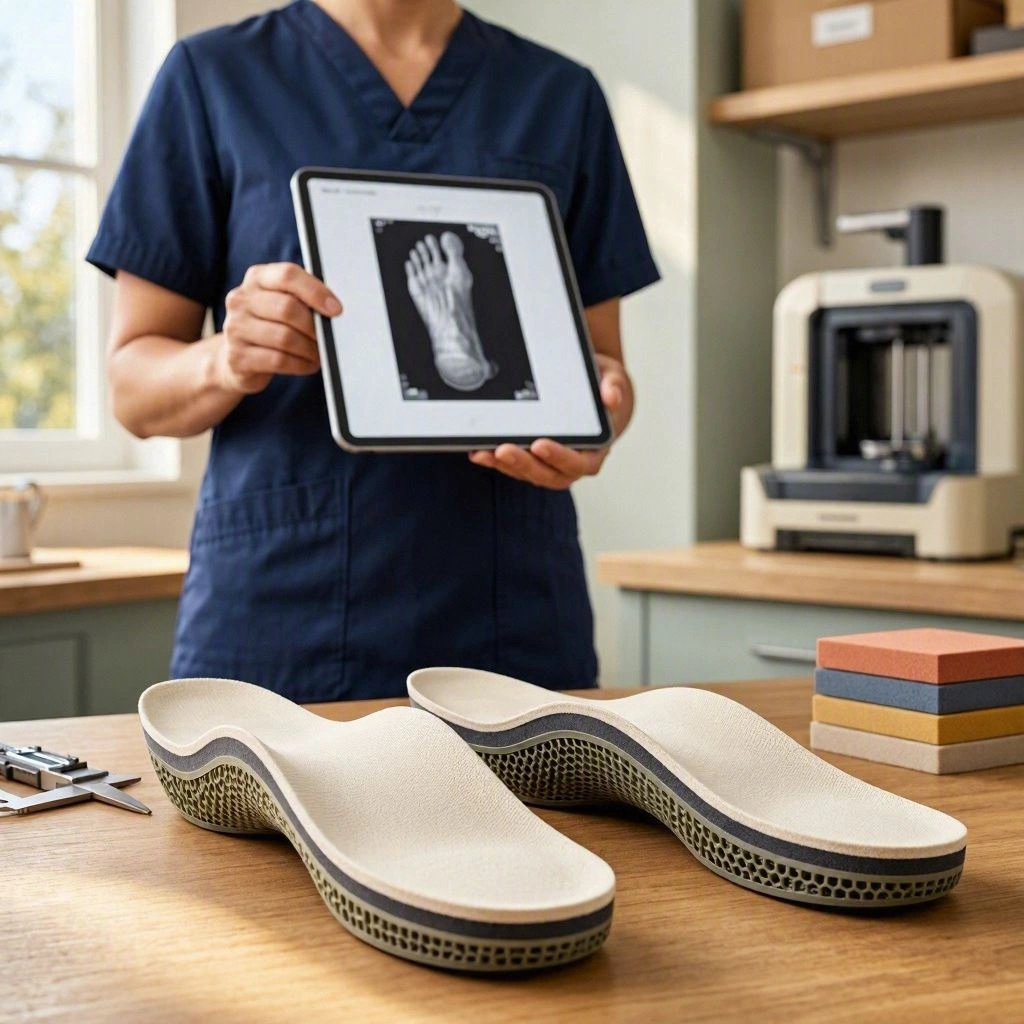
Scanning or Casting
Depending on the clinic and orthotic system, the shape of the foot may be captured using a 3D scanner, cast, or another measurement technique.
For example, some Thornhill clinics describe using 3D scanning technology to create an impression of the foot for custom fabrication.
The specific technology is less important than whether the assessment produces information that is relevant to the individual’s condition.
Why Proper Assessment Matters (Custom Orthotics Thornhill)
A custom orthotic is only useful when it is appropriate for the person’s needs.
An assessment can help answer important questions:
-
Is an orthotic actually necessary?
-
What problem is it intended to address?
-
What type of support is appropriate?
-
What footwear will it be used with?
-
Does the patient need rehabilitation as well?
-
Are there other factors contributing to the symptoms?
For example, a person with foot pain may have a strength deficit, sudden training increase, unsuitable footwear, or another condition that needs attention.
An orthotic alone may not address these factors.
How Custom Orthotics Are Made
Once the assessment is complete, measurements or a foot impression may be sent to a laboratory or fabrication facility.
The manufacturing process can vary depending on the provider and orthotic design.
Materials can differ in:
-
Firmness
-
Flexibility
-
Cushioning
-
Thickness
-
Durability
The appropriate design depends on the intended use.
For example, someone who spends most of the day standing may have different requirements from a competitive runner.
Some Thornhill providers use digital scanning and specialized fabrication systems to create individualized orthotics.
What Should Custom Orthotics Feel Like?
A new orthotic may feel different from a regular shoe insole.
It can take some time for the feet and lower limbs to adapt to a new support device.
However, significant pain, persistent rubbing, pressure points, or blistering should not simply be ignored.
If the orthotics cause problems, contact the provider for an assessment and possible adjustment.
Proper fit is important because an orthotic that does not fit appropriately may not perform as intended.
Some Thornhill orthotic providers specifically emphasize fitting and adjustment as part of the process.
Breaking In New Custom Orthotics
Many people do not immediately wear new orthotics for an entire day.
Instead, a gradual introduction may be recommended depending on the device and the individual’s circumstances.
A provider may suggest:
-
Wearing the orthotics for a limited period.
-
Checking how the feet respond.
-
Gradually increasing wearing time.
-
Monitoring for discomfort or pressure.
-
Returning for adjustment if necessary.
The exact break-in schedule should follow the instructions provided by your orthotic professional.
Custom Orthotics and Footwear (Custom Orthotics Thornhill)
Even a well-designed orthotic needs appropriate footwear.
Shoes should provide enough space for the foot and orthotic combination.
Important considerations may include:
-
Shoe width
-
Shoe depth
-
Heel stability
-
Sole structure
-
Removable insoles
-
Intended activity
An orthotic that fits comfortably in one pair of shoes may not fit properly in another.
For this reason, bring the shoes you use most often when attending an orthotic assessment.
Some local Thornhill providers specifically recommend bringing regularly worn shoes to help evaluate fit.
How Long Do Custom Orthotics Last?
The lifespan of an orthotic depends on several factors.
These can include:
-
Material
-
Manufacturing method
-
Body weight
-
Activity level
-
Frequency of use
-
Footwear
-
Wear and tear
An active runner may wear out an orthotic faster than someone who only uses it for occasional walking.
Regular inspection can help identify when an orthotic may need adjustment or replacement.
If symptoms return or the device becomes uncomfortable, an assessment can determine whether the orthotic is still appropriate.
Do Custom Orthotics Fix Foot Problems Permanently?
Custom orthotics should not be viewed as a guaranteed permanent solution.
They are tools that may help modify support, pressure distribution, or movement during specific activities.
Some conditions may improve through strengthening, mobility work, activity modification, and other rehabilitation strategies.
In other situations, ongoing support may be useful.
The most appropriate approach depends on the individual and the condition being treated.
Custom Orthotics and Physiotherapy
Orthotics and physiotherapy can sometimes work together.
For example, a person with foot pain may benefit from an orthotic while also performing exercises designed to improve foot and lower-limb strength.
A rehabilitation program may include:
-
Calf strengthening
-
Foot strengthening
-
Balance exercises
-
Hip strengthening
-
Mobility work
-
Gait retraining
-
Activity progression
This combination can address both support and physical capacity.
Several Thornhill clinics offer orthotic services alongside physiotherapy or rehabilitation.
Custom Orthotics for People Who Stand at Work
Some occupations require many hours of standing or walking.
Examples include:
-
Healthcare workers
-
Retail employees
-
Restaurant workers
-
Teachers
-
Warehouse workers
-
Construction workers
Prolonged standing can increase foot fatigue and discomfort.
An orthotic may be considered when a foot-related mechanical issue is contributing to symptoms.
However, footwear, work surfaces, movement breaks, and overall physical conditioning should also be considered.
Custom Orthotics for Older Adults
Older adults may experience changes in foot structure, strength, balance, and mobility.
Foot discomfort can sometimes make people less active, which can contribute to further loss of physical capacity.
Depending on the situation, orthotic support may be considered alongside:
-
Strengthening
-
Balance exercises
-
Mobility training
-
Appropriate footwear
-
Walking programs
The primary goal should be maintaining safe and meaningful mobility.
Choosing Custom Orthotics Thornhill
When searching for Custom Orthotics Thornhill, consider the following factors.
Professional Assessment
Look for a provider who performs a comprehensive assessment rather than simply selecting a standard device.
Qualified Professionals
Ask who performs the assessment and fitting. Depending on the clinic, services may involve a chiropodist, pedorthist, physiotherapist, or another qualified professional.
Customization
Ask how the orthotic is designed and what information is used to determine its shape and support.
Fit and Adjustments
Find out whether follow-up fitting and adjustments are available.
Your Footwear
Make sure the provider understands which shoes you plan to use with the orthotics.
Your Activity Level
Tell the provider whether you walk, run, play sports, work on your feet, or have other specific activity requirements.
Thornhill has several providers offering custom orthotics and related foot-care services, including BioPed Footcare & Orthotics, Advanced Pedorthic Services & Medical Equipment, and The Foot Institute. Availability, services, and appointment details can change, so confirm current information directly with the provider.
Questions to Ask Before Getting Custom Orthotics (Custom Orthotics Thornhill)
Before purchasing custom orthotics, consider asking:
-
Do I actually need custom orthotics?
-
What problem are the orthotics intended to address?
-
Could a standard insert work instead?
-
Who will perform my assessment?
-
How will my feet and gait be evaluated?
-
What type of orthotic is recommended?
-
Which shoes can I use?
-
How long will the orthotics take to make?
-
Is follow-up fitting included?
-
What should I do if they cause discomfort?
-
Will I need physiotherapy or exercises as well?
These questions can help you understand what you are paying for and whether the proposed treatment makes sense for your situation.
When Should You Replace Custom Orthotics?
There is no universal replacement schedule.
Instead, look for changes such as:
-
Visible material damage
-
Loss of support
-
Cracks
-
Changes in fit
-
Persistent discomfort
-
Return of previous symptoms
-
Significant changes in activity
-
Changes in footwear requirements
Children and teenagers may also need reassessment as their feet and bodies develop.
An orthotic that was appropriate several years ago may not necessarily remain appropriate forever.
Are Custom Orthotics Right for Everyone?
No.
Custom orthotics can be useful for selected patients, but they are not necessary for every person with foot pain.
A professional assessment should determine whether an orthotic is likely to provide meaningful benefit.
Sometimes the better approach may be:
-
Exercise
-
Footwear changes
-
Activity modification
-
Strength training
-
Mobility work
-
Weight management where appropriate
-
Rest and recovery
-
Medical evaluation
The right treatment is the one that addresses the actual factors contributing to the problem.
Frequently Asked Questions About Custom Orthotics Thornhill
What are Custom Orthotics Thornhill?
Custom Orthotics Thornhill refers to individually designed foot orthotic services available in Thornhill. These devices are designed based on an assessment of the individual’s feet, movement, symptoms, and functional requirements.
Are custom orthotics better than regular insoles?
Not necessarily. Some people benefit from standard inserts, while others may require individualized support. The appropriate option depends on the person’s condition and assessment.
Can custom orthotics help plantar fasciitis?
Custom orthotics may be considered as part of treatment for some people with plantar fasciitis. Exercise, activity modification, footwear, and other rehabilitation strategies may also be important.
Can orthotics help knee pain?
Orthotics may be useful in selected cases where foot mechanics are relevant to lower-limb loading. However, knee pain can have many causes and should be appropriately assessed.
Can I wear custom orthotics in running shoes?
Many custom orthotics can be designed for athletic footwear, but the design needs to be compatible with the shoe and the individual’s activity.
How long does it take to get custom orthotics?
The timeline depends on the provider, assessment process, manufacturing method, and laboratory. Ask your provider for the current estimated turnaround time.
Do custom orthotics hurt at first?
A new orthotic can feel unfamiliar. However, significant pain, rubbing, or blistering should be discussed with the provider because adjustments may be necessary.
How long do custom orthotics last?
Their lifespan depends on the material, activity level, frequency of use, body weight, footwear, and other factors. Regular inspection can help determine when replacement is appropriate.
Do I need physiotherapy with custom orthotics?
Not everyone does. However, physiotherapy and exercise may complement orthotic treatment when strength, mobility, balance, or movement patterns also contribute to symptoms.
How do I find the right custom orthotics provider in Thornhill?
Look for a qualified professional who performs a detailed assessment, explains why an orthotic is recommended, provides appropriate fitting, and offers follow-up when necessary.
Final Thoughts
Custom orthotics can be a useful tool for selected people experiencing foot and lower-limb problems. However, the most important part of the process is not simply purchasing an insert. It is determining whether an orthotic is appropriate and designing it around the individual’s actual needs.
For people searching for Custom Orthotics Thornhill, a comprehensive assessment can examine foot structure, gait, symptoms, footwear, activity level, and lower-limb function.
Depending on the findings, treatment may involve custom orthotics, physiotherapy, strengthening, mobility exercises, footwear changes, or a combination of approaches.
A properly fitted orthotic should be comfortable, appropriate for the intended activity, and integrated into a broader plan when additional rehabilitation is necessary.
If you are experiencing persistent foot, heel, knee, or lower-limb pain, professional assessment can help identify the factors contributing to your symptoms and determine whether custom orthotics are a suitable option for you.