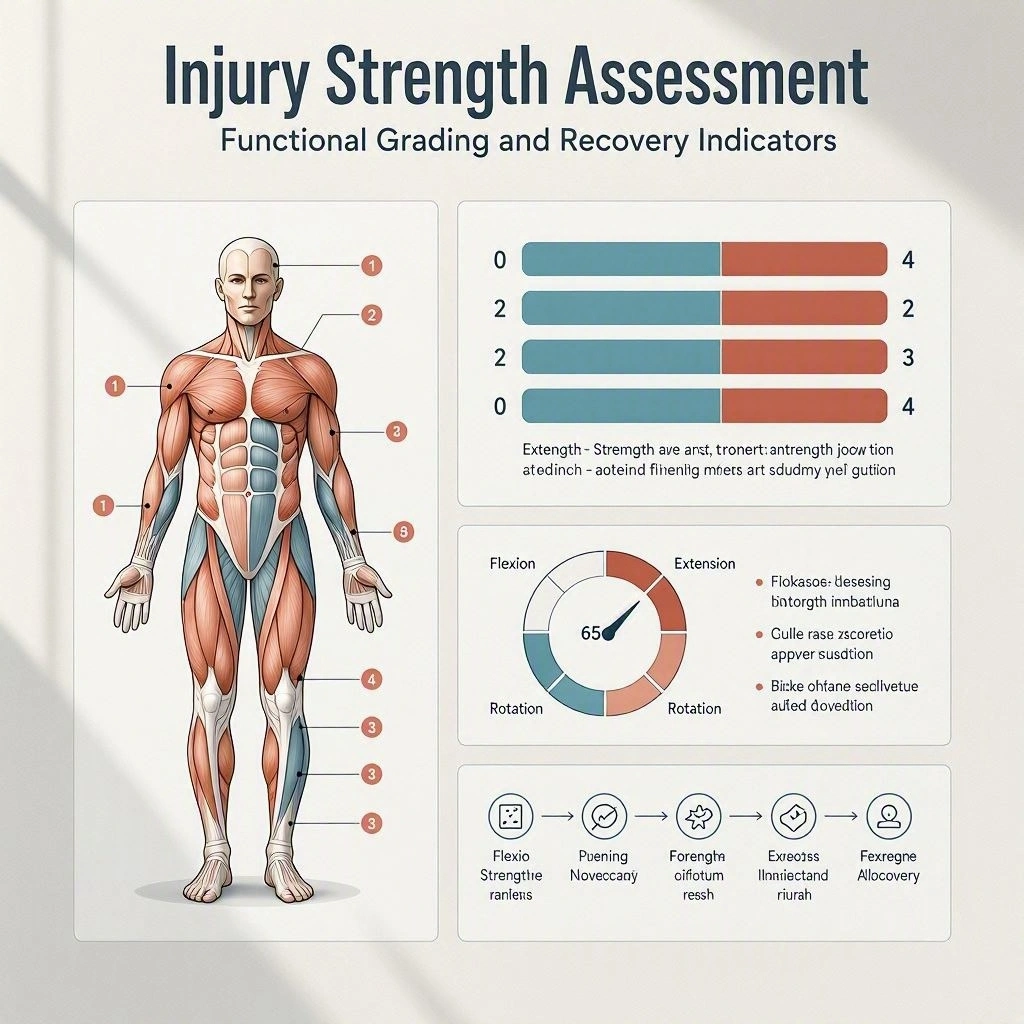
Injury Strength Assessment: Complete Guide to Strength Evaluation and Recovery
Introduction
Muscle strength is one of the most important components of physical function. It allows people to walk, lift, climb stairs, exercise, maintain balance, perform work tasks, and participate in sports. After an injury, however, strength can change significantly. Pain, swelling, inactivity, protective movement patterns, and changes in coordination can all affect how effectively a muscle or muscle group works. An Injury Strength Assessment provides a structured way to evaluate strength after an injury and identify physical limitations that may influence recovery. A qualified rehabilitation professional can use different assessment methods to determine whether weakness is present, how it affects movement, and how rehabilitation should progress.
Strength assessment is not simply about determining whether one muscle is “strong” or “weak.” A comprehensive evaluation considers the injured area, surrounding muscles, movement patterns, balance, endurance, functional performance, and the physical requirements of the patient’s daily life or sport.
For example, someone recovering from a knee injury may have reduced quadriceps strength that affects walking, stair climbing, squatting, and running. A person recovering from a shoulder injury may have reduced strength during reaching or lifting. An athlete may require additional testing to determine whether the injured limb has regained enough strength for demanding sport-specific movements.
This guide explains what an Injury Strength Assessment involves, why it matters, which methods professionals may use, how strength changes after injury, and how assessment results can support a safe and progressive rehabilitation program.
What Is an Injury Strength Assessment?
An Injury Strength Assessment is a structured evaluation used to determine how an injury has affected muscle strength and physical function.
A qualified healthcare or rehabilitation professional may assess individual muscles, muscle groups, or functional movements depending on the injury.
The assessment can examine:
-
Muscle strength
-
Strength differences between limbs
-
Muscle activation
-
Functional strength
-
Endurance
-
Stability
-
Movement control
-
Balance
-
Power
-
Ability to tolerate physical loads
The exact assessment method depends on the injury, the patient’s health, and their rehabilitation goals.
For someone with a minor ankle injury, simple resistance testing and functional exercises may provide useful information. An athlete returning after a major lower-limb injury may require more advanced strength testing and sport-specific performance evaluation.
The primary purpose is to understand current physical capacity and use that information to guide rehabilitation.
Why Is Injury Strength Assessment Important?
Strength loss can occur even when pain has started to improve.
A person may feel comfortable during everyday activities but still have significant weakness when exposed to higher physical demands.
This is one reason strength assessment can be useful during rehabilitation.
An Injury Strength Assessment may help identify:
-
Muscle weakness
-
Strength asymmetry
-
Reduced endurance
-
Poor muscle activation
-
Reduced functional capacity
-
Movement compensation
-
Difficulty controlling joints
-
Inability to tolerate specific loads
These findings can help a rehabilitation professional determine which exercises should be included in a recovery program.
For example, if an assessment identifies reduced quadriceps strength after a knee injury, the rehabilitation plan may emphasize progressive quadriceps strengthening while also addressing mobility, balance, and functional movement.
Who Performs an Injury Strength Assessment?
Strength assessments may be performed by qualified professionals such as:
-
Physical therapists
-
Physiotherapists
-
Sports rehabilitation professionals
-
Athletic trainers
-
Other appropriately trained healthcare professionals
The professional’s exact scope of practice varies depending on qualifications and local regulations.
The assessment should be appropriate for the patient’s condition. When symptoms indicate a need for medical investigation, a rehabilitation professional may recommend evaluation by a physician or another healthcare provider.
What Happens During an Injury Strength Assessment?
The assessment usually begins with a discussion about the injury and the patient’s goals.
The professional may ask:
-
How did the injury happen?
-
When did symptoms begin?
-
Which movements are difficult?
-
What activities increase symptoms?
-
Have you had previous injuries?
-
Have you received surgery or other treatment?
-
What activities do you want to return to?
-
What are your work or sports requirements?
After discussing the injury, the professional may perform physical strength tests.
Depending on the condition, these may include manual resistance testing, functional exercises, dynamometer measurements, endurance tests, or sport-specific tasks.
Injury and Medical History
A detailed history helps provide context for strength findings.
For example, someone who has recently stopped using a limb because of pain may have weakness related partly to reduced activity.
Similarly, someone recovering from surgery may have specific restrictions that affect which strength tests are appropriate.
Previous injuries are also important.
A patient with repeated ankle injuries may have weakness or balance limitations that existed before the latest injury.
Understanding the timeline and history allows the professional to interpret strength measurements more accurately.
Manual Muscle Testing
Manual muscle testing is a common clinical method for evaluating muscle strength.
During this type of assessment, the patient performs a specific movement while the professional applies controlled resistance.
The professional observes how well the patient can maintain or perform the movement.
Manual testing can provide useful information about:
-
Muscle activation
-
Relative weakness
-
Ability to resist force
-
Pain during contraction
-
Movement control
It can be especially useful when assessing basic muscle function.
However, manual testing has limitations. More precise measurement may be appropriate when small strength differences need to be detected.
Dynamometer Strength Testing
A dynamometer can provide an objective measurement of force.
Depending on the equipment, it can measure strength during specific movements.
Dynamometry may help professionals:
-
Quantify strength
-
Compare sides
-
Track progress
-
Evaluate rehabilitation outcomes
-
Monitor changes over time
For example, a professional may measure the strength of both legs and compare the results during rehabilitation.
The meaning of a strength measurement depends on the testing position, technique, equipment, and individual’s characteristics.
Comparing Strength Between Limbs
Side-to-side comparison can provide useful information.
For example, after an injury to the right leg, the professional may compare right and left leg performance.
A difference does not automatically indicate that something is wrong. Natural differences can exist between sides.
However, a substantial difference in strength may be relevant when it is consistent with the injury, symptoms, movement limitations, or functional demands.
The professional can interpret the results in context rather than relying on a single number.
Functional Strength Assessment
Functional strength describes the ability to use strength during real-world movements.
Someone may perform well during an isolated muscle test but struggle with a squat, step, lift, or running movement.
Functional assessment may include:
-
Squats
-
Lunges
-
Step-ups
-
Sit-to-stand movements
-
Walking
-
Carrying
-
Lifting
-
Pushing
-
Pulling
The specific tests should reflect the individual’s needs.
For an office worker, functional strength may involve standing, walking, and carrying light objects.
For an athlete, strength must eventually support high-speed and high-load movements.
Assessing Muscle Endurance
Strength and endurance are different physical qualities.
A person may produce a strong contraction once but struggle to maintain performance over repeated movements.
Muscle endurance can be important for:
-
Running
-
Cycling
-
Swimming
-
Repetitive work
-
Long-distance walking
-
Sports
-
Extended physical tasks
An Injury Strength Assessment may therefore include repeated movements or timed exercises.
The professional may monitor how performance changes with fatigue.
Poor endurance can affect movement quality and may become particularly important when someone returns to longer or more demanding activities.
Assessing Strength After a Muscle Injury
Muscle strains can cause pain and reduced strength.
A rehabilitation professional may assess the injured muscle gradually according to the stage of healing.
For example, after a hamstring injury, assessment may eventually examine:
-
Hamstring strength
-
Hip strength
-
Single-leg control
-
Running ability
-
Acceleration
-
Deceleration
The assessment should progress as healing allows.
Testing too aggressively during an early stage can unnecessarily aggravate an injury.
Assessing Strength After a Ligament Injury
Ligament injuries can affect both strength and joint stability.
For example, after a knee ligament injury, rehabilitation may address:
-
Quadriceps strength
-
Hamstring strength
-
Hip strength
-
Balance
-
Stability
-
Functional movement
Strength testing can help identify deficits that may remain after symptoms improve.
More demanding testing may be required before returning to high-level sports.
Assessing Strength After an Ankle Injury
Ankle injuries can affect the muscles surrounding the ankle and lower leg.
Strength assessment may examine:
-
Calf strength
-
Ankle inversion
-
Ankle eversion
-
Foot control
-
Single-leg balance
-
Functional movement
Weakness may affect walking, running, jumping, and changing direction.
Rehabilitation can progressively restore strength and control.
Assessing Strength After a Shoulder Injury
Shoulder injuries may affect several muscle groups involved in lifting and arm movement.
Depending on the condition, an assessment may consider:
-
Shoulder flexion
-
Shoulder extension
-
Abduction
-
Internal rotation
-
External rotation
-
Scapular control
-
Functional reaching
Strength testing should be appropriate for the specific injury.
The professional may also consider neck, upper-back, and trunk movement when evaluating overall shoulder function.
Assessing Strength After a Hip Injury
Hip strength plays an important role in walking, running, balance, and lower-body movement.
A strength assessment may evaluate:
-
Hip flexors
-
Hip extensors
-
Hip abductors
-
Hip adductors
-
Rotational strength
-
Single-leg control
Weakness in the hip muscles can influence movement throughout the lower limb.
However, strength findings should always be interpreted within the broader clinical picture.
Assessing Strength After a Fracture
Fractures can result in reduced muscle strength because of immobilization and reduced activity.
Once medical clearance allows strengthening, rehabilitation can gradually restore physical capacity.
An assessment may track:
-
Muscle strength
-
Range of motion
-
Balance
-
Functional movement
-
Endurance
The progression should follow medical and rehabilitation guidance.
Strength Assessment After Surgery
Surgical procedures can temporarily reduce strength.
The rehabilitation process should respect postoperative restrictions and healing requirements.
Depending on the procedure, strength assessment may occur at different stages.
Early testing may focus on basic muscle activation and safe movement.
Later assessments can examine more demanding functional strength.
The timing should be determined by the rehabilitation team and surgical guidelines.
How Pain Can Affect Strength Testing
Pain can change how a person produces force.
A patient may have adequate muscle capacity but produce less force because a movement is uncomfortable.
Therefore, a strength assessment should consider both the amount of force produced and the patient’s symptoms.
Pain during testing may also affect movement technique.
A professional can modify the test when necessary and determine whether additional evaluation is appropriate.
Muscle Inhibition After Injury
After some injuries, muscles may not activate normally.
Pain, swelling, and changes in joint function can influence muscle activation.
This can make a person appear weaker even when the muscle itself has not experienced a major structural injury.
For example, swelling around a knee can affect quadriceps activation.
Rehabilitation may therefore combine symptom management, movement exercises, strengthening, and progressive loading.
Strength Asymmetry
Strength asymmetry refers to differences in physical capacity between sides or muscle groups.
Some asymmetry is normal.
However, a significant difference may be relevant after injury, especially for activities that require balanced performance.
Professionals may monitor asymmetry throughout rehabilitation.
The goal is not necessarily to create perfectly identical sides. Instead, the objective is to achieve appropriate capacity for the individual’s activities and physical demands.
Injury Strength Assessment for Athletes
Athletes often require more advanced strength evaluation because sports place high demands on the body.
An athlete may need sufficient strength for:
-
Sprinting
-
Jumping
-
Landing
-
Cutting
-
Throwing
-
Tackling
-
Accelerating
-
Decelerating
A rehabilitation program may therefore include strength tests that reflect sport-specific requirements.
For example, a soccer player returning after a lower-limb injury may need progressive strength testing alongside running, change-of-direction, and ball-related activities.
Strength Testing for Runners
Runners depend on coordinated strength throughout the lower body.
Assessment may include:
-
Calf strength
-
Quadriceps strength
-
Hamstring strength
-
Gluteal strength
-
Single-leg control
-
Trunk stability
A runner returning after injury may need gradual exposure to running loads rather than immediately returning to previous mileage.
Strength assessment can contribute to decisions about training progression.
Strength Assessment for Workplace Injuries
Physical work can require substantial strength.
Depending on the occupation, workers may need to:
-
Lift
-
Carry
-
Push
-
Pull
-
Climb
-
Bend
-
Reach
-
Stand for long periods
An Injury Strength Assessment can help identify whether physical limitations remain.
Rehabilitation can then focus on the specific demands of the job.
Strength and Return to Work
Returning to work may require more than symptom improvement.
For physically demanding jobs, the person may need enough strength and endurance to tolerate repeated tasks.
A rehabilitation program can progressively introduce work-related movements.
The goal is to build capacity safely rather than abruptly returning to full workload.
Strength and Return to Sport
Returning to sport requires consideration of multiple physical qualities.
Strength is important, but it is not the only factor.
Athletes may also need:
-
Mobility
-
Balance
-
Coordination
-
Speed
-
Power
-
Endurance
-
Agility
-
Sport-specific skills
A strength assessment can provide one piece of the return-to-sport decision.
Progressive Strength Training During Rehabilitation
Once appropriate, progressive resistance training can help rebuild physical capacity.
Progression may involve increasing:
-
Resistance
-
Repetitions
-
Sets
-
Range of motion
-
Movement speed
-
Exercise complexity
For example, rehabilitation may progress from bodyweight exercises to resistance bands, free weights, machines, or more advanced functional exercises.
The appropriate progression depends on the injury and the individual’s response.
The Importance of Exercise Technique
Strength training is most useful when performed with appropriate technique.
Poor technique may reduce the effectiveness of an exercise or increase unnecessary physical stress.
A rehabilitation professional can provide instruction on:
-
Body position
-
Movement control
-
Breathing
-
Range of motion
-
Load management
Technique often becomes increasingly important as resistance and exercise complexity increase.
Tracking Strength Progress
One advantage of strength assessment is the ability to monitor changes over time.
Progress can be tracked using:
-
Repetition performance
-
Resistance levels
-
Dynamometer measurements
-
Functional tests
-
Endurance tests
-
Movement quality
Tracking progress can help demonstrate whether the rehabilitation program is producing meaningful improvements.
Strength Assessment and Injury Prevention
Strength assessment can also play a role in injury prevention.
Weakness does not guarantee injury, but inadequate physical capacity may make certain activities more challenging.
For example, someone returning to running after a long period of inactivity may benefit from gradually improving lower-body strength and conditioning.
Athletes may also use strength testing to monitor training and identify areas that need additional attention.
Common Strength Assessment Mistakes
Testing Too Early
Aggressive strength testing immediately after an injury may be inappropriate.
Assessment should respect tissue healing and medical restrictions.
Focusing on One Muscle
Movement depends on multiple muscles and systems.
A single strength measurement does not describe complete physical function.
Ignoring Pain
Pain can influence performance and should be considered during testing.
Comparing Everyone With the Same Standard
Strength requirements depend on age, activity, sport, occupation, and individual characteristics.
Returning to Activity Based Only on Strength
Strength is important, but mobility, balance, endurance, coordination, and sport-specific capacity may also matter.
How to Prepare for an Injury Strength Assessment
Wear comfortable clothing that allows movement.
Bring relevant medical information when available, particularly if you have had surgery, imaging, or previous treatment.
Be prepared to explain:
-
How the injury occurred
-
Current symptoms
-
Activities that remain difficult
-
Previous injuries
-
Your rehabilitation goals
Accurate information can help the professional interpret the assessment.
Questions to Ask Your Rehabilitation Professional
You may want to ask:
-
Which muscles are currently weak?
-
How significant is the strength difference?
-
What tests will you use?
-
How will progress be measured?
-
Which exercises should I perform?
-
How often should I train?
-
When can resistance increase?
-
What activities should I avoid temporarily?
-
What criteria will determine my return to sport or work?
Understanding the results can improve participation in rehabilitation.
How Often Should Strength Be Assessed?
There is no universal schedule.
The appropriate frequency depends on:
-
Injury type
-
Severity
-
Recovery stage
-
Rehabilitation goals
-
Training demands
-
Progress
Some patients may be reassessed at key stages, while others may need more frequent monitoring.
The rehabilitation professional can determine an appropriate approach.
Benefits of Injury Strength Assessment
A structured strength assessment can provide several benefits.
Identifying Weakness
Testing can reveal strength limitations that may not be obvious during normal daily activities.
Guiding Exercise Selection
Results can help determine which muscle groups require additional attention.
Tracking Progress
Repeated measurements can demonstrate changes during rehabilitation.
Supporting Functional Recovery
Strength testing can be connected to real-life tasks and activity requirements.
Supporting Return to Activity
Assessment can contribute to decisions about progressing toward work, exercise, or sport.
When Should You Seek a Strength Assessment?
Consider professional assessment if an injury has caused:
-
Persistent weakness
-
Difficulty walking
-
Difficulty lifting
-
Reduced exercise performance
-
Balance problems
-
Repeated injuries
-
Difficulty returning to sport
-
Difficulty performing work tasks
A professional assessment may be particularly useful when weakness continues after other symptoms have improved.
When Urgent Medical Evaluation May Be Necessary
An Injury Strength Assessment should not replace urgent medical care when serious symptoms are present.
Major trauma, severe pain, significant deformity, uncontrolled bleeding, sudden neurological symptoms, loss of consciousness, or an inability to use a limb following significant trauma may require urgent medical evaluation.
If weakness develops suddenly without an obvious injury, especially when accompanied by neurological symptoms, prompt medical attention is important.
Choosing the Right Rehabilitation Professional
When selecting a professional, consider:
-
Professional qualifications
-
Experience with your type of injury
-
Experience with your sport or occupation
-
Assessment methods
-
Rehabilitation approach
-
Communication style
-
Progress-tracking methods
A good rehabilitation plan should be individualized rather than based entirely on a generic exercise list.
The Role of Strength in Long-Term Recovery
Strength is not only important for returning to normal activity. It also supports long-term physical capacity.
After recovering from an injury, maintaining an appropriate level of strength can help people tolerate everyday activities and exercise.
A long-term strength program may include:
-
Resistance training
-
Functional exercises
-
Mobility work
-
Balance exercises
-
Conditioning
The appropriate program depends on individual goals and physical condition.
Frequently Asked Questions
What is an Injury Strength Assessment?
An Injury Strength Assessment is a structured evaluation of muscle strength and physical function following an injury. It can identify weakness, asymmetry, endurance limitations, and functional deficits.
Why is strength testing important after an injury?
Strength can remain reduced even after pain improves. Testing can identify weakness and help guide rehabilitation and return-to-activity decisions.
Who can perform an Injury Strength Assessment?
Qualified physical therapists, physiotherapists, sports rehabilitation professionals, athletic trainers, and other appropriately trained healthcare professionals may perform strength assessments depending on their qualifications and scope of practice.
How is muscle strength tested?
Strength may be evaluated through manual resistance testing, dynamometers, functional movements, repetition tests, endurance exercises, or other appropriate methods.
Can an injury cause muscle weakness?
Yes. Pain, swelling, inactivity, reduced muscle activation, and changes in movement can all contribute to weakness after an injury.
Can strength return after an injury?
Strength often improves with appropriate rehabilitation and progressive exercise. The timeline depends on the injury, severity, treatment, and individual recovery.
Should both sides be tested?
Comparing sides can provide useful information, particularly after a unilateral injury. However, natural differences between sides should also be considered.
Is strength enough to determine whether I can return to sports?
No. Strength is only one part of return-to-sport readiness. Mobility, balance, coordination, endurance, power, movement quality, and sport-specific capacity may also be important.
Can strength assessment help prevent another injury?
It may help identify modifiable physical limitations. Addressing weakness and improving overall physical capacity can support a more prepared return to activity.
How often should strength be reassessed?
The schedule depends on the injury, rehabilitation stage, goals, and progress. A rehabilitation professional can determine when reassessment is appropriate.
Can I perform strength tests at home?
Simple exercises can demonstrate general physical ability, but formal strength assessment is more appropriate when you are recovering from an injury or need objective measurements.
What happens after a strength assessment?
The professional can use the findings to develop or modify a rehabilitation program. This may include progressive strengthening, mobility exercises, balance training, functional movements, and gradual return to activity.
Final Thoughts
An Injury Strength Assessment can provide valuable information during the rehabilitation process. An injury may cause weakness even after pain and other symptoms begin to improve, and these strength deficits can affect movement, work, exercise, and sports performance.
A comprehensive assessment looks beyond a single muscle. It may consider muscle strength, endurance, balance, stability, movement control, functional performance, and the physical demands of the individual’s lifestyle.
Depending on the injury, professionals may use manual muscle testing, dynamometers, functional exercises, endurance tests, and sport-specific assessments. Repeated testing can also help monitor progress throughout rehabilitation.
Strength should be rebuilt gradually. A person may need adequate mobility, balance, coordination, endurance, and confidence in addition to strength before returning to demanding activities.
If an injury continues to cause weakness or limits your ability to work, exercise, walk, or participate in sports, a qualified rehabilitation professional can assess your current capacity and help develop an individualized recovery strategy.
The ultimate goal of an Injury Strength Assessment is not simply to produce a number. It is to understand physical capacity, identify meaningful limitations, guide rehabilitation, and help the individual progress toward safe and effective movement.